Blog

  • Unlock Your Singapore Dream: 7 Reasons to Use an Immigration Consultant for your PR Application

    Unlock Your Singapore Dream: 7 Reasons to Use an Immigration Consultant for your PR Application

    Navigating the Singapore PR application process can feel like trying to solve a complex puzzle, especially the government doesn’t share its framework for approvals. Most of the time, for the untrained applicant, after parsing the Immigration and Checkpoints Authority’s, ICA, website you are left to make educated guesses on what the ICA are seeking in an ideal PR profile. Along with numerous requirements, strict criteria, and subtle nuances, it’s easy to feel overwhelmed. This is where expert guidance becomes invaluable. Immigration consultants have in-depth knowledge of the system, understanding both the written rules and the unwritten expectations. Their expertise can be the difference between a successful application and a disappointing rejection. Here’s why this strategy could be your key to unlocking a future in Singapore. Inside Singapore’s World-Class Education System: The Secrets Behind Its Success

    Short Guide for Indians Moving to Singapore: Company Incorporation, Employment Pass, PR, and CECA Benefits class=””>1.     Lots of Competition and Low Number of Approvals

    The path to becoming a Singapore Permanent Resident (PR) can be complex and challenging with likely well over 100,000-150,000 applicants each year and growing. From the large applicant pool only around 30,000-34,000 are granted PR each year. Given long preparation and wait times for the result, high stakes of a rejection and fierce competition, many applicants are turning to professional consultants to boost their chances of success. Unless the applicant is already highly versed and knowledgeable in Singapore immigration matters, applications submitted by non-professional consultants’ risk being thrown in the heap of mediocrity when compared to the submissions prepared by experienced and skilled consultants.

    2. Simplify Your Singapore PR Journey, Save Time and Reduce Stress with Professional Assistance

    The Singapore PR application process can be very daunting at the best of times. From gathering the right documents to filling out forms correctly, every step matters. A seasoned consultant can guide you through this maze, ensuring you don’t miss crucial details or make common mistakes. They’ll help you understand each requirement, assist in collecting and organizing necessary documents, and ensure your application is complete and error-free. This not only saves you time but also significantly reduces stress and uncertainty. The consultant will also help guide you when you have missing documents or if your profile is more complex, and requires more strategic planning and execution. What Minister Gan’s 2026 Population Speech Means for Singapore PR and Citizenship Applicants Singapore’s Population Cools in 2025: Deeper Insights for Residency Applicants

    3. Navigating Nuanced Criteria for PR Success

    While the basic eligibility criteria for Singapore PR are publicly available, the actual evaluation process is more nuanced. Consultants have insights into the less obvious factors that can influence your application’s success. They understand what the ICA looks for beyond the basic requirements. This insider knowledge allows them to help you highlight your strengths and address potential weaknesses in your application, significantly improving your chances of approval. This often involves deep profiling of the applicant and actively working with the consultant to follow proven protocols that help increase chances of success.

    4. Enhance Your PR Profile with Expert Strategies

    Singapore’s PR application process is highly competitive, with a substantial rejection rate. Many applicants, despite meeting the basic criteria or seemingly having strong profiles, face disappointment. Consultants bring strategies to the table that can help you stand out from other applicants are working alone or with other consultants. They know how to present your profile in the best light, emphasizing aspects that align with Singapore’s long-term goals and values. Their experience with numerous applications gives them insight into what works and what doesn’t, allowing you to avoid common pitfalls that lead to rejection. Strategising is especially crucial when your profile is complex with missing documents, uncommon but unique lived experiences for yourself and/of family members. “Adding Value” to Singapore: What ICA Looks For (and How You Can Show It)

    5. Stay Updated with Ever-Changing PR Application Rules

    Immigration policies and application procedures are subject to frequent updates. Keeping track of these changes can be challenging for individual applicants. PR consultants make it their business to stay informed about the latest developments. They can alert you to new requirements, changing priorities, or shifts in evaluation criteria. This up-to-date knowledge ensures your application is always in line with current expectations, preventing delays or rejections due to outdated information. They also apply best practices to your submission. Sometimes as an outsider or uninitiated to immigration matters, you don’t know what you don’t know.

    6. Developing a Standout PR Application Package

    Your PR application and the accompanying documents submitted is your opportunity to make a compelling case for why you should be granted permanent residency. A consultant can help you craft a standout application package by including information/documents that are not in the standard ICA checklist. One such document is the cover letter, which will highlight your unique contributions, potential value to Singapore and bring together all the important elements of your profile to the forefront of the submission. They can also advise on which supporting documents will strengthen your case and how to present them effectively. With their guidance, you can create an application that not only meets all requirements but also leaves a lasting positive impression.

    7. Expert Analysis and Guidance Post-Rejection

    In the event of a rejection, consultants can offer valuable insights and assistance on the path forward following such unfortunate news. They will analyse 1) the reasons for rejection, if any are given, 2) previous submission, 3) changes to the applicant’s circumstances. Following the analysis, they will address any deficiencies and provide guidance on how to improve future submission. Depending on the requirements and constraints of the applicant, the consultant will also advise on whether it is more appropriate to appeal or lodge a new submission. This support can be crucial in achieving PR status on subsequent attempts while working within any constraints or goals the applicant may have such as time constraints.

    Secure Your Future in Singapore: Take the Next Step with Confidence

    Applying for Singapore PR is a significant step towards building your future in this vibrant city-state. While it’s possible to navigate the process on your own, working with a consultant can give you a significant advantage. Their expertise, insights, and personalized guidance can maximize your chances of success, saving you time, reducing stress, and bringing you closer to your dream of calling Singapore home, and apprising yourself to the many benefits that come with a PR status.

    Remember, your PR application is more than just paperwork – it’s your gateway to new opportunities and a new life. With the right support, you can approach this challenge with confidence, knowing you’ve given yourself the best possible chance of success. Take the first step towards your Singapore future today and contact E&H Immigration Consultancy for expert guidance on your PR application

    Ready to apply for Singapore PR with expert support? E&H Immigration’s our Singapore PR application service provides strategic, profile-tailored case building to maximise your approval chances.

    Also worth reading: Singapore PR Approval Rate Myth: Why 90% Claims Don’t Survive Basic Math — a data-driven look at what realistic PR approval odds actually look like.

    Related reading: Before choosing a consultant, read our guide on why clients should be cautious of immigration consultancies offering unlimited warranty in Singapore — and what to look for in a firm that will actually get your case right the first time.


  • Case Study: A Journey to Singapore Permanent Residency

    Case Study: A Journey to Singapore Permanent Residency

    Background

    Meet a South Korean national who had lived overseas since he was 2 years old. After moving to Singapore, he found a place where he truly felt accepted and decided to pursue his studies here. Little did he know, this decision would mark the beginning of a challenging yet rewarding journey toward becoming a Singapore Permanent Resident (PR). Short Guide for Indians Moving to Singapore: Company Incorporation, Employment Pass, PR, and CECA Benefits

    The Challenge

    He had already been living in Singapore for 10 years when he decided to apply for PR status. Despite his deep connection to the country, his first three PR applications were rejected. Undeterred, he continued to study, maintaining a valid Foreign Student Pass throughout his education. Feeling the weight of multiple rejections, he was on the brink of giving up. Inside Singapore’s World-Class Education System: The Secrets Behind Its Success

    The Turning Point

    Determined to make Singapore his permanent home, He decided to engage the services of an immigration specialist. This decision was crucial in changing the trajectory of his application process. The specialist guided him in crafting a compelling application that highlighted his dedication to Singapore, his stable employment, and his long-term intentions.

    The Application Process

    He submitted his fourth PR application in March. This time, his application was meticulously prepared, detailing his contributions and future plans among many other factors:

    • Commitment to Citizenship: He expressed his intention to apply for Singapore Citizenship in the future.

    • Economic Contribution: He emphasized his stable job and ongoing contributions to the Central Provident Fund (CPF).

    • Appreciation for Safety: He highlighted how Singapore’s safety and stability were key factors in his desire to settle down long-term.

    The Outcome

    After a 7-month wait, his persistence and the expertise of his immigration specialist paid off. He received the long-awaited news that his PR application had been approved.

    Conclusion

    His journey to Singapore PR status is a testament to the power of perseverance and the importance of seeking professional guidance when needed. His story serves as an inspiration to many who face similar challenges, demonstrating that with determination and the right support, success is within reach.

    What Minister Gan’s 2026 Population Speech Means for Singapore PR and Citizenship Applicants class=””>He is now enjoying life as a Singapore Permanent Resident, contributing to the community, and planning his future as a Singapore citizen. His story underscores the value of never giving up on your dreams and the impact that expert assistance can have on navigating complex immigration processes. “Adding Value” to Singapore: What ICA Looks For (and How You Can Show It) Singapore’s Population Cools in 2025: Deeper Insights for Residency Applicants

    Ready to start your own PR journey? E&H Immigration’s our Singapore PR application service provides strategic, profile-tailored case building to maximise your approval chances.

  • Singapore PR or Citizenship Rejected? Here’s Your Comeback Strategy (Appeal or Reapplication)

    Singapore PR or Citizenship Rejected? Here’s Your Comeback Strategy (Appeal or Reapplication)

    Facing a Singapore PR or Citizenship application rejection? Don’t lose hope! This guide explores your options for a successful comeback: appealing the decision or submitting a stronger reapplication.

    Short Guide for Indians Moving to Singapore: Company Incorporation, Employment Pass, PR, and CECA Benefits What Minister Gan’s 2026 Population Speech Means for Singapore PR and Citizenship Applicants class=””>Appealing Your Rejection (Limited Timeframe!) Singapore’s Population Cools in 2025: Deeper Insights for Residency Applicants

    Did the ICA reject your application? Here’s how to fight back with a well-crafted appeal letter:

    • Act Quickly! You only have 6 months from the rejection date to submit an appeal.

    • Highlight Significant Changes: Showcase improvements since your initial application (promotion, marriage, increased community involvement).

    • Personalize Your Appeal: Ditch generic templates. Explain why your unique skills and commitment make you a valuable addition to Singapore.


    Winning Appeal Strategies:

    • Quantify Your Value: Don’t just say “promotion.” Mention your new position and salary increase to demonstrate your economic contribution. “Adding Value” to Singapore: What ICA Looks For (and How You Can Show It)

    • Focus on Long-Term Commitment: Getting married or buying property in Singapore shows you plan to stay for the long haul.

    • Address Feedback (if any): Use your appeal letter to demonstrate how you’ve addressed any weaknesses identified in your initial application.


    Reapplication: A Fresh Start

    If you haven’t had major changes, reapplying might be a better option:

    • Self-Assessment: Evaluate your profile to identify areas where you can improve your eligibility score by using our Singapore residency eligibility calculator here.

    • Strengthen Your Profile: Gather missing documents or certifications that could strengthen your application.

    • Consider Professional Help: Immigration specialists can analyze your situation and suggest strategies for a stronger application.

    Unsure which path is right for you, or need help crafting a winning appeal letter? E&H Immigration Consultancy can guide you through the entire process. Our experienced team understands the complexities of Singapore’s immigration system and can help you navigate your comeback strategy. Inside Singapore’s World-Class Education System: The Secrets Behind Its Success

    Don’t let a rejection stop you from achieving your Singapore dream! Contact E&H Immigration Consultancy today for a free consultation. We’ll help you maximize your chances of success.

    Visit us online: https://www.eh-immigration.com/

    Email us: info@eh-immigration.com

    Remember: High Standards for Both Options

    The Immigration & Checkpoints Authority (ICA) holds both appeals and reapplications to rigorous standards. Careful preparation and understanding the eligibility criteria are crucial.

    Achieve Your Singapore Dream!

    By crafting a compelling appeal or a robust reapplication, you can significantly increase your chances of securing Singapore PR or Citizenship.

    Considering an appeal or reapplication? E&H Immigration’s appeal service helps you re-strategise and build a stronger case for re-submission.

  • Choosing between LTVP or PR for Residency in Singapore.

    Choosing between LTVP or PR for Residency in Singapore.

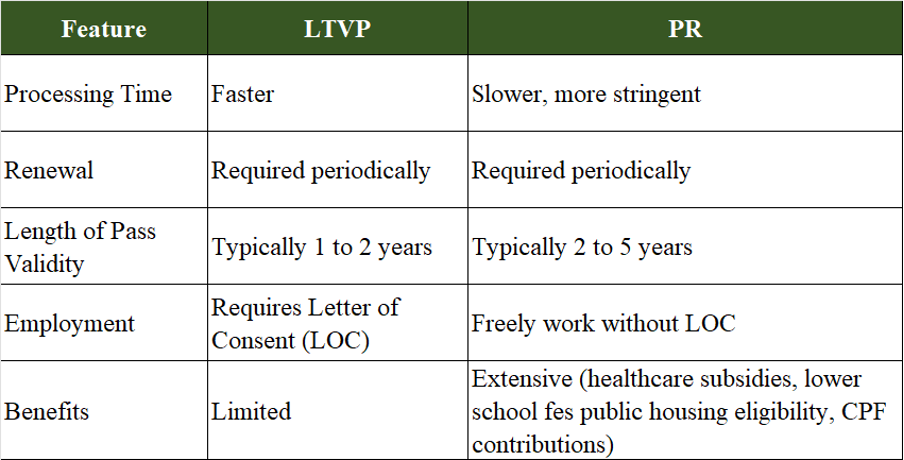
    Choosing the right residency option for yourself depends on your individual needs and goals. This article compares the Long-Term Visit Pass (LTVP) and Singapore Permanent Residency (PR) for spouses of existing Singaporeans or PR holders.

    Short Guide for Indians Moving to Singapore: Company Incorporation, Employment Pass, PR, and CECA Benefits What Minister Gan’s 2026 Population Speech Means for Singapore PR and Citizenship Applicants class=””>Decision Framework for LTVP vs PR: Singapore’s Population Cools in 2025: Deeper Insights for Residency Applicants

    Source: ICA

    Long Term Visit Pass (LTVP)

    Pros:

    • Faster Application: Easier and quicker application process compared to PR. On average around 4 weeks.

    • Flexibility: Allows extended stay in Singapore with renewals from 6 months onwards.

    • Work Option: You can apply for an LOC to work in Singapore.

    Cons:

    • Limited Benefits: LTVP holders don’t enjoy the same benefits as PRs, such as subsidies and social programs.

    • Renewal Requirements: You need to renew the LTVP periodically.

    Permanent Residency (PR)

    Pros:

    • Stability: Provides greater long-term residency and stability in Singapore.

    • Extensive Benefits: PRs have access to various social benefits like healthcare subsidies, lower school fees for children at public schools (see appendix 1), eligibility to purchase re-sale public housing (HDB flats), stay for extended period (up to end of the Re-entry Permit) to search for employment, and can contribute to the Central Provident Fund (CPF) retirement savings scheme. “Adding Value” to Singapore: What ICA Looks For (and How You Can Show It)

    • Pathway to Citizenship: PR can be a stepping stone to applying for Singapore citizenship in the future.

    Cons:

    • Stringent Application: The PR application process is more complex and requires meeting specific criteria. Approval can be more challenging and take on average between 6-12 months to receive an outcome.

    • National Service (NS) Liability: Male children of PRs may be subject to NS obligations when they reach adulthood.

    Choosing the Right Option for You

    • Immediate Needs: If you need to be in Singapore quickly, the LTVP might be the better short-term option.

    • Long-Term Plans: If you plan to settle in Singapore for the long term and enjoy more benefits, applying for PR is more advantageous.

    • Eligibility and Preparedness: Consider your eligibility for PR and preparedness for the application process, which requires detailed documentation and can take time.

    Example:

    John and Mary, a married couple, recently moved to Singapore when John received a job offer. Mary, as John’s spouse, initially applied for an LTVP due to the faster processing time. However, after settling in and enjoying life in Singapore, they decided on a long-term stay. John and Mary are now preparing their application for Singapore PR to access the wider range of benefits and opportunities Singapore offers.

    Navigating the complexities of immigration processes in Singapore can be challenging. E&H Immigration Consultancy, a trusted immigration specialist, can guide you through the LTVP or PR application process for spouses of PR holders.

    Our experienced consultants can:

    • Help you determine the best residency option for your individual needs and goals.

    • Assist you with gathering required documentation and completing the application process.

    • Offer ongoing support and answer your questions throughout the application journey.

    Don’t navigate Singapore’s immigration system alone! Contact E&H Immigration Consultancy today for a free consultation and discuss your residency options.

    Appendix 1: Public school fees for International Students (IS) and students on PR

    Considering Singapore PR over LTVP? E&H Immigration’s our Singapore PR application service provides expert guidance tailored to your situation. Also see: E&H Immigration’s our LTVP service.

  • The Pros and Cons of Singapore Citizenship in Short

    The Pros and Cons of Singapore Citizenship in Short

    Singapore, renowned for its strategic location, economic strength, and vibrant multicultural environment, attracts many to its shores, both as tourists and as potential residents. Acquiring Singaporean citizenship offers numerous benefits, but it also comes with certain challenges. Here, we explore the pros and cons of becoming a citizen of the Lion City.

    Advantages of Singapore Citizenship

    High Standard of Living

    What Minister Gan’s 2026 Population Speech Means for Singapore PR and Citizenship Applicants>Singapore boasts one of the highest standards of living in the world. It offers world-class infrastructure, social stability, open trade policies, excellent healthcare, a robust education system, and a safe environment, making it an attractive place to live and raise a family. Singapore’s Population Cools in 2025: Deeper Insights for Residency Applicants

    Strong Economy

    As a global financial hub, Singapore provides ample economic opportunities. Its stable economy, low unemployment rate, and business-friendly environment make it a favorable place for both entrepreneurs and professionals.

    World-Class Education

    Singapore’s education system is globally acclaimed, with its universities and schools consistently ranked among the best. Citizens have access to quality education from primary to tertiary levels, often with government subsidies and financial aid through schemes like CDAC, SINDA, MENDAKI, Edusave Pupils Fund, Edusave Grants, and Edusave Scholarships & Awards. Inside Singapore’s World-Class Education System: The Secrets Behind Its Success

    Healthcare Excellence

    The country’s healthcare system is among the best in the world, offering high-quality medical services. Citizens benefit from substantial government subsidies, making healthcare more affordable.

    Worlds Strongest Passport

    A Singaporean passport is one of the most powerful in the world, providing visa-free or visa-on-arrival access to numerous countries. This significantly eases international travel for Singaporean citizens. According to the VisaGuide Passport Index, the Singaporean passport holds the top position, offering visa-free entry to 196 countries, making it one of the most sought-after passports globally.

    Multicultural Society

    Singapore is celebrated for its diverse cultural mix, with people from various backgrounds living harmoniously. This blend of Chinese, Malay, Indian, and other cultures enriches everyday life, from languages spoken to the food enjoyed. Festivals such as Chinese New Year, Hari Raya, Deepavali, and Christmas bring people together, showcasing Singapore’s cultural richness through shared celebrations and culinary delights. Short Guide for Indians Moving to Singapore: Company Incorporation, Employment Pass, PR, and CECA Benefits

    Safety and Cleanliness

    Singapore’s low crime rate is a testament to its efficient law enforcement and high public awareness. Advanced security measures, including extensive surveillance and proactive policing, contribute to the safety of its citizens and residents. The city-state is also renowned for its cleanliness, maintained through rigorous public policies. “Adding Value” to Singapore: What ICA Looks For (and How You Can Show It)

    Parenthood Subsidies

    Singapore provides various parenthood benefits and subsidies to support families. These include the Baby Bonus Scheme, childcare and infant care subsidies, and parental leave entitlements, making it more affordable to raise children in the country.

    Affordable Housing

    Citizens have the exclusive opportunity to purchase Built-To-Order (BTO) flats from the Housing and Development Board (HDB). These government-subsidized flats are significantly more affordable than private housing, providing citizens with a cost-effective option for homeownership.

    Disadvantages of Singapore Citizenship

    Mandatory National Service

    Male citizens and second-generation permanent residents are required to serve in the National Service for two years, followed by reservist duties. They must also undertake up to 40 days of Operationally Ready National Service each year until they reach 50 years old for officers or 40 years old for non-officers. This commitment can be a significant consideration for families.

    No Dual Citizenship

    Singapore does not allow dual citizenship. Individuals wishing to become Singaporean citizens must renounce their citizenship in any other country. This can be a significant drawback for those who have strong ties to their country of origin or who wish to retain the benefits of their previous nationality.

    High Cost of Living

    According to the Economist Intelligence Unit (EIU) Cost of Living survey on the cost of living, housing, transportation, and daily expenses in Singapore can be considerably higher than in many other countries, which can be a challenge for some residents. 

    Limited Natural Resources

    Singapore is a small island nation with very few natural resources, relying heavily on imports for water, food, and energy. This dependence on external sources makes the country vulnerable to global supply chain disruptions and geopolitical tensions. Despite efforts like desalination plants, NEWater, urban farming, and high-tech agriculture, Singapore’s reliance on imports remains a critical issue.

    Singapore Citizenship offers a wealth of advantages, from economic opportunities and educational excellence to global mobility and a high standard of living. However, potential citizens must also weigh these benefits against the challenges, such as mandatory national service, high living costs, and strict regulations. Ultimately, the decision to pursue Singaporean citizenship depends on individual priorities and circumstances, balancing the country’s unique offerings with its inherent challenges. If you would like to know more about how to become a Singapore citizen, please visit E&H Immigration Consultancy. 

    Weighing up Singapore citizenship? E&H Immigration’s our Singapore Citizenship service provides expert, profile-tailored guidance at every step of the process.

  • How to Improve and strengthen Your LTVP Application

    How to Improve and strengthen Your LTVP Application

    Submitting the basic documents is a necessary step, but to stand out from other applicants, you’ll need to go the extra mile. With many compulsory documents to prepare, it can feel overwhelming to consider additional supporting steps. Here are key strategies to enhance and strengthen your Long-Term Visit Pass (LTVP) application:

    1. Thorough Preparation

    Start preparing your application well in advance. Organize all necessary documents meticulously and ensure their accuracy. Use a checklist to verify that you have included every required piece of documentation and supporting evidence. Rushed applications are more likely to have errors or missing information. What Minister Gan’s 2026 Population Speech Means for Singapore PR and Citizenship Applicants

    2. Additional Supporting Documents

    Beyond the basic required documents, include additional supporting evidence to bolster your application. This can include:

    • Financial Statements: Provide detailed bank statements, proof of income, investment portfolios, and any other financial documentation to demonstrate your financial stability.

    • Relationship Evidence: Provide character reference letters from family and friends to prove the authenticity of your relationship.

    • Health Records: Ensure your health records are up to date and include your personal health insurance to showcase long-term planning and personal stability

    3. Detailed Cover Letter

    Write a comprehensive cover letter that clearly explains your reasons for applying for the LTVP, your relationship with your sponsor (if applicable), and your plans in Singapore. This letter should provide context and clarity to your application, helping the ICA understand your situation better.

    4. Address Previous Immigration Issues

    You might worry that declaring previous immigration offences on your application form will lead to an immediate rejection, and you might even consider not disclosing them at all. However, if the ICA discovers that you have intentionally withheld this information, it will give them a stronger reason to reject your application for dishonesty, and your future chances of approval could be significantly hindered.

    Uncovering the Ethnic Quota for PR and Citizenship in Singapore Inside Singapore’s World-Class Education System: The Secrets Behind Its Success Short Guide for Indians Moving to Singapore: Company Incorporation, Employment Pass, PR, and CECA Benefits style=”text-align: justify; font-family: Pontano Sans;”>Solution:

    If you have any history of visa overstays, deportations, or violations of immigration laws, address them honestly in your application. Explain any mitigating circumstances and provide evidence of your compliance with immigration regulations since those incidents.

    5. Professional Consultation

    Consider seeking the expertise of an agency. These professionals can provide invaluable advice, ensure every detail of your application is meticulously completed, and help you navigate common pitfalls. By leveraging their knowledge, you can significantly enhance the strength and success of your LTVP application.

    6. Stay Informed.

    The authorities have changed policies without prior notice to the public. Hence, staying updated on any changes in immigration policies or requirements can help you stay abreast with ICA’s regulations. Eligibility Criteria for Singapore PR: A Complete Overview

    Conclusion

    Receiving a rejection for your Long-Term Visit Pass (LTVP) application can be frustrating, but it doesn’t mean the end of your journey. By understanding the common reasons for rejection and following the provided solutions, you can significantly improve your chances of approval in future applications. Take the time to prepare thoroughly, provide accurate and comprehensive documentation, and seek professional advice if needed. With the right approach, you can navigate the LTVP application process successfully and enjoy your extended stay in Singapore.

    Ready to strengthen your LTVP application? E&H Immigration’s our LTVP service provides expert guidance tailored to your situation.

  • Why My Long-Term Visit Pass (LTVP) Application Was Rejected: Key Reasons and Solutions

    Why My Long-Term Visit Pass (LTVP) Application Was Rejected: Key Reasons and Solutions

    Applying for a Long-Term Visit Pass (LTVP) in Singapore can be a challenging process, and receiving a rejection can be disheartening despite following all the guidelines and submitted all the required documents. Understanding the common reasons for rejection and knowing how to address them can improve your chances of success in future applications. How to Improve and strengthen Your LTVP Application

    Choosing between LTVP or PR for Residency in Singapore. Inside Singapore’s World-Class Education System: The Secrets Behind Its Success style=”text-align: justify; font-family: Pontano Sans;”>In this article, we will explore the top reasons why LTVP applications are often rejected, provide an insight on ICA’s decision making process, and provide actionable solutions to help you navigate the process more effectively.

    Common Reasons for LTVP Rejection

    1. Insufficient Documentation One of the primary reasons for LTVP rejection is the submission of incomplete or incorrect documentation. The Immigration and Checkpoints Authority (ICA) requires a comprehensive set of documents to assess your eligibility.

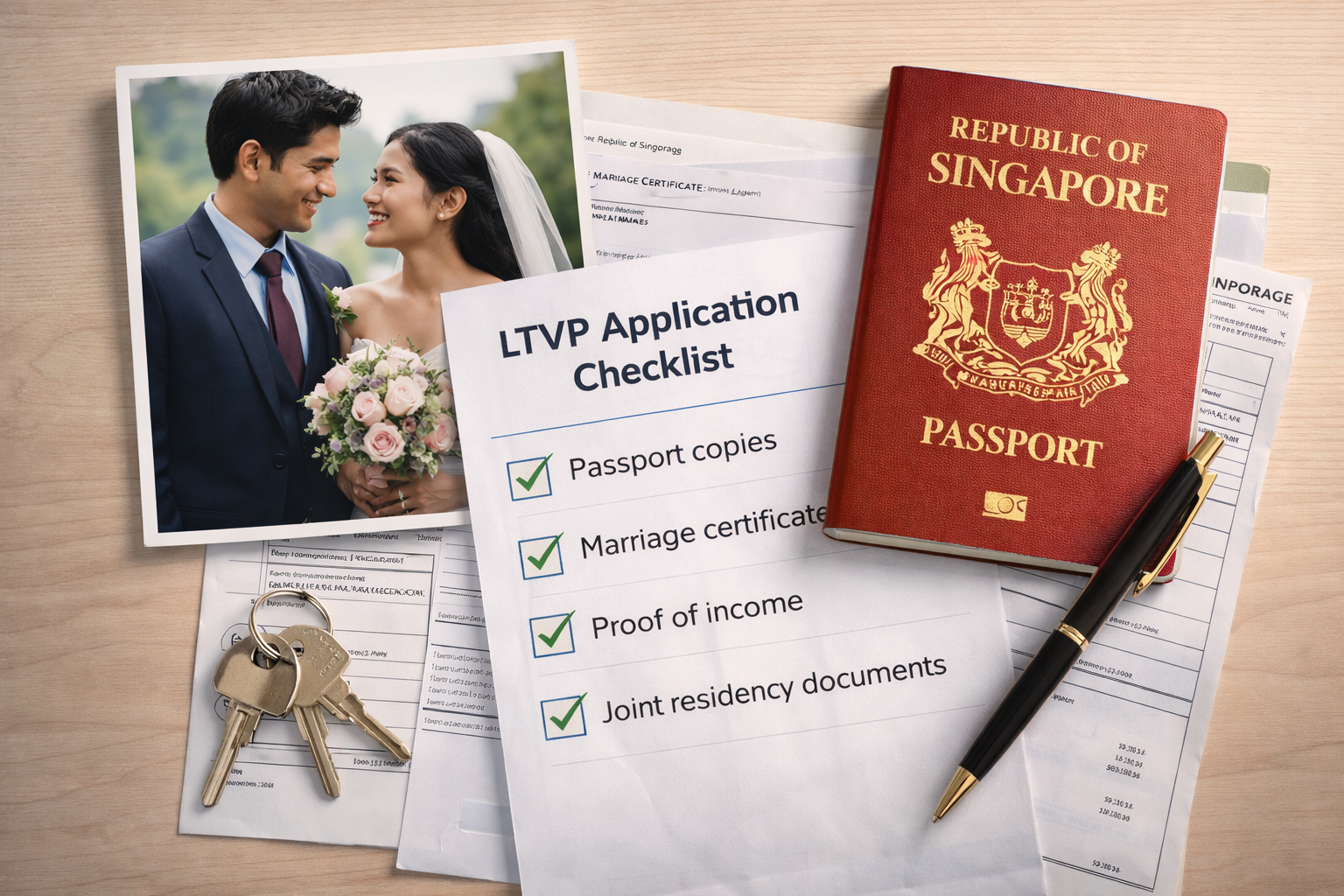
    Solution: Ensure that you provide all necessary documents, including a valid passport, marriage certificate, birth certificates (for parents), and any other relevant paperwork. Documents not in English must be translated and notarised by a notary public in Singapore or the country that issued the document. How Can I Bring My Foreign Aged Parent Into Singapore? Exploring the Available Immigration Passes

    2. Inaccurate Information Providing incorrect or inconsistent information on your application can lead to rejection. This includes discrepancies in personal details, employment history, or relationship status.

    Solution: Carefully review your application before submission. Ensure all information is accurate and matches your supporting documents. Any discrepancies can raise red flags and lead to a denial. For example, the start and end dates of your employment should tally with what is stated in your resume and official employment documents.

    3. Financial Insufficiency The ICA needs assurance that you can financially support yourself and your family members during your stay in Singapore. If your financial proof is deemed insufficient, your application may be rejected.

    Solution: Provide clear evidence of your financial stability. This can include bank statements, employment letters, or proof of income. If sponsored by a Singaporean spouse or parent, include their financial details as well.

    4. Health Concerns Applicants must meet certain health standards. If there are significant health issues that were not disclosed or inadequately addressed, it might result in rejection.

    Solution: Undergo the required medical examinations and provide accurate health reports. Address any health concerns transparently and ensure all medical documentation is up to date. You may also provide ICA with you personal health insurance policies to showcase long-term financial planning.

    5. Previous Immigration Issues Any history of visa overstays, deportations, or violations of immigration laws can negatively impact your LTVP application.

    Solution: Maintain a clean immigration record. If you have previous issues, address them in your application and explain any mitigating circumstances. Demonstrating compliance with immigration regulations can bolster your case.

    6. Relationship Authenticity For applications based on marital or familial relationships, proving the length of your relationship is crucial. If the ICA doubts the authenticity, your application may be denied.

    Solution: Provide ample evidence of your relationship. This can include testimonials from family and friends. The more evidence you provide, the stronger your case

    Please note that the Immigration and Checkpoints Authority (ICA) does not disclose specific reasons for application rejections, and the outcome of your application is at the sole discretion of the authorities. This article aims to provide general guidance and should not be considered as a guarantee of approval. For personalized advice, please contact E&H Immigration Consultancy to understand the reasons behind your rejection.

    Had an LTVP application rejected? E&H Immigration’s our LTVP service provides expert guidance tailored to your situation.

  • Timing your Singapore PR or Citizenship submission to gain an edge.

    Timing your Singapore PR or Citizenship submission to gain an edge.

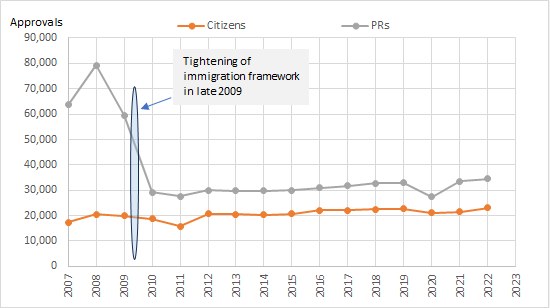
    Getting approved for Singapore Permanent Residency (PR) or Citizenship (SC) is notoriously hard with numerous stories of multiple failed attempts over many years. One reason for this is that the yearly approvals have moved to about an average of about 30,000 for PRs and 20,000 for SCs due to the Singapore government moving to a more restrictive and controlled immigration framework in late 2009. We are expecting these approvals to increase by around 1% on average per year as the population grows. What Minister Gan’s 2026 Population Speech Means for Singapore PR and Citizenship Applicants Short Guide for Indians Moving to Singapore: Company Incorporation, Employment Pass, PR, and CECA Benefits Singapore’s Population Cools in 2025: Deeper Insights for Residency Applicants

    Inside Singapore’s World-Class Education System: The Secrets Behind Its Success “Adding Value” to Singapore: What ICA Looks For (and How You Can Show It) class=””>Chart 1: ICA approvals of Singapore PRs and Citizens

    Source: Singapore Immigration and Checkpoints Authority

    Based on the latest data in Jun 2023[i], there is a pool of around 540,000 of PRs that could, taken to the extreme, apply to be citizens. However, since not all PRs want to be citizens and only some may make the decision to apply, we think the amount of new applications each year is perhaps 60,000 to 100,000 each year. For PRs, there are around 662,000[ii] of non-residents are eligible to be PRs. From this eligibility pool we think maybe 80,000 to 120,000 will apply for PR each year. This means the path to Singapore residency is a highly competitive one. Given this backdrop, applicants need to find any kind of edge they can to get ahead. We think one of these edges comes from timing your submission to periods when there will be potentially be less competition with fewer submissions in those periods.

    Using Google search trends of “Singapore PR applications” and “Singapore citizenship applications” as a proxy for lagged submissions we can make some judgements on when best to submit your application. Before continuing, we would like to note that we have made the assumption that final submissions will on average happen 1 month after the search of these keywords are done as people will still need to collate the appropriate documents before submitting to the ICA. 

    The best periods to submit your application

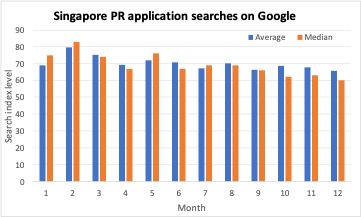
    Using the latest 10 years of data from Google we find that the last two months of the year and January looks like a better period to submit applications for Singapore PR applications as the median total of searches bottom out in December. In contrast the most competitive periods and least favourable periods looks to be around March and June. Please remember we have used a 1 month lag to make the conclusion e.g. if searches peak in February each year then 1 month later, in March, people will submit their applications.

    Chart 2: Monthly Google searches for “Singapore PR applications” from 2013 to 2023

    Source: Google

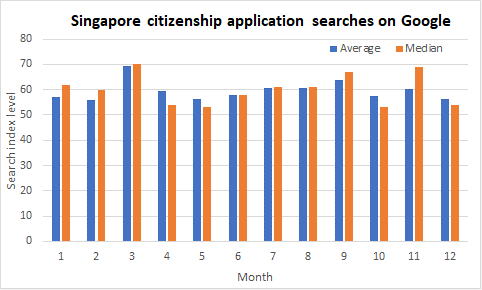
    Again, using the last 10 years of data from Google, we think the best time to make submissions for Singapore citizenship applications is during May, Jun, Nov, and January. Whereas, the least favourable months for submissions are potentially around April, October and December.

    Chart 3: Monthly Google searches for “Singapore citizenship applications” from 2013 to 2023

    Source: Google

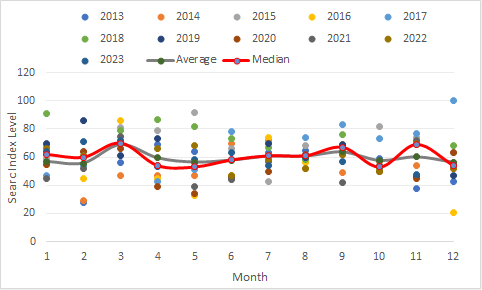
    However, we would caveat that due to wide variability in the data in some months, or in geek speak the distribution is not normally distributed, our confidence level in making these conclusions during these months are weaker. We have shown this variability in the chart below with data points for each year plotted for each month along with the averages and medians. These months include the October, November, January, February, April and March as the difference between the average and median is quite large, implying a less normal or skewed distribution of data points. Therefore, assuming a 1 month lag for submissions then we are less confident about our conclusions for November, December, February, May and April. Similar adjustments to our conclusions to PR applications also need to be made.

    Chart 4: Detailed monthly Google searches for “Singapore citizenship applications” from 2013 to 2023

    Source: Google

    If you like to boost your chances of success using this edge and other methods please reach out to E&H Immigration Consultancy for a complimentary 60 minute 1 on 1 session with our expert consultants.

    [i] See population-in-brief-2023.pdf

    [ii] This is based on data from the Singapore Department of Statistics and Ministry of Manpower comprised of 194,700 of Employment Passes, 177,000 of S-Passes, 283,200 of Dependent Passes, and 7,100 of Student Passes. Note, we have assumed only 10% of all 71,000 Student Pass holders are eligible as they need to have studied in Singapore for at least 2 years, pass at least one national exam (PSLE and either GCE or an Integrated Programme).

    Ready to time your Singapore PR application? E&H Immigration’s our Singapore PR application service provides expert guidance tailored to your situation. Also see: E&H Immigration’s our Singapore Citizenship service.

  • Denied? Don’t Despair! Navigate Your Singapore Citizenship Application Rejection and Master the Appeal Process

    Denied? Don’t Despair! Navigate Your Singapore Citizenship Application Rejection and Master the Appeal Process

    You’ve applied for Singapore citizenship and have waited months, even more than a year and finally you get a mail you’ve been eagerly waiting for but the result from the ICA is a rejection. “Adding Value” to Singapore: What ICA Looks For (and How You Can Show It)

    Inside Singapore’s World-Class Education System: The Secrets Behind Its Success Short Guide for Indians Moving to Singapore: Company Incorporation, Employment Pass, PR, and CECA Benefits style=”text-align: justify; font-family: Pontano Sans; font-size: calc((var(–large-text-size-value) – 1) * 1.2vw + 1rem);”>Many Singapore permanent residents aspire to obtain Singaporean Citizenship, but the process is more challenging than expected. While the government states that Singapore PRs can apply for citizenship after two years, the selection criteria for new citizens are stringent.

    Rejections for Singapore citizenship applications are common, with more cases of rejection than approval. If you’re facing rejection and seeking guidance, you’re in the right place.

    Before hastily preparing an appeal letter, it’s essential to pause and consider your options carefully.

    In this article, we’ll delve into the components of the Singapore citizenship application, potential reasons for rejection, and key factors the ICA evaluates when considering an appeal.

    Common Causes for Rejected Singapore Citizenship Applications

    Experiencing a rejection can be disheartening, especially when it comes to your Singapore citizenship application. Unfortunately, the Immigration & Checkpoints Authority (ICA) typically does not disclose specific reasons for rejections. However, there are common factors that could lead to such outcomes:

    1. Incomplete Application Steps: Missing out on any required steps during the application process can result in rejection.

    2. Incorrect Documentation: Submitting incorrect or incomplete documentation can lead to your application being turned down.

    3. Essential Documents Omitted: Failing to submit essential documents as part of your application can be a reason for rejection.

    4. Form Errors: Errors or inaccuracies in filling out application forms can also lead to rejection.

    5. Criminal Record: Any criminal convictions, even minor ones, can negatively impact your application.

    6. Security Concerns: If the ICA has any reason to believe that you may pose a security risk to Singapore, your application will likely be rejected.

    If you believe your application was error-free, rejection may stem from other factors. For instance, the ICA may seek more convincing evidence of your financial stability and commitment to Singapore in your application. Understanding these potential reasons can help you prepare a stronger application in the future.

    Key Changes to Highlight in Your Appeal Letter

    When writing an appeal letter for your Singapore citizenship application, it’s essential to highlight significant changes in your profile that warrant reconsideration. Here are some key points to include:

    1. Salary Increment: Demonstrate a significant increase in your monthly salary to show stronger financial stability.

    2. Promotion at Work: Highlight any recent promotions to indicate career advancement and the value you bring to your organization. What Minister Gan’s 2026 Population Speech Means for Singapore PR and Citizenship Applicants Singapore’s Population Cools in 2025: Deeper Insights for Residency Applicants

    3. Change in Marital Status and Newborn: Mention any changes in your marital status or the birth of a child, which signify your long-term plans in Singapore and align with the country’s focus on family growth.

    4. Property Ownership: Emphasize any recent property purchases in Singapore, showing your long-term commitment and investment in the country.

    Ensure to back up your appeal with relevant evidence, such as pay slips, appraisals, and birth certificates.

    If none of these changes apply to you, it might be best to wait and strengthen your profile before reapplying for Singapore citizenship.

    Consult a Professional Immigration Expert

    Before making your next move, seek professional advice. If your applications have been repeatedly rejected, it’s evident that expert guidance is needed to identify the missing elements.

    At E&H Immigration Consultancy, we thoroughly review your profile, documents, and past applications. We provide tailored recommendations to enhance your chances of a successful appeal.

    Citizenship application rejected? E&H Immigration’s our appeal and reapplication service provides expert guidance tailored to your situation. Also see: E&H Immigration’s our Singapore Citizenship service.

  • How important is your level of education when applying for Singapore residency (PR and citizenship)?

    How important is your level of education when applying for Singapore residency (PR and citizenship)?

    It turns out your parents were right about staying in school and going to university, at least that is the case for applicants for Singapore residency. Data from the Immigration and Checkpoints Authority (ICA), Singapore’s government agency in charge of granting Singapore Permanent Residency (SPR) and Citizenship (SC), shows that for 4 out of 5 people that are granted PR and citizenship have had education beyond secondary school level.

    “Adding Value” to Singapore: What ICA Looks For (and How You Can Show It) Short Guide for Indians Moving to Singapore: Company Incorporation, Employment Pass, PR, and CECA Benefits What Minister Gan’s 2026 Population Speech Means for Singapore PR and Citizenship Applicants>Education Profile of SCs and PRs granted in 2022

    New PRs New SCs
    Total approvals 34,493 23,082
    By highest qualification attained among those aged 20 & over (%)
    Post-secondary 81.3 78.2
    Secondary and below 18.7 21.8

    Source: ICA

    Is the ICA approving people to become citizen or PR because they spent more time learning beyond secondary school or is the pool of applicants already consist of 4 times more people with education beyond secondary shooling? We suspect it could be a combination of the two and, honestly, we will never really know unless the ICA shares more detailed breakdown of applicant profiles over the past decade. However, we do think that education is an important component in your profile because studies have shown more educated people tend to have higher incomes and higher incomes along with more education tends to lead to higher wealth.

    Education* Percentage of families Median income (2013) Median wealth (2013) Wealth-to-income ratio** Millionaires (family wealth)
    No high school diploma 12% $22,320 $37,766 1.43 1 in 110
    High school diploma 50% $41,190 $95,072 2.15 1 in 18
    Two- or four-year degree 25% $76,293 $273,488 3.45 1 in 4.6
    Advanced degree 13% $116,265 $689,100 5.58 1 in 2.6

    NOTE: *Based on the education level of a family headed by someone 40 years of age or older. **This ratio shows how much wealth each group has per dollar of income. For example, the ratio for families without a high school degree was 1.43, which means that, on average, for every $1 of income there was $1.43 of wealth. The ratio is a measure of how efficient people are at turning income into wealth.

    SOURCE: Boshara, Ray; Emmons, William R. and Noeth, Bryan. “The Demographics of Wealth: How Age, Education and Race Separate Thrivers from Strugglers in Today's Economy.” Essay No. 2: Education and Wealth, Federal Reserve Bank of St. Louis, May 2015, pp. 4, 5, 9, and 13. Singapore’s Population Cools in 2025: Deeper Insights for Residency Applicants

    Source: US Federal Reserve

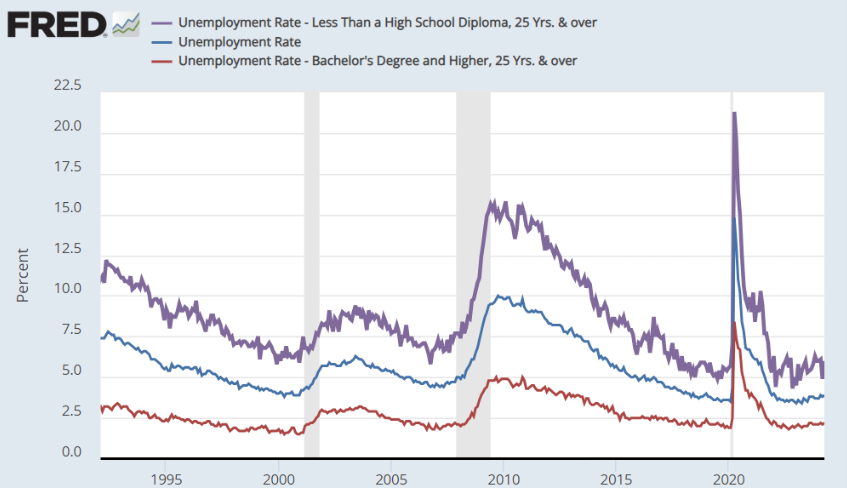
    People who are more educated also tend to have better job opportunities with lower rates of unemployment.

    Unemployment declines as education increases

    Source: US Federal Reserve

    More importantly, we have seen the government recognise the importance of education through the introduction of the Complementarity Assessment Framework (COMPASS[i]) points system on 1 September 2023, where the level of education and the ranking of the school can give you up to 20 points out of 40 needed to get an Employment Pass (EP). Having an EP is one pathway to get a PR. While COMPASS is not directly used to evaluate PR or citizenship applications, we do think some elements of it, such as the level of education, continue to play a significant factor in the application process. Inside Singapore’s World-Class Education System: The Secrets Behind Its Success

    What can you do if you think you score poorly for education?

    Fortunately, education is not the only determining factor for your Singapore PR or citizenship application. There are a multitude of other factors that also determine the success of your application. Come speak to E&H Immigration Consultancy if you need help with your application and please leave a comment if you have had issues with your application due to a weak education profile.

    [i] COMPASS has 6 criteria, where each criterion can earn up to 20 points, comprising the applicant’s: salary, qualifications, skills, company employee diversity, company strategic economic priorities (see https://www.mom.gov.sg/passes-and-permits/employment-pass/eligibility).

    Planning your Singapore PR or citizenship application? E&H Immigration’s our Singapore PR application service provides expert guidance tailored to your situation. Also see: E&H Immigration’s our Singapore Citizenship service.