Blog

  • Master the Singapore Permanent Residency Application with Expert Help

    Master the Singapore Permanent Residency Application with Expert Help

    Applying for Singapore Permanent Residency can be a transformative experience, opening up numerous opportunities such as stability, career advancement, and education. Yet, proper guidance can make it much less intimidating. This is it thus expert aids can usher you in. Let’s explore how you can become a pro at estate planning to secure your future in Singapore.

    Recognizing the significance of being a permanent resident.

    With a strong economy, efficient government processes, and a stable environment, Singapore offers people a cosmopolitan city. Your application is a ticket to be an asset of the ever-growing community of the nation and not just a formality. Having this status means you will have access to healthcare, education, and jobs. Since so much is at stake, it is important to get your application ready.

    How Consultancy Services Help With Immigration.

    It is important to understand the eligibility requirements and documentation for application. When you partner with an Immigration Consultancy Singapore firm, they guide you the whole way. The immigration consultancy Singapore experts analyze your profile and suggest improvements. Also, they ensure it complies with the latest regulations. Through their expertise, the chances of getting approved increase.

    One-Stop Application Guide

    A powerful application is the key to success. Immigration consultants help in documenting and presenting important details like work history, financial capability and personal achievements. They also assist you in tailoring your submission based on your unique contribution to Singapore. When you put up a strong case, you stand out.

    Benefits of Professional Help.

    When you take professional help, you can save time and reduce stress. A consultant knows the ins and outs of every application step and the problems likely to occur. They will help keep you on track to avoid delays, mistakes, and compliance with rules. Their help will ensure you have a complete, correct, and sure application.

    Conclusion.

    Getting permanent residency in Singapore is a life-altering choice that demands accuracy and commitment. You can make this journey successful with the help of professionals at E&H Immigration Consultancy Singapore. Getting assistance guarantees that you follow a suitable path in everything from the evaluations of requirements to writing a successful application.

    Make Permanent Residency Your Next Move!

    Eager to make your dreams come true? Don’t Turn Away PR Applications as Forthcoming Updates Will be Beneficial in Regaining PR Eligibility. Visit to our website for your next journey!

    Need expert help with your PR application? E&H Immigration’s our Singapore PR application service provides strategic, profile-tailored case building to maximise your approval chances.

  • Incorporating a Company in Singapore and Obtaining an Employment Pass (EP): Your Step-by-Step Guide

    Incorporating a Company in Singapore and Obtaining an Employment Pass (EP): Your Step-by-Step Guide

    Introduction

    Singapore is not just a thriving global business hub; it’s also one of the safest and most secure countries in the world. With its pro-business environment, efficient legal system, and excellent infrastructure, Singapore attracts professionals and entrepreneurs from around the globe. For those looking to build their dreams here, incorporating a company and obtaining an Employment Pass (EP) is an excellent first step.

    “Adding Value” to Singapore: What ICA Looks For (and How You Can Show It) Short Guide for Indians Moving to Singapore: Company Incorporation, Employment Pass, PR, and CECA Benefits What Minister Gan’s 2026 Population Speech Means for Singapore PR and Citizenship Applicants class=””>In addition to its vibrant economy, Singapore offers unparalleled safety for residents and families. If you’re considering making this city-state your next home, read more about its safety and security here: Why Singapore Should Be Your Next Safe and Secure Home.

    Let’s dive into how you can incorporate a company in Singapore, secure an EP, and even bring your family along.

    1. Incorporating a Company in Singapore

    Step 1: Choosing Your Business Structure

    Your journey begins with choosing the right business structure. For most entrepreneurs, a Private Limited Company (Pte Ltd) is the ideal choice. This structure not only offers limited liability protection but also positions your business as a credible entity to partners and clients. With low corporate tax rates and access to various government grants, a local incorporated company is the perfect foundation for growth.

    Imagine laying the cornerstone of your dream business—this first step is about ensuring your foundation is rock-solid.

    Step 2: Selecting a Primary Industry and Activity

    Every company in Singapore must define its primary business activities, which are categorized under the Singapore Standard Industrial Classification (SSIC) codes. To search for the relevant codes users can go to here or here. This step involves carefully choosing the industry and activity that best represent your business operations.

    For example:

    • A tech startup might classify itself under SSIC 62011 – Software Development.

    • A retail store might fall under SSIC 47110 – General Retail Sales.

    Choosing the right SSIC code is crucial because it affects licensing requirements and compliance obligations. If you’re unsure, consulting a corporate service provider can save you time and effort.

    Step 3: Name Approval

    The next step is to select a name for your business. Singapore’s regulator, ACRA (Accounting and Corporate Regulatory Authority), requires that your company name be unique and free from prohibited or offensive terms. Once you’ve chosen a name, you can reserve it on the BizFile+ portal or you can get a Corporate Secretary firm to help you. This process is often instantaneous, but in some cases, it may take up to a day for approval especially if the name sounds similar to other company names already in the system.

    Step 4: Meeting Statutory Requirements

    To register your company, Singapore’s laws mandate that you fulfil several statutory requirements:

    1. Shareholder: At least one shareholder is required. This can be an individual or a corporate entity.

    2. Local Resident Director: You’ll need at least one director who is a Singaporean citizen, permanent resident (PR), or Employment Pass (EP) holder.

    3. Company Secretary: Appoint a qualified company secretary within six months of incorporation.

    4. Paid-Up Capital: A minimum of SGD 1 is required. But we recommend SGD 50,000 at least for applicants intending to get an EP.

    5. Registered Address: A physical office address in Singapore (no P.O. Boxes) must be provided.

    For foreign entrepreneurs without a local connection, appointing a Nominee Director is a temporary solution. These services are often provided by corporate consultants to meet statutory obligations while your EP application is pending.

    Step 5: Preparing the Necessary Documents

    Incorporating a company involves gathering essential documents:

    • For shareholders and directors:

      • Passport copies. Certified true copies and notarised if the applicant is based overseas and wants to submit online.

      • Proof of residential address. Certified true copies and notarised if the applicant is based overseas and wants to submit online.

    • For the company:

      • Constitution (formerly Memorandum and Articles of Association).

      • Certificate of Incorporation (if corporate shareholders are involved).

    Having all your documents ready ensures a smooth incorporation process with faster approval times.

    Step 6: Registering the Company

    Once everything is in place, you can file your incorporation request via ACRA’s BizFile+ portal. If you find the process daunting, corporate service providers can guide you through it. Typically, incorporation is completed within 1–2 days, giving you a fast-track start to your business in Singapore.

    2. Applying for an Employment Pass (EP)

    Understanding the EP

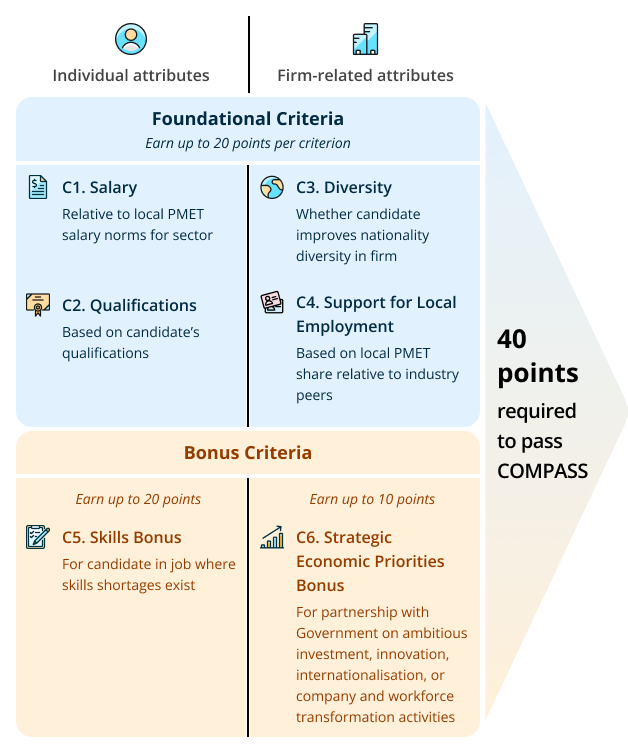
    The Employment Pass (EP) allows foreign professionals, managers, and directors to work in Singapore. As the shareholder and director of your newly incorporated company, you’re eligible to apply for an EP, provided you meet the salary threshold. As of the time of writing this SGD 5,000 per month (higher for older candidates) but this will increase to SGD5,600 from 1 January 2025. Candidates should also have relevant experience and a clearly defined job role that aligns with the company’s business activities. Applicants should ideally also have no prior legal or immigration violations. Unless exempted, candidates must score at least 40 points from the Complementarity Assessment Framework (COMPASS). Candidates can gain points from either personal individual attributes such as education and salary or from the company attributes such as company diversity and/or support for local employment. Singapore’s Population Cools in 2025: Deeper Insights for Residency Applicants Inside Singapore’s World-Class Education System: The Secrets Behind Its Success

    Source: Singapore Ministry of Manpower

    Key Documents for EP Application

    • Passport copy. Certified true copies and notarised if the applicant is based overseas and wants to submit online.

    • Verified educational certificates. Candidates need to ensure their qualifications are authentic and were awarded by accredited institutions. Acceptable forms of verification include:

      • Background screening companies,

      • Government/awarding institution’s verification portal,

      • The OpenCerts portal: https://www.opencerts.io/.

    • A detailed resume highlighting relevant experience.

    • Incorporation documents, including the Certificate of Incorporation and Business Profile. 

    Steps and Timelines

    1. Data Preparation:

      • Verification of educational qualifications: 1–2 weeks.

      • Document compilation: 1–2 days.

    2. Submission: File your application through the Ministry of Manpower (MOM) portal.

    3. Processing Time: 1–3 weeks for approval.

    Once approved, you’ll receive an In-Principle Approval (IPA) letter, valid for six months.

    Finalizing Your EP

    After receiving IPA:

    • Enter Singapore (if applicable) using the IPA letter.

    • Complete a medical check-up, if required.

    • Submit medical results to MOM.

    • Register biometrics for the EP card, which is typically delivered within 4 working days.

    3. Family Visa Options

    Dependent Pass (DP)

    As of the time of writing, if you earn SGD 6,000 or more, your spouse and unmarried children under 21 years old can apply for a Dependent Pass. Required documents include marriage and birth certificates, along with passport copies. The MOM, in contrast to the ICA, will accept spouses from a common-law marriage.

    Long-Term Visit Pass (LTVP)

    For parents, or common-law spouses, earning SGD 12,000 or more qualifies you to apply for an LTVP. Supporting documents such as affidavits and financial proof are essential.

    4. Transition from Nominee Director to Local Director

    Once your EP is approved, you can replace the nominee director with yourself. This transition involves filing Form 45 with ACRA and can be handled seamlessly with professional help.

    5. Path to Permanent Residency (PR)

    EP holders can apply for PR after 1–2 years of stay. As a PR, you gain access to public healthcare, housing options, and a pathway to citizenship. Applying for PR solidifies your long-term plans in Singapore.

    Conclusion

    Incorporating a company and obtaining an EP in Singapore is not just a legal process—it’s the start of a new chapter. Whether you’re building a global business or planning to bring your family to a secure, vibrant environment, Singapore offers a wealth of opportunities. By following these steps and seeking professional guidance when needed, you’ll be well on your way to success.

    Your journey to success begins here

    Need Expert Guidance? Contact E&H Immigration Consultancy

    Navigating the process of company incorporation, Employment Pass (EP) applications, and permanent residency (PR) in Singapore can be complex. That’s where E&H Immigration Consultancy comes in. With over a decade of experience in Singapore’s immigration and business landscape, we provide tailored solutions to meet your needs.

      • Why Choose Us?

        • Expertise in Singapore immigration laws and regulations.

        • Proven track record in securing EPs, DPs, LTVPs, and PR approvals.

        • End-to-end support, from company incorporation to final visa approvals.

        • Personalized consultation to fit your unique business and immigration goals.

      • Our Services

        • Incorporate your company quickly and seamlessly.

        • Optimize your EP application with expert guidance and strong documentation.

        • Plan your path to permanent residency and citizenship.

    Take the first step toward building your future in Singapore. Visit E&H Immigration Consultancy to schedule a consultation or speak with one of our experienced advisors today. Let us help you make your Singapore dream a reality!

    Your Success, Our Mission

    FAQ

    Setting up a company and applying for an EP? E&H Immigration’s our Work Pass service provides expert guidance tailored to your situation.

  • Top Tips for a Successful Singapore Citizenship Application

    Top Tips for a Successful Singapore Citizenship Application

    Becoming a citizen of Singapore offers numerous opportunities and benefits. Long-term access to one of the world’s strongest passports and opportunities to enjoy exceptional social privileges will define why the journey toward citizenship is so rewarding but requires proper planning.

    With a sound economy, excellent health care, and a rich cultural calendar, Singapore promises what many only dream of having. The procedure for acquiring Singapore citizenship is not too simple and requires very careful preparation.

    Whether for work just for one’s interest in investing in the future or because one loves and wants to be a part of the Singapore way of life, citizenship can be achieved through proper knowledge and enlightenment.

    Immigration rules are always in flux, and therefore, sometimes hiring a professional who can guide you through the latest requirements will make all the difference. E&H Immigration Consultancy is a trusted immigration consultancy that helps you go through the process of citizenship without hassle.

    This blog discusses effective tips if you are willing to become a Singapore citizen without unnecessary stress.

    Benefit Details
    Right to Vote Actively participate in shaping Singapore’s future through elections.
    Strong Passport Enjoy visa-free or visa-on-arrival access to over 190 countries.
    Career Opportunities Gain exclusive access to jobs reserved for citizens and enhanced employment stability.
    Social Benefits Avail healthcare subsidies, education grants, and housing support schemes.

    If these benefits resonate with your aspirations, starting your citizenship application process might be the best decision for your future. Inside Singapore’s World-Class Education System: The Secrets Behind Its Success Why Singapore Should Be Your Next Safe and Secure Home

    Tips to Apply for Singaporean Citizenship

    The process to become a Singapore citizen can be streamlined with proper preparation. Here are some useful tips:

    1. Be Sure That You Qualify On All Conditions

    Before you submit an application to become a Singaporean citizen, first ensure that you qualify based on some stipulated conditions. These are the starting points meant to guide you in determining whether you have met all these requirements to apply for Singaporean citizenship.

    • Singapore Permanent Resident: You must be a permanent resident of Singapore before being eligible to apply for citizenship. If you happen to be one, you have already made an excellent start.

    • Time in Singapore: Normally, you should have spent at least two years here as PR before applying. It shows that you care about the country.

    • Work or Study: You need to be working or studying here as these promote better chances of approval.

    If you don’t meet all these requirements, it is better to wait until you do and then apply. This will ease the application process.

    2. Gather All Required Documents

    One of the most essential steps in the application procedure is gathering the correct documents. Without them, your application might be delayed or rejected.

    Here is a list of some of the common documents required:

    • Passport: Original passport issued to you from your country of origin.

    • Work Permit or Employment Pass: If you are working in Singapore, you will probably be asked to provide proof of employment.

    • Proof of Financial Soundness: Your salary slips or tax documents could be presented.

    3. Honest and Accurate Application

    You will want to make sure you are truthful and accurate in filling out your citizenship form. If you are wrong or give false information, you risk facing the denial of your application. Make sure you double-check all your details, including personal information, family history, and work history.

    4. Highlight Your Contributions to Society in Singapore

    The more you can demonstrate your contribution to the society of Singapore, the stronger your application will be. Contributions on many levels include:

    • Contributions to Sports, Physical and Mental Education

    • Contributions to Culture and Arts

    • Contributions in Business and Commerce

    • Contributions to Social Welfare

    Employment: An established job or a business in Singapore will depict you contributing to the economy.

    Community Involvement: Volunteer work or involvement in community organisations can show that you are interested in the community. What Minister Gan’s 2026 Population Speech Means for Singapore PR and Citizenship Applicants “Adding Value” to Singapore: What ICA Looks For (and How You Can Show It) Singapore’s Population Cools in 2025: Deeper Insights for Residency Applicants

    Taxes: Paying taxes on time and observing the law of the country are significant and can help your application process.

    Singapore needs people who will help it prosper. To really make your application stand out, show that you have already done this as much as possible.

    5. Seek Help from Professionals to Avoid Blunders

    On your path to become a Singapore citizen, you must avoid blunders with utmost care. Therefore, it can help a lot to get professional assistance by using the expertise of an expert. E&H Immigration is quite experienced and will be able to help you throughout the process. They can:

    • Verify all your documents to ensure everything is correct.

    • Prepare your application so that it is in accordance with your needs.

    • You should keep up with what your application status has been and try to address any problems.

    You are free to hire experts to help with the application. This can save you time and stress and increase your chances of success, too!

    6. Under the Timeline for Processing

    The processing time for an application for Singapore citizenship is up to 12 months, and you just have to be patient during this time.

    7. Prepare for an Interview 

    For some applications, there is a face-to-face interview. It will become the most intimidating step of the application procedure, as the authorities will question you and learn about you. They might ask you for information related to your working experience, your reason behind becoming a citizen of Singapore, and your contribution to how you can serve Singapore.

    To prepare for the interview:

    • Be clear about your reasons for wanting to become a Singapore citizen. Consider how Singapore fits into your life and goals.

    • Know your background. Read over the information in your application so you’re prepared to answer any questions.

    • Preparing for an interview demonstrates that you are serious about your application and fully committed to joining Singapore.

    8. Stay Patient and Keep Your Documents Updated

    You may have to wait for some time after submitting your application to hear a decision from them. Wait patiently. In case of any change in your situation like a new job, address, or any family situation, you should update your application. This will make the authorities feel that you are responsible and serious regarding your application.

    Why Choose Professionals? Details
    Save Time Avoid spending countless hours researching or redoing applications.
    Error-Free Applications Professionals catch mistakes you might overlook, ensuring accuracy.
    Customised Support Receive tailored advice to strengthen your application.
    Updated Knowledge Experts stay informed about the latest eligibility criteria and guidelines.

    Choosing professional services ensures a smoother, stress-free journey when you apply for Singaporean citizenship.

    How E&H Immigration Simplifies the Process

    E&H Immigration has years of experience and over 1,000 cases handled; it also ensures that you meet all eligibility criteria with personalised advice to help you become a Singapore citizen.

    Document Preparation

    We will help to organise, verify and format your documents so that your application is error-free.

    Targeted Plans

    E&H Immigration designs solutions for each unique personal situation and thus will get a legitimate plan for a successful application.

    Post Submission Monitoring and Updates

    We will help update the ICA with new relevant information post submission. We will also help guide clients how to handle follow up queries from authorities until a final result is given.

    Conclusion

    You may find it difficult to apply for Singaporean citizenship, but proper preparation and support can make a big difference in one’s chances of getting through it. Whether you have already spent some time in Singapore as a PR or are just starting, the following tips will ensure that your application process is much smoother and more successful.

    E&H Immigration is here to guide you through every step to become a Singapore citizen, whether it be checking that your documents are in order or guiding you through the entire application process. With our team’s skills, we ensure to make your journey through this arduous process smoother and more bearable. Ready to take the next step in becoming a Singapore citizen? Don’t be afraid to get in touch and acquire the professional support you need.

    Considering applying for Singapore citizenship? E&H Immigration’s our Singapore Citizenship service provides expert, profile-tailored guidance at every step of the process.

  • Why Singapore Should Be Your Next Safe and Secure Home

    Why Singapore Should Be Your Next Safe and Secure Home

    In a world increasingly marked by conflict, rising crime rates, and diminishing societal stability, Singapore has emerged as a global exemplar of safety and peace. The recently published Global Peace Index (GPI) 2024 underscores this status, ranking Singapore as the safest country in terms of societal safety and security. A lower score on the index indicates a better ranking, making Singapore’s achievement all the more notable. This distinction offers compelling reasons for individuals seeking refuge from the uncertainties of an increasingly volatile world to consider Singapore as their next home.

    Singapore Leads in Societal Safety and Security

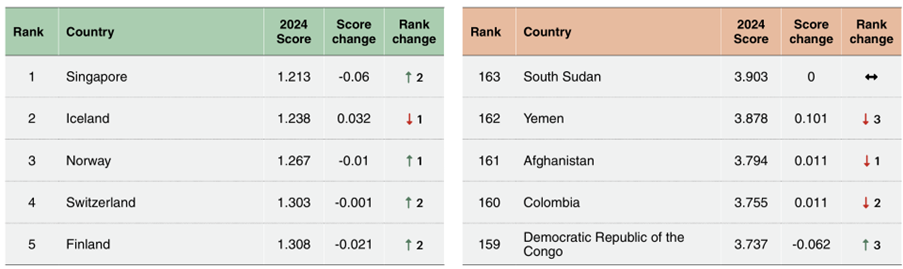
    The Global Peace Index evaluates 163 nations based on 23 indicators across three domains: societal safety and security, ongoing domestic and international conflict, and militarization. While Iceland maintains its position as the most peaceful country overall for the 17th consecutive year, Singapore takes the lead in the societal safety and security domain, with an impressive score of 1.213. This achievement surpasses Iceland, which ranks second in this category, followed by Norway, Switzerland, and Finland.

    Short Guide for Indians Moving to Singapore: Company Incorporation, Employment Pass, PR, and CECA Benefits>2024 Global Peace Index – Top 10 most peaceful countries

    Rank Country Score Change in rank from 2023
    1 Iceland 1.112 No change
    2 Ireland 1.303 No change
    3 Austria 1.313 1
    4 New Zealand 1.323 -1
    5 Singapore 1.339 3
    6 Switzerland 1.350 3
    7 Portugal 1.372 -1
    8 Denmark 1.382 -3
    9 Slovenia 1.395 -2
    10 Malaysia 1.427 2

    Source: Institute for Economics and Peace

    Five Most & Least Safe Countries by Safety and Security Domain (2024)

    Source: Institute for Economics and Peace

    Singapore’s top rank in societal safety and security reflects its exceptionally low crime rates, effective law enforcement, and the trust citizens place in its justice system. The nation’s robust infrastructure, strategic urban planning, and proactive governance also contribute to this unparalleled safety.

    Safety Amid Global Instability

    The GPI 2024 paints a troubling picture of the global landscape. With 56 active conflicts worldwide—the highest since the end of World War II—and increased internationalization of conflicts, peace remains elusive in many regions. North America, for instance, experienced significant deterioration in peacefulness, driven by surges in violent crime and heightened perceptions of insecurity. The United States, in particular, has seen rising social tensions and crime, making safety a growing concern for many residents.

    In stark contrast, Singapore offers a sanctuary of stability. Its proactive approach to maintaining law and order, coupled with community-driven initiatives to promote social harmony, ensures a sense of security rarely found elsewhere. For expatriates and families seeking a peaceful environment, this safety is a cornerstone of Singapore’s appeal.

    A Safe Haven in a World of Change

    Singapore’s safety is reinforced by a combination of outstanding metrics:

    Low Murder Rates: Singapore’s murder rate stands at just 0.12 per 100,000 people—one of the lowest globally—with only 7 homicides recorded in 2022. This starkly contrasts with higher rates seen in many other developed countries. For example, the United States has a murder rate of 6.38 per 100,000 people with 21,593 reported homicide cases in 2022.

    Murder (Homicide) rates in 2022 – Top countries with lowest murder rates

    Lowest murders rank Country Total Murders Murder Rate: Per 100,000
    1 Singapore 7 0.12
    2 Oman 12 0.26
    3 Macau 2 0.29
    4 Hong Kong 30 0.40
    5 Switzerland 43 0.49
    6 South Korea 275 0.53
    7 Italy 322 0.55
    8 Norway 30 0.55
    9 Slovenia 13 0.61
    10 Cyprus 8 0.64

    Source: United Nations Office on Drugs and Crime

    Low Crime Rates: According to the Global Organized Crime Index (GOCI), Singapore has one of the lowest crime rates globally with a ranking of 8th and an index score of 23.1 (lower is better with the country with lowest crime rate having a score of 14.3 in Qatar). This reflects the nation’s stringent law enforcement and strong societal norms and values. In contrast, the United States is ranked around 85 with an index score of 49.2 and the United Kingdom is ranked around 76 with a score of 46.9. What Minister Gan’s 2026 Population Speech Means for Singapore PR and Citizenship Applicants “Adding Value” to Singapore: What ICA Looks For (and How You Can Show It) Singapore’s Population Cools in 2025: Deeper Insights for Residency Applicants

    Global Organized Crime Index (2023) – Top countries with least overall crime

    Lowest Crime Rank Country Crime Index
    1 Qatar 14.3
    2 United Arab Emirates 14.6
    3 Taiwan 16.1
    4 Oman 19.6
    5 Armenia 21.6
    6 Hong Kong 21.7
    7 Japan 22.9
    8 Singapore 23.1
    9 Bahrain 24.2
    10 Slovenia 24.2

    Source: Global Initiative Against Transnational Organized Crime

    Low Corruption: Ranked 5th globally on the 2023 Corruption Perceptions Index with a score of 83 (higher score means lower corruption), Singapore is among the least corrupt nations in the world. The marginal difference of only a few points from the top four countries underscores its exceptional governance and transparency.

    Corruption Perceptions Index (2023) – Top countries with lowest corruption

    Least Corrupt Rank Country Score
    1 Denmark 90
    2 Finland 87
    3 New Zealand 85
    4 Norway 84
    5 Singapore 83
    6 Sweden 82
    6 Switzerland 82
    7 Netherlands 79
    8 Germany 78
    8 Luxembourg 78

    Source: Transparency International

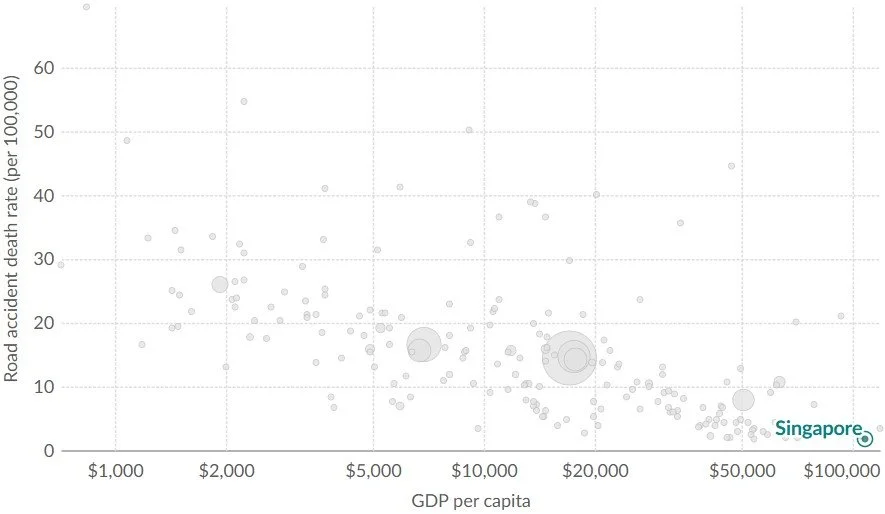
    Road Safety: Singapore ranks first with only 1.9 deaths per 100,000 individuals (death rate), alongside Sweden and Malta, for having the lowest number of deaths caused by road incidents globally. In comparison, the United States has over 5 times more with a death rate of 10.8 per 100,000 individuals.

    Road Accident Death Rates – Top countries with lowest death rates

    Least deaths rank Country Deaths per 100,000
    1 Sweden 1.90
    1 Singapore 1.90
    1 Malta 1.90
    1 Norway 1.90
    2 United Kingdom 2.00
    3 Switzerland 2.10
    3 Ireland 2.10
    4 Japan 2.20
    5 Iceland 2.40
    6 Denmark 2.60

    Source: The Institute for Health Metrics and Evaluation

    Road Accident Death Rates vs GDP per capita (2021)

    Source: IHME, Global Burden of Disease (2024); World Bank (2023), OurWorldinData

    These factors collectively demonstrate why Singapore remains a paragon of safety and a desirable destination for individuals seeking security and peace of mind.

    Why Choose Singapore?

    1. Unparalleled Safety: Ranked #1 in societal safety and security by the GPI, Singapore offers an environment where residents can live and work without fear of crime or instability. This is especially a big positive for families with young kids.

    2. Political and Social Stability: Singapore’s governance model emphasizes harmony, inclusivity, and the rule of law, fostering a cohesive society.

    3. Thriving Economy: As a global financial hub, Singapore provides abundant opportunities for professionals and businesses, backed by a stable and transparent economic framework.

    4. Family-Friendly Environment: With world-class education, healthcare, and public amenities, Singapore is an excellent choice for families seeking a safe and nurturing environment for their children. Inside Singapore’s World-Class Education System: The Secrets Behind Its Success

    5. Proactive Governance: Singapore’s ability to adapt to global challenges while maintaining internal stability is a testament to its visionary leadership.

    A Future Built on Peace

    As the GPI report reveals, the likelihood of major global conflicts is higher than at any time since its inception. For those seeking a secure and peaceful environment in such uncertain times, Singapore remains a top choice. With its exceptionally low murder rates, minimal crime, low corruption, and exemplary road safety, Singapore is a beacon of stability and a model for urban governance. Its commitment to societal safety, coupled with a forward-looking approach to development, ensures it will continue to be a safe haven in a rapidly changing world.

    In conclusion, Singapore’s exceptional safety metrics, as highlighted by the Global Peace Index 2024 and other data, reaffirm its status as one of the safest countries in the world. For individuals and families considering migration, Singapore offers not just safety, but also a bright and secure future.

    Make Singapore Your Home with E&H Immigration Consultancy

    Are you planning to relocate to Singapore? Whether you’re drawn by its exceptional safety, stability, or abundant opportunities, E&H Immigration Consultancy is here to assist. Our dedicated team of experts specializes in helping individuals and families secure Employment PassesPermanent Residency, and Citizenship in Singapore.

    We provide personalized guidance to make your migration process smooth and stress-free. Start your journey to a brighter, safer future in Singapore today. Visit E&H Immigration Consultancy to learn more about how we can help with your Employment Pass, Permanent Residency, or Citizenship applications.

    Considering making Singapore your permanent home? E&H Immigration’s our Singapore PR application service provides strategic, profile-tailored case building to maximise your approval chances.

  • Understanding the differences in Long Term Visit Pass (LTVP) from ICA and MOM in Singapore

    Understanding the differences in Long Term Visit Pass (LTVP) from ICA and MOM in Singapore

    1. What is the Long-Term Visit Pass (LTVP)?

    Why Singapore Should Be Your Next Safe and Secure Home Inside Singapore’s World-Class Education System: The Secrets Behind Its Success Short Guide for Indians Moving to Singapore: Company Incorporation, Employment Pass, PR, and CECA Benefits class=””>The Long-Term Visit Pass (LTVP) allows foreigners to stay in Singapore for extended periods. It is commonly issued to spouses, children, and parents of Singapore citizens, Permanent Residents (PRs), and certain work pass holders. The LTVP is issued by two government agencies:

    2. Eligibility for LTVP Under ICA and MOM

    Eligibility and criteria differ significantly between the two agencies. Below is a comparison of eligibility between ICA and MOM:

    Criteria ICA (for citizens/PRs) MOM (for work pass holders)
    Spouse Eligibility Spouse of a citizen/PR Spouse of EP or S Pass holder (includes common-law marriages) with minimum salary of SGD 6,000/month
    Children Eligibility Biological/adopted unmarried child of a Singapore citizen/PR under 21 years old Biological/adopted/step child under 21 years old with minimum salary of SGD 6,000/month
    Parents Eligibility Parents of Singapore citizen/PR Parents of EP/S Pass holders with minimum salary of SGD 12,000/month
    Minimum Salary Requirement Not disclosed S$6,000/month for spouse and children or S$12,000 for parents
    Other factors Family ties, economic contribution, qualifications, age, family profile, length of residency of sponsor and applicant No
    Processing Time 6 weeks 2 weeks
    Validity and Renewal Tied to sponsor’s PR/citizenship status Tied to work pass holder’s employment status
    Duration of Stay Up to 5 years Limited by the validity of the work pass
    Common-law Marriages Not recognised Recognised

    Source: ICA, MOM

    3. Key Differences Between ICA and MOM LTVP

    The differences between the LTVP applications with ICA and MOM reflect the different purposes of the two agencies:

    • ICA LTVP: Focuses on family unity for long-term or permanent stay. Applicants are sponsored by Singaporeans or PRs, who typically reside in Singapore indefinitely. ICA evaluates applications based on the applicant’s family ties, though specific salary or employment guidelines are not provided.

    • MOM LTVP: Tailored for dependents of work pass holders, who are generally in Singapore for employment purposes. Since employment is time-limited, MOM applies stricter guidelines, including salary thresholds, to ensure the financial security of dependents during their stay.

    4. How to Approach an LTVP Application with ICA

    Unlike MOM, ICA does not specify salary benchmarks or occupation requirements, making it harder for applicants to gauge eligibility. Applicants seeking ICA LTVP approval should take the following into consideration:

    1. Use MOM Guidelines as a Reference: Although ICA applications are evaluated case-by-case, MOM’s minimum salary thresholds (e.g., S$6,000 for spouses) can serve as a very rough guide for financial adequacy. However, we have seen applicants with much less salary compared to MOM salary thresholds also get approved based on other factors in the profile.

    2. Demonstrate Financial Stability: Sponsors should provide proof of stable income or other financial resources like owning the house they live in to show that they can support their dependents. This is particularly useful in the absence of formal salary guidelines from ICA.

    3. Emphasize Family Ties and Contribution: As ICA prioritizes family integration, sponsors should highlight their role in the family and the importance of the applicant’s presence in Singapore.

    4. Account for Processing Times: ICA applications can take longer than MOM (6 weeks or more), so applicants should plan accordingly.

    Conclusion

    Choosing the right pathway for a Long-Term Visit Pass (LTVP) in Singapore depends on various factors, including your sponsor’s status, your relationship to the sponsor, and the nature of your stay in Singapore. As outlined, the differences between the Immigration & Checkpoints Authority (ICA) and the Ministry of Manpower (MOM) reflect the distinct purposes each agency serves—ICA focuses on family unity for long-term or permanent residency, while MOM emphasizes financial stability for dependents of work pass holders.

    For those navigating the ICA process, the lack of explicit salary guidelines can make applications more challenging. Using MOM’s thresholds as a reference can help, though the ICA takes a broader view, often prioritizing family connections and other stability factors.

    Need Assistance?

    If you need professional guidance to navigate the complexities of the LTVP application or assistance with submissions, reach out to E&H Immigration Consultancy. Visit www.eh-immigration.com to learn more about our services and how we can help you with your immigration needs.

    Need help with your LTVP application? E&H Immigration’s our LTVP service provides expert guidance tailored to your situation.

  • Uncovering the Ethnic Quota for PR and Citizenship in Singapore

    Uncovering the Ethnic Quota for PR and Citizenship in Singapore

    For a very long-time people living in Singapore, locals and non-locals, have long suspected that Singapore has an ethnic quota system for its immigration policy. It wasn’t until last June 2023 that these suspicions were indeed confirmed to be true when K Shanmugam, the Minister for Home Affairs and Minister for Law, shared during a panel discussion on “Revisiting Pluralism” [1] at the Institute of Policy Studies that “the government has publicly committed to keeping our racial percentages more or less constant” when asked about Singapore’s immigration policy. While Singapore has a well known and established ethnic quota system in public housing, which we will discuss in more depth later, there has never really been any clear public acknowledgement of an ethnic quota system for immigration until 2023. 

    In this article we delve more deeply into the ethnic quotas for immigration policy, especially for Singapore permanent residency (PR) and Singapore citizenship (SC). We begin by examining what other areas have ethnic quotas in place and what gave rise to these quotas. We then examine official immigration and population data to see how the quota system has worked over time. We then discuss how these quotas, and any discernible changes, impacts the approvals of new PRs and SCs. Singapore’s Population Cools in 2025: Deeper Insights for Residency Applicants

    How Singapore’s ethnic policy keeps communities diverse

    Introduced in 1988, the government implemented the Group Representation Constituencies (GRC) system which required at least one minority candidate (either Malay, Indian, or other minorities) to be represented in each GRC team. Under Singapore’s political system, citizens are elected to parliament either through single member constituencies (SMC) or GRCs which comprise of 3 to 6 members, who contest elections together. For GRC contested seats, the entire team wins or loses together so no single person within the team can get elected by themselves in those constituencies. The GRC system was created to keep all races living together peacefully, make sure minorities are included, and avoid neighbourhoods having only one type of people. Short Guide for Indians Moving to Singapore: Company Incorporation, Employment Pass, PR, and CECA Benefits

    One year later, in 1989, citing the need to root out ethnic enclaves, the government introduced the Housing Development Board (HDB[2]) Ethnic Integration Policy (EIP} to further institutionalise the ethos of racial harmony in society. Under the EIP, purchases of new and resale HDB apartments would need to comply with upper limits on the proportion of apartments that could be owned by each ethnic group within a neighbourhood[3] and apartment block level. The last published quota in 2010[4], indicated that within neighbourhoods, Chinese had a limit of 84%, Malays 22%, Indians and other minorities 12%. Within each block Chinese limits were 87%, Malays 25%, Indians and other minorities 15%.

    Why does Singapore care so much about racial harmony?

    The legacy of riots and independence

    In Singapore’s early years, racial harmony became a critical focus for the government. The scar tissue from 2 distinct periods (1964-1965 and 1969) in Singapore’s history has sharpened its focus on this issue. As Asian nations recovered and rebuilt from the devastation of World War II, calls for self-governance grew stronger. These calls eventually led to the formation of peninsula Malaysia as an independent country in 1957 as the Federation of Malaya. Then in 1963, The Federation of Malaya united with Singapore, Sabah (North Borneo) and Sarawak to form Greater Malaysia. Singapore joined the Federation of Malaysia to gain independence from British colonial rule, to seek higher economic benefits from having a larger common market, and to combat the threat of communism in Southeast Asia. However, in 1964 the racial riots from July to September, mainly between the ethnic Chinese and Malays, led to deaths of 36 people and injuries of 560 people with thousands arrested to prevent further escalation of violence and damage to property. It was during this tumultuous period the government established Goodwill Committees across constituencies to promote racial harmony and address community concerns. In August 9, 1965, due to deep irreconcilable differences in racial, political, economic and social issues the Malaysian Parliament voted unanimously for the expulsion of Singapore. On the same day, Lee Kuan Yew announced Singapore’s independence as a sovereign state, marking the end of a brief but tragic union with Malaysia. While race was not the only issue for the separation it was a dominant concern among Singapore’s leaders at that time. For example, Singaporean leaders said Malaysia wanted a “Malay Malaysia” and not a “Malaysian Malaysia”.

    A new vision of racial unity

    From the pain and anguish of those years, Singapore began to embrace the idea of equality and meritocracy for its society and even led to the Foreign Minister S. Rajaratnam describing Singapore as a “little United Nations in the making” in his 1965 maiden speech to the United Nations General Assembly. Minster Rajaratnam would then go on to establish Singapore’s National Pledge in 1966: “We, the citizens of Singapore, pledge ourselves as one united people, regardless of race, language or religion, to build a democratic society based on justice and equality so as to achieve happiness, prosperity and progress for our nation.”. To this day this pledge has been recited publicly in unison at school assemblies, in Singapore armed forces and at national day gatherings. What Minister Gan’s 2026 Population Speech Means for Singapore PR and Citizenship Applicants Inside Singapore’s World-Class Education System: The Secrets Behind Its Success

    Unfortunately, from May to June in 1969 the spillover in fear and negative sentiment from racial clashes in Malaysia sparked localised fighting in a few locations in Singapore between groups of Malays and Chinese, eventually leading to 4 deaths and 80 injuries. These tragic events would deepen the governments resolve to have a racially harmonious society.

    How rigid are the ethnic quotas?

    Looking over the past 10 years of immigration data there would be very little doubt to the observer that an ethnic quota is in place with hardly any variation in the ethnic groups as a % of the total resident population from year to year and even over a 10 year time frame.

    Singapore resident (PR and SC) population by ethnicity

    Date % of total resident population
    Chinese Malays Indians Others
    Jun-2024 73.99% 13.52% 9.04% 3.45%
    Jun-2023 74.04% 13.53% 9.03% 3.39%
    Jun-2022 74.12% 13.60% 9.00% 3.28%
    Jun-2021 74.25% 13.66% 8.90% 3.19%
    Jun-2020 74.35% 13.49% 8.96% 3.21%
    Jun-2019 74.36% 13.43% 9.01% 3.21%
    Jun-2018 74.34% 13.41% 9.03% 3.22%
    Jun-2017 74.34% 13.38% 9.05% 3.23%
    Jun-2016 74.31% 13.37% 9.07% 3.24%
    Jun-2015 74.31% 13.35% 9.10% 3.25%
    10Y average 74.24% 13.47% 9.02% 3.27%
    10Y std dev 0.13% 0.10% 0.05% 0.08%
    10Y change -0.27% 0.18% -0.08% 0.17%

    Source: Singapore Department of Statistics

    This stands in stark contrast to Malaysia which over the same time frame has between 2x to 26x more deviation for each ethnic group. For example, in Malaysia the standard deviation of the Malay resident population over the past 10 years is about 2.51%, whereas in Singapore the same metric for Malays is on 0.1%. In relative terms, this makes Malaysia 25.6 times more volatile compared to Singapore.

    Comparison of 10Y standard deviation of % total resident population across countries

    Country Chinese Malays Indians Others
    Singapore (SG) 0.13% 0.10% 0.05% 0.08%
    Malaysia (MA) -1.31% 2.51% -0.55% -0.19%
    MA over SG* 10.04 25.60 10.34 2.32

    *absolute value of ratio of MA over SG “Adding Value” to Singapore: What ICA Looks For (and How You Can Show It)

    Source: Department of Statistics Malaysia, Singapore Department of Statistics, E&H Immigration Consultancy

    What does this mean for prospective applicants looking to become PRs or SCs?

    Firstly, while it may look like the quota system is quite rigid over the past 10 years, the data over a longer period paints a different picture. For example, in the 10 years between 2004 to 2014, there was a sizeable decline of -1.9% for Chinese and increases of 0.97% and 1.52% for Indians and Other minorities, respectively. In the 10 years before this, between 1994 to 2004, the changes were also quite large with a decrease of -1.32% for Chinese and increases of 0.91% and 0.54% for Indians and other minorities, respectively.

    Changes in ethnic population as % of total population over the past 30 years

    Period Chinese Malays Indians Others
    10y chg: 2014 to 2024 -0.27% 0.18% -0.08% 0.17%
    10y chg: 2004 to 2014 -1.91% -0.59% 0.97% 1.52%
    10y chg: 1994 to 2004 -1.32% -0.12% 0.91% 0.54%

    Source: Singapore Department of Statistics and E&H Immigration Consultancy

    Based on the older data, we can see that the immigration policy was far less restrictive and with probably a more meritocratic based system across all prospective applicants for Singapore residency meaning Indians would compete with Chinese and Malays. However, since the tightening in immigration policy in 2010, we think there is less competition of applicants across ethnic groups and more competition within ethnic groups. This means smaller ethnic groups like Indians and other minorities are more disadvantaged as the pool of grants for their ethnic group in absolute terms will be smaller.

    Winners and losers of the ethnic quota system

    Keeping the quotas as they are today helps Chinese people the most because their numbers have dropped the most in the past 30 years with the proportion of Chinese dropping to 73.99% in 2024 from 77.49% in 1994. This also helps the Malays as their relative size also shrunk from 1994 to 2014 but since then has increased a little to 13.52% in 2024. Based on Minister K Shanmugam’s remarks in 2023 that part of the reason for having the quota was that “Senior leaders in the Malay community have expressed that they want to keep the Malay population at around 14-15% or at least continue to remain the second largest community in Singapore.”. This would favour more leeway upwards for the Malay population. We think growth in the Malay population will likely be remain moderate as Minister K Shanmugam has also said that its hard to attract talented Malaysian and Indonesian Malays into Singapore. While on the other hand there are multitude of Chinese and Indians looking to become Singapore residents. To put some numbers behind this, there are about 25.6 million ethnic Malays in Malaysia and Indonesia, whereas there are about 1.426 billion Chinese and 1.429 billion Indians globally[5]. The Indians and other minorities probably have the worst position because the pool of prospective applicants for Singapore residency are typically orders of magnitude more than the small quota allocated for them. To put this into perspective we have estimated the 2023 breakdown of PRs and SCs granted based on the 10 year averages of the ethnic population as % of the total. As shown in the table below, the number of Indians granted citizenship (SCs) is about 2,117 while the Chinese were estimated be granted is 17,426, which is about 8.2x more than the grants for Indians. We would caveat though that the quota for Indians is probably larger and would include the other minorities also, likely following the HDB Ethnic Integration Policy quota system. But even so, the absolute number of grants is relatively small.

    Estimated PR and SC granted based on ethnic quotas

    Country Chinese Malays Indians Others Total
    % of population, 10Y avg 74.24% 13.47% 9.02% 3.27% 100.00%
    Estimated PRs granted* 25,606 4,648 3,110 1,127 34,491
    Estimated SCs granted* 17,426 3,163 2,117 767 23,472

    * Estimated breakdown by ethnic group based on 2023 total grants after applying 10y average % of population

    Source: Singapore Department of Statistics, ICA, and E&H Immigration Consultancy

    [1] https://www.facebook.com/MothershipSG/videos/spore-govt-committed-to-maintaining-racial-percentages-but-cmio-shouldnt-be-over/1288118582129078/

    [2] The HDB is the government agency tasked with providing government subsidised housing for Singaporeans.

    [3] In the context of HDB housing, a neighbourhood refers to a collection of HDB residential blocks within a defined geographical area. The boundaries of a neighbourhood are set by the Urban Redevelopment Authority (URA) and Housing Development Board (HDB) for planning and community purposes.

    [4] https://www.sg101.gov.sg/social-national-identity/examples/hdb/

    [5] This is based on 2023 UN estimates for the population of China and India. We have not included ethnic Chinese and Indians living abroad elsewhere.

    Planning your Singapore PR or citizenship application? E&H Immigration’s our Singapore PR application service provides expert guidance tailored to your situation. Also see: E&H Immigration’s our Singapore Citizenship service.


  • Singapore Population Crosses 6 Million: Implications for PR and Citizenship Policies

    Singapore Population Crosses 6 Million: Implications for PR and Citizenship Policies

    The Singapore government released the 2024 population data a few days ago. These are some of major changes and our takeaways from the recent update: What Minister Gan’s 2026 Population Speech Means for Singapore PR and Citizenship Applicants

    Inside Singapore’s World-Class Education System: The Secrets Behind Its Success “Adding Value” to Singapore: What ICA Looks For (and How You Can Show It) class=””>The overall population (residents and non-residents) increased to 6.04 million as at June 2024 from 5.92 million from June 2023 (+2% YoY). This is the first time the total population has exceeded 6 million people. However, much of the increase was due to the non-resident population increasing by 5% from 1.77 million in June 2023 to 1.86 million in June 2024. On the other hand, the resident population (PRs and citizens) increased by only 0.76% from 4.15 million in June 2023 to 4.18 million in June 2024.

    Overall Population June 2023 June 2024 Chg YoY %YoY
    Resident population 4,149,300 4,180,900 31,600 0.76%
      – Citizen population 3,610,700 3,635,900 25,200 0.70%
      – Permanent Resident population 538,600 544,900 6,300 1.17%
    Non-resident population 1,768,400 1,856,000 87,600 4.95%
    Total population 5,917,600 6,036,900 119,300 2.02%

    Source: Singapore Department of Statistics and ICA

    2025 Elections and Immigration: How PR and Citizenship Approvals May Be Affected Singapore’s Population Cools in 2025: Deeper Insights for Residency Applicants

    Given the proximity of the general election and the sensitive nature of immigration, especially now that non-resident employment growth at 42,900 over the past 12 months is growing close to 3.5x more than resident employment at 12,400, we think the topic of immigration will be a hot button issue leading into the general election which is expected to be held in the second or third quarter of 2025. We would not be surprised to see more immigration/foreign worker tightening measures or some slowing in PR or citizenship approvals ahead of elections. 

    Employment Type 3M chg: Mar2024/Jun2024 12M chg: Jun2023/Jun2024
    Resident Employment 700 12,400
    Non-Resident Employment 13,200 42,900
    Total Employment 14,900 55,300

    Source: Singapore Ministry of Manpower

    PR and Citizenship Application Success: Why Age, Marriage, and Family Status Matter in Singapore

    In other metrics, we think new applicants for PR and citizenship will gain some edge if they are younger and married with few or no kids, as the median age of Singaporean citizens increased by 0.4 years from 43 years in June 2023 to 43.4 years in June 2024 and resident birth rates as measured by the total fertility rate (an estimate of the average number of children that a woman is expected to have during her lifetime) has declined from 1.04 in 2022 to 0.97 to 2023 and citizen births declined by 5.43% from 30,429 in 2022 to 28,777 in 2023. Moreover, citizen marriages have declined by 1.7% from 24,767 in 2022 to 24,355 in 2023

    Marriage and Parenthood 2022 2023 Chg YoY %YoY
    Citizen births 30,429 28,777 -1,652 -5.43%
    Citizen marriages 24,767 24,355 -412 -1.66%

    Source: Singapore Department of Statistics and ICA

    PR and Citizenship Grant Trends: Navigating the Competitive Singapore Application Process

    In terms of residency grants (approvals), there has been a small increase in total grants along the same % increase in resident population increase discussed earlier. Total PRs granted was close to flat at 34,493 in 2022 vs 34,491 in 2023. While total citizenship granted increased by 1.7% from 23,082 in 2022 to 23,472 in 2023. Taken together, the total residency grants increased by about 0.7%yoy. We think the application process remains very competitive given such small increases in grants against much larger gains in non-resident population.

    Residency grants 2022 2023 Chg YoY %YoY
    Permanent Residents 34,493 34,491 -2 -0.01%
    Citizenship 23,082 23,472 390 1.69%
    Total 57,575 57,963 388 0.67%

    Source: Singapore Department of Statistics and ICA

    Ethnic Diversity in Singapore: Insights for PR and Citizenship Applicants

    Lastly and more surprisingly, ethnic diversity remained unchanged from June 2023 to June 2024. Perhaps it’s a typo from the government report or perhaps the ethnic quota is at play here. We leave this to readers to make the final judgement on this. If it is the latter, then for the unlucky few in the minority your application for residency should be faultless and submitted to a high level to showcase all the positives in your profile. If you need help in this regard, please reach out to E&H Immigration Consultancy for our tried and tested protocols to elevate your application to the next level.

    Planning your Singapore PR application? E&H Immigration’s our Singapore PR application service provides expert guidance tailored to your situation. Also see: E&H Immigration’s our Singapore Citizenship service.
  • PR Application Rejected: 7 Reasons why your application was rejected.

    PR Application Rejected: 7 Reasons why your application was rejected.

    Are you struggling to get your Singapore Permanent Residency (PR) application approved? You’re not alone. Many applicants face multiple rejections due to common mistakes that could have been avoided with better preparation. Understanding the root causes of these rejections can make all the difference. In this article, we’ll uncover the 7 key reasons why PR applications get rejected in Singapore and provide actionable steps to improve your chances of success. Whether it’s incomplete documentation, gaps in qualifications, or poor societal integration, addressing these issues head-on is crucial for a successful outcome. Read on to ensure your next PR submission is your strongest yet.

    1. Insufficient Documentation

    A frequent cause of PR application rejections in Singapore is inadequate or incomplete documentation. The Immigration and Checkpoints Authority (ICA) requires applicants to submit a comprehensive set of documents, and even minor errors in the application form or omissions can lead to rejection. Whether it’s failure to provide a declaration letter for the dispossession of documents or filling out the form incorrectly, there is little room for mistakes given the high scrutiny applied to PR applications.

    Short Guide for Indians Moving to Singapore: Company Incorporation, Employment Pass, PR, and CECA Benefits>To avoid disqualification, ensure all mandatory documents, such as identity documents, education certificates, and employment records, are meticulously checked and organised to comply with ICA’s required format. Documents should also be scanned in coloured copies. Furthermore, any non-English documents must be translated and notarized in Singapore, with the translations authenticated by the Singapore Academy of Law. What Minister Gan’s 2026 Population Speech Means for Singapore PR and Citizenship Applicants Singapore’s Population Cools in 2025: Deeper Insights for Residency Applicants Inside Singapore’s World-Class Education System: The Secrets Behind Its Success

    2. Gaps in Skills and Qualifications

    While the official criteria for PR do not explicitly include qualifications or skills, ICA does take these into account, particularly in relation to your job and economic contributions. Singapore values applicants with skills that are in demand for the development of the nation.

    Applicants with relevant qualifications and sought-after skills may have a better chance of approval. It’s worth researching what skills are currently in demand and potentially upskilling before reapplying for PR to improve your standing.

    3. Lack of Financial Stability

    Financial stability is another significant factor in PR approval. Applicants must demonstrate a reliable income source and sufficient resources to support themselves and any dependents. Repeated rejections often stem from applicants failing to provide enough evidence, such as insurance documents, investment statements, or employment contracts, to prove their financial security.

    4. Poor Integration into Society

    Singapore places a high value on applicants who actively integrate into its society. This can include involvement in community activities, volunteering, donation, or demonstrating a commitment to learning about Singaporean culture and languages. A lack of integration, such as limited participation in local events or minimal knowledge of Singapore’s values, can be a reason for rejection. “Adding Value” to Singapore: What ICA Looks For (and How You Can Show It)

    To enhance your application, consider volunteering with local non-profit organizations or participating in community-building activities that show your commitment to becoming a part of Singaporean society.

    5. Inconsistent Employment History

    A stable employment history is crucial for a successful PR application. Frequent job changes or periods of unemployment may raise doubts about your long-term commitment to Singapore. Highlighting a steady career progression and contributions to the local economy can strengthen your application.

    6. Neglecting Endorsements

    Letters from reputable individuals or organizations can significantly bolster your PR application. These endorsements serve as character references and attest to your potential contributions to Singapore. Failing to secure endorsements may weaken your case, making rejection more likely.

    7. Failing to Address Previous Rejections

    If your PR application has been previously rejected, it’s essential to address the reasons for the rejection in your new application. Simply resubmitting the same documents without making improvements is unlikely to succeed. Take the time to understand the reasons behind your earlier rejection, and actively work to correct any shortcomings before reapplying.

    Conclusion

    While repeated PR application rejections can be frustrating, it’s crucial to remain determined and take proactive steps to address common reasons for failure. By ensuring your documentation is in order, improving your financial standing, integrating into society, maintaining stable employment, seeking endorsements, addressing past rejections, and demonstrating genuine intent, you can significantly improve your chances of securing permanent residency in Singapore.

    Consider speaking with E&H Immigration Consultancy to understand what are the industry’s best practices to get your Singapore Permanent Residence approved. Visit us for more information.

    PR application rejected? E&H Immigration’s our appeal and reapplication service provides expert guidance tailored to your situation. Also see: E&H Immigration’s our Singapore PR application service.

  • How Much Money Will You Save On Your Child’s School Fees When You Become A Singapore Permanent Resident (PR) ?

    How Much Money Will You Save On Your Child’s School Fees When You Become A Singapore Permanent Resident (PR) ?

    Singapore offers significant financial benefits for Permanent Residents (PR) and citizens, particularly in the realm of education. For those considering Singapore as their long-term home, one of the most attractive perks is the government subsidies that dramatically reduce education costs for children. In the text below, we will highlight the contrast between what citizens, PRs, and foreigners pay for school fees.

    Educational Fees for PRs and Citizens vs. Foreigners

    One of the major incentives for obtaining PR or citizenship status is access to subsidized education, significantly lowering fees at all educational stages, from primary school to post-secondary institutions like junior colleges and polytechnics.

    Primary School Fees

    • Citizens: Primary education is nearly free for Singaporean citizens, who only pay a small miscellaneous fee of $6.50 to $13 monthly.

    • PRs: PR parents pay $230 to $268 monthly for primary school education.

    • Foreigners:

      • ASEAN students pay between $490 and $528 monthly.

      • Non-ASEAN students face the highest costs, with fees ranging from $825 to $888.

    For example, over six years of primary school:

    • Singaporean citizens pay a total of $468 to $936.

    • PRs pay $16,560 to $19,296.

    • International students from ASEAN countries pay $35,280 to $38,016.

    • Non-ASEAN students pay a hefty $59,400 to $63,936.

    Secondary School Fees

    • Citizens: For government or government-aided secondary schools, Singaporean citizens pay between $5 and $25 per month, with a total cost of around $1,200 over four years.

    • PRs: PRs pay $440 to $520 monthly, with a total cost of $24,960 over four years.

    • Foreigners:

      • ASEAN students pay $840 to $920 monthly, or $44,160 over four years.

      • Non-ASEAN students pay between $1,600 and $1,770 monthly, adding up to $84,960.

    For independent secondary schools, fees increase significantly:

    • Singaporean citizens pay $300 to $600 monthly, totaling $28,800 over four years.

    • PRs pay between $600 and $1,000 monthly, reaching $48,000.

    • International students face fees ranging from $1,000 to $2,500 per month, with non-ASEAN students paying up to $120,000.

    Post-Secondary Education

    Junior College

    • Citizens: The total cost for two years is around $792.

    • PRs: PR students pay $520 to $607 monthly, with a total cost of $14,568.

    • Foreigners:

      • ASEAN students pay $1,070 to $1,127 monthly, or $27,048 in total.

      • Non-ASEAN students face $1,950 to $2,127 monthly, with a final total of $51,048.

    Polytechnic

    • Citizens: Annual tuition fees are $3,000, totaling $9,000 over three years.

    • PRs: PR students pay $6,200 annually, or $18,600 over three years.

    • Foreigners:

      • Both ASEAN and non-ASEAN international students pay the same fee of $11,900 per year, amounting to $35,700 for three years.

    Institute of Technical Education (ITE)

    • Citizens: Depending on the course, annual fees range from $430 to $590, with a total cost of $860 to $1,180 for two years.

    • PRs: PR students pay between $6,150 and $7,760 annually, adding up to $12,300 to $15,520.

    • Foreigners:

      • ASEAN students pay $17,400 to $20,550 annually, while non-ASEAN students pay the same, totaling $34,800 to $41,100 for two years.

    Conclusion

    For foreign students, especially those from non-ASEAN countries, the cost of education in Singapore is significantly higher compared to citizens and PRs. PRs save tens of thousands of dollars over the course of their child’s education. For example, while a non-ASEAN foreign student may pay up to $63,936 for six years of primary school, a PR would only pay up to $19,296. These savings grow even more substantial at the secondary and post-secondary levels, making PR status a financially advantageous option for families looking to stay long-term in Singapore.

    Therefore we encourage you to take the next steps today! Visit our website at E&H Immigration Consultancy to learn more about our services and schedule a consultation. Let us help you unlock your Singapore dream and make your PR application a success.

    Considering Singapore PR for your family? E&H Immigration’s our Singapore PR application service provides strategic, profile-tailored case building to maximise your approval chances.

  • Singapore Global Investor Programme (GIP) Scheme – Things You Need To Know

    Singapore Global Investor Programme (GIP) Scheme – Things You Need To Know

    Introduction to Singapore’s Global Investor Programme (GIP)

    Singapore’s Global Investor Programme (GIP) is a prestigious immigration scheme designed to attract high-net-worth individuals and their families to the country. By making a significant investment in Singapore, applicants can obtain permanent residency status and enjoy the numerous benefits of living in one of the world’s most dynamic and prosperous cities. With its stable political environment, world-class infrastructure, and high quality of life, Singapore is an attractive destination for investors and their families.

    Short Guide for Indians Moving to Singapore: Company Incorporation, Employment Pass, PR, and CECA Benefits What Minister Gan’s 2026 Population Speech Means for Singapore PR and Citizenship Applicants>The GIP offers a pathway to permanent residency for global investors seeking to expand their businesses and investments from Singapore. Applicants will need to have a substantial business track record and successful entrepreneurial background to qualify. Singapore’s Population Cools in 2025: Deeper Insights for Residency Applicants

    Who Is Eligible For Singapore’s GIP?

    In order to qualify for the GIP program, you must meet either one of the four qualifying criteria.

    Criteria One: Established Business Owners

    1. You must have at least three years of experience as a business owner or entrepreneur.

    2. Your company should have a consistent annual turnover of at least S$200 million over the past three years, including the year preceding your application.

    3. To qualify, you may merge up to two of your companies, provided they are involved in at least one of the industries specified in Annex B and meet the minimum turnover criteria.

    4. For privately held companies, you should own at least 30% of the business

    5. If your company is publicly traded, you must be a major shareholder.

    6. Your company’s industry must be one of those specified in Annex B.

    7. The applicant is required to select one of the investment options A, B, or C and make a substantial investment in that chosen option.

    Criteria Two: Next Generation Business Owners

    1. You and your immediate family must have a significant stake in the company that you will be using to apply for GIP, owning at least 30% or being the majority shareholder.

    2. Your company should have a consistent annual turnover of at least S$500 million over the past three years, including the year preceding your application.

    3. You must hold a senior management position within the company, such as a C-suite executive or board director.

    4. Your company should operate in one or more of the industries listed in Annex B.

    5. The applicant is required to select one of the investment options A, B, or C and make a substantial investment in that chosen option.

    Criteria Three: Founders of Fast Growing Companies

    1. You must be one of the main founders and a major shareholder of a private company valued at at least S$500 million.

    2. Your company must have received investments from well-respected venture capital or private equity firms.

    3. Your company should operate in one or more of the industries listed in Annex B.

    4. The applicant is required to select one of the investment options A, B, or C and make a substantial investment in that chosen option.

    Criteria Four: Family Office Principals

    1. You must have at least five years of proven track record in entrepreneurship, investment, or management.

    2. Your net investible or liquid assets should be at least S$200 million. Net investible assets include financial assets but exclude real estate. The Singapore government reserves the right to determine if your assets are suitable for the program.

    3. The applicant is required to make a substantial investment in option C.

    What Are The GIP Investment Commitment Options (A , B, or C)?

    Option A: A substantial investment of at least S$10 million in either a new business venture or the growth of an existing business operation in Singapore.

    1. Business Plan Requirement: Applicants must submit a comprehensive five-year business or investment plan. This plan should outline projected employment figures, anticipated expenditures, and financial forecasts for the Option A company. The plan’s feasibility, your role in driving the company’s growth, the nature of the business activities, and potential job creation in Singapore will all be evaluated.

    2. Additional Requirements: Option A applicants must hold a minimum of 30% ownership stake in the Option A company and be actively involved in its management (e.g., C-suite executive or board member). Additionally, the company must operate in one of the industries listed in Annex B.

    Option B: Make a S$25 million investment in a pre-approved “GIP-select fund”* that focuses on investing in companies based within Singapore.

    1. While applying for Option B, while the main requirement is a S$25 million investment in a GIP-select fund, authorities might request details on any other potential business ventures you have planned for Singapore.

    2. The most up-to-date list of approved GIP-select funds can be found on the Singapore Economic Development Board website: http://www.edb.gov.sg/gip.

    Option C: To apply under Option C, you must establish a Singapore-based Single-Family Office (SFO) with Assets-Under-Management (AUM) of at least S$200 million. A minimum of S$50 million of these assets must be physically transferred to Singapore and invested in any of the four approved investment categories listed below.

    The four approved investment categories include:

    Business Plan and Investment Strategy: Applicants choosing Option C are required to submit a comprehensive five-year business plan outlining projected employment figures and annual financial forecasts. This plan will be assessed based on your role within the SFO, the functions it will perform, your proposed investment sectors, types of assets, geographical focus, and any philanthropic interests you may have.

    Offshore Assets and Investment Timeline: While offshore assets can contribute to the minimum AUM requirement, at least S$50 million in investable assets must be physically transferred to Singapore and held there upon receiving approval-in-principle for your PR status. Additionally, within 12 months of your PR status being finalized, a minimum of S$50 million must be invested into any of the four approved categories, and this investment must be maintained throughout the validity of your Re-Entry Permit. “Adding Value” to Singapore: What ICA Looks For (and How You Can Show It)

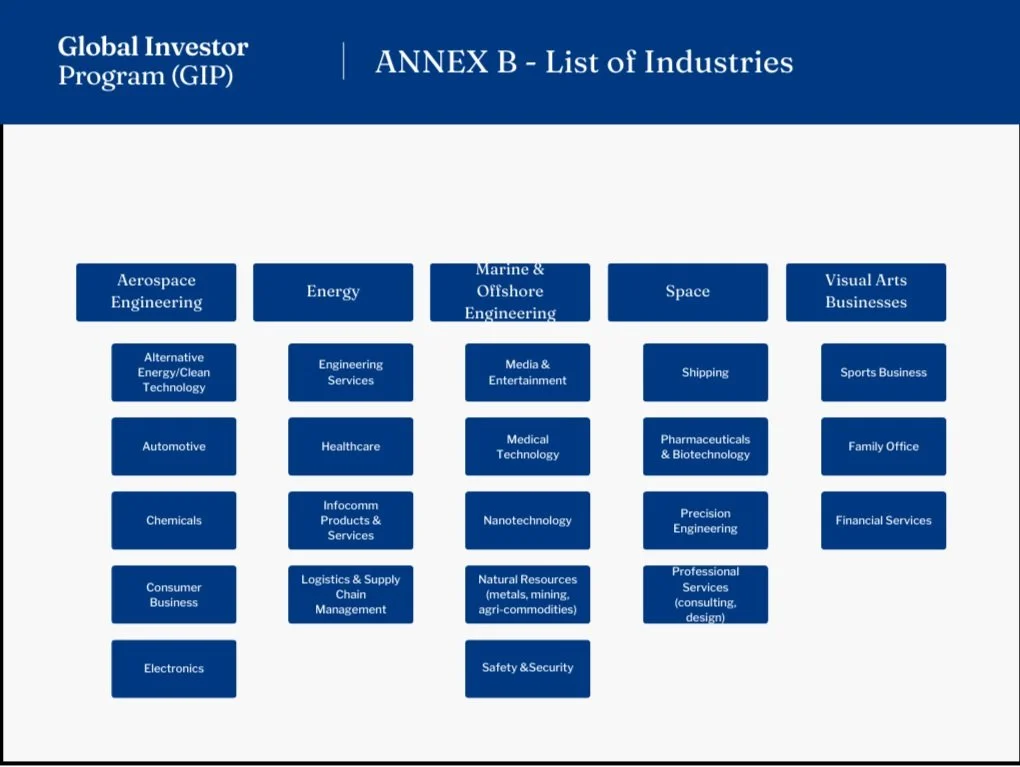
    ANNEX B: LIST OF INDUSTRIES

    Can I Sponsor My Family Members Under GIP?

    Yes. Your spouse and children under the age of 21 are eligible for PR under GIP, but male children who are granted PR status may be required to enroll in Singapore’s National Service, depending on their age.

    How To Apply For GIP ?

    Here are the steps that you need to take to get started on your GIP application:

    1. Submit an application fee of S$10,000 to the Economic Development Board (EDB) via telegraphic transfer.

    2. Download all the application forms – Application Form, Form 4, Form A, Form B, Form C, Excel spreadsheet for Family Member Details.

    3. Ensure that all your documents are translated and notarised. The date of notarization must be dated 1 year prior the GIP application submission.

    4. Submit the forms and documents online, and in hard copy to EDB within 1 month from the date of remittance of the application fee.

    5. Attend an interview with EDB representatives to discuss your application.

    6. If conditionally approved, receive Approval in Principle (AIP) status, valid for 6 months.

    7. Use this period to finalize your approved investment plans.

    8. Submit documentation to EDB to verify the completion of your investments.

    9. Upon confirmation, receive a final approval letter, confirming your Permanent Resident (PR) status in Singapore.

    Renewal Criteria For Singapore Permanent Residence (REP)

    For a 5-year renewal:

    • Option A applicants:

      1. Must fulfill the investment conditions under Option A of the GIP.

      2. Your company in Singapore must employ at least 30 employees (at least half must be Singapore Citizens), with a minimum of 10 incremental employees.

      3. You or your dependents (under your GIP application) must have resided in Singapore for more than half the time.

    • Option B applicants:

      1. Must fulfill the investment conditions under Option B of the GIP.

      2. Maintain a S$25 million investment in a GIP-select fund.

      3. You or your dependents (under your GIP application) must have resided in Singapore for more than half the time.

    • Option C applicants:

      1. Must fulfill the investment conditions under Option C of the GIP.

      2. Your Single-Family Office in Singapore must employ at least 5 incremental professionals (with at least 3 Singapore Citizens) and maintain S$50 million AUM across any of the 4 investment categories.

      3. You or your dependents (under your GIP application) must have resided in Singapore for more than half the time.

    For a 3-year renewal:

    • Option A applicants:

      1. Must fulfill the investment conditions under Option A of the GIP.

      2. Either:

        • (A) Your company in Singapore must employ at least 30 employees (with at least 10 incremental employees and half being Singapore Citizens).

        • (B) You or your dependents must have resided in Singapore for more than half the time.

    • Option B applicants:

      1. Must fulfill the investment conditions under Option B of the GIP.

      2. Either:

        • (A) Maintain a S$25 million investment in a GIP-select fund.

        • (B) You or your dependents must have resided in Singapore for more than half the time.

    • Option C applicants:

      1. Must fulfill the investment conditions under Option C of the GIP.

      2. Either:

        • (A) Your Single-Family Office in Singapore must employ at least 5 incremental professionals (with at least 3 Singapore Citizens) and maintain S$50 million AUM.

        • (B) You or your dependents must have resided in Singapore for more than half the time.

    Additional Notes:

    • Employment and economic contributions are measured incrementally from the date of final PR approval.

    • Family Office professionals must be involved in legal, tax, investment, or philanthropy-related roles.

    • Option C applicants must provide proof of their S$50 million AUM deployment in Singapore.

    Consult With Us Today

    Ready to take the next step toward securing your Permanent Residency through Singapore’s Global Investor Programme (GIP)? E&H Immigration Consultancy is here to guide you through every stage of the process.

    With our expertise in GIP applications, personalized support, and deep understanding of the investment requirements, we ensure that your journey to PR is smooth and efficient. Visit us at E&H Immigration Consultancy and let us help you achieve your PR goals through strategic investments in Singapore.

    Interested in the Global Investor Programme? E&H Immigration’s our Global Investor Programme service provides expert guidance tailored to your situation.