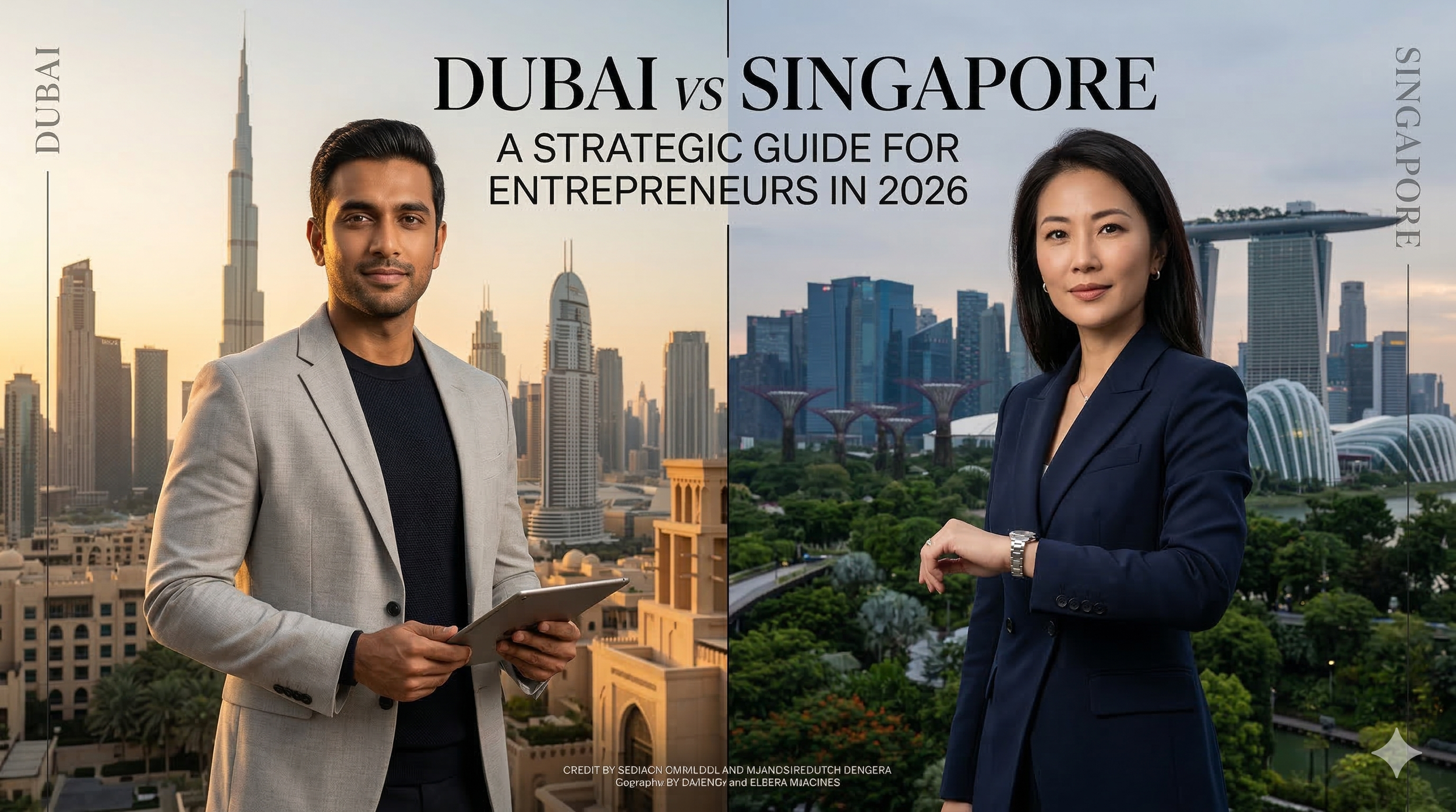
The global macroeconomic landscape in 2026 is defined by a fundamental restructuring of capital deployment, talent mobility, and supply chain logistics. As venture capital markets recalibrate toward fundamental valuations and the artificial intelligence revolution forces a reevaluation of digital infrastructure, the competition among sovereign jurisdictions to attract high-yield enterprises has intensified. At the apex of this global competition stand two distinct ecosystems: the Republic of Singapore and the United Arab Emirates (UAE), specifically anchored by Dubai.
Foreign entrepreneurs choosing to relocate or establish holding entities must strip away the marketing narratives and tourism-centric positioning of both jurisdictions. The most objective way to evaluate these two ecosystems is through a multi-dimensional analysis of the strategic sectors, capital architecture, logistical frameworks, human capital dynamics, and expatriate economics defining Singapore and the UAE in 2026. It is designed specifically for founders evaluating company incorporation in Singapore, the Singapore Employment Pass process, and long-term pathways to Singapore Permanent Residency (PR) — alongside the UAE alternative.
Whether you are a fintech founder, an e-commerce operator, or a professional services consultant, the decision of where to base your company will shape your tax position, access to capital, hiring capabilities, and personal residency options for years to come.
1. Strategic Sectoral Alignment and Economic Diversification
Foreign founders moving to the United Arab Emirates typically focus on sectors that align with the country’s strategic geographic location, tax-friendly Free Zone infrastructure, and highly aggressive economic diversification goals aimed at post-oil sustainability.
1.1 Technology, Artificial Intelligence, and Web3
Dubai has deliberately positioned itself as the primary global hub for blockchain, cryptocurrency, and Web3 enterprises. This strategy is executed through the Virtual Assets Regulatory Authority (VARA), which provides legal clarity for digital assets that is often lacking in Western jurisdictions. Tech-focused Free Zones such as the DIFC Innovation Hub, Dubai Internet City, and Dubai Silicon Oasis provide the physical and legal infrastructure for these enterprises to scale rapidly.
In contrast, Singapore’s technology sector is characterized by intense institutional depth. While it possesses a robust blockchain sector, Singapore’s regulatory apparatus — governed by the Monetary Authority of Singapore (MAS) — maintains a highly conservative, systemic-risk-averse approach to volatile retail cryptocurrency. Consequently, Singapore’s tech ecosystem heavily dominates in advanced deep-tech, biotechnology, and complex enterprise Software-as-a-Service (SaaS) models.
1.2 Fintech and Financial Services
Fintech consistently dominates venture capital investment in both ecosystems. Singapore dominates this sector at a global institutional level: as the 4th-ranked global financial centre (GFCI 38), Singapore hosts the regional headquarters of the world’s largest banks, sovereign wealth funds, family offices, and insurance conglomerates. The ASEAN financial services market, valued at approximately $60–70 billion in 2025 annual fintech deal flow, is predominantly accessible through Singapore as the primary gateway.
Dubai operates through the Dubai International Financial Centre (DIFC), which functions as an independent common-law jurisdiction with English as its operating language. The DIFC’s DFSA serves as the primary hub for institutions targeting the MENA financial market, which manages an estimated $3.5–4 trillion in assets.
1.3 E-commerce, Trading, and Logistics
Singapore’s strategic value is its function as the primary e-commerce aggregation and logistics hub for Southeast Asia (ASEAN), a market comprising approximately 600 million consumers with a combined GDP of roughly $3.8 trillion in 2025. Singapore controls the primary maritime chokepoint through the Strait of Malacca and processes approximately 20–25% of global trade by volume.
Dubai’s advantage is scale of geographic reach: the Dubai World Central and Jebel Ali Port create a combined air-sea logistics megacomplex that serves a catchment area of approximately 3 billion people across the Middle East, Africa, and South Asia (MEASA).
1.4 Real Estate, PropTech, and Construction
Dubai is an unambiguous winner for real estate investment from a purely financial returns perspective, offering gross rental yields between 6–10% on residential property (compared to 2–4% in Singapore), zero property capital gains tax, and zero foreign buyer restrictions. Singapore deliberately suppresses real estate speculation through the 60% Additional Buyer’s Stamp Duty (ABSD) levied on foreign nationals.
1.5 Tourism, Hospitality, and Luxury Services
Both ecosystems are global leaders in luxury hospitality and international tourism. Dubai welcomed approximately 17 million international visitors in 2023–2024; Singapore hosted approximately 15.5 million visitors in 2024. Neither market offers a decisive advantage, though Dubai’s lower VAT (5% vs 9% GST) marginally reduces operational friction for this sector.
1.6 Consultancy and Professional Services
Singapore’s advantage is institutional credibility: a registered Singapore Pte Ltd with an Employment Pass-holding director is immediately recognized by Fortune 500 companies and institutional investors worldwide as a credible, compliant entity. Dubai’s advantage is speed and cost: a DMCC or IFZA Free Zone company can be established in days at lower cost, with no local director requirement.
1.7 Green Energy and Manufacturing
Singapore’s government, through the Economic Development Board (EDB), is aggressively targeting advanced manufacturing as a strategic pillar, particularly in semiconductors, precision engineering, and biomedical manufacturing. The UAE has made a massive, state-directed emphasis on green energy, clean technology, and sustainability initiatives.
1.8 The Strategic Function of UAE Free Zones
When foreign founders move to the UAE, they typically establish their businesses within specific Free Zones tailored to their exact industry. These Free Zones allow for 100% foreign ownership, full and immediate repatriation of capital and profits, and significant tax exemptions.
2. Technology, AI, and Fintech: The Venture Capital & Innovation Framework
2.1 Venture Capital Deployment
Singapore captured approximately $4.2 billion in VC deal value in 2024–2025, representing approximately 78.1% of total Southeast Asian VC activity. The concentration of capital reflects the dominance of Singapore as the de facto headquarters for SEA-focused venture funds: Peak XV Partners, Temasek, GIC’s venture arm, and Vertex Ventures all maintain primary operations in Singapore.
Dubai’s VC ecosystem captured approximately $1.4 billion in 2024, though this figure is heavily skewed by mega-deal events. The primary VC sectors in Dubai are enterprise software, Web3/cryptocurrency infrastructure, and early-stage consumer technology.
2.2 Sector Specialization Data
| Index / Metric (2025 Data) | Singapore | Dubai / UAE |
|---|---|---|
| VC Deal Value Capture | ~$4.2B (78.1% of SEA market) | ~$1.4B (Heavily Mega-Deal Skewed) |
| Primary VC Sector Focus | Deep-tech, Biotech, Inst. FinTech | Enterprise Software, Web3, Crypto |
| StartupBlink Global Rank | 4th Globally (National) | 44th Globally (City) |
| Global Innovation Index (GII) | 5th Globally | 30th Globally |
| GFCI 38 Financial Rank | 4th Globally (Rating: 763) | 11th Globally (Rating: 748) |
3. Trading, E-commerce, and Logistics: The Infrastructure & Flow Framework
3.1 Logistics Performance Index
The World Bank’s Logistics Performance Index (LPI) serves as the gold standard for measuring trade execution. Singapore ranks #1 globally on the World Bank LPI. The UAE ranks #7 globally.
| Metric | Singapore | Dubai / UAE |
|---|---|---|
| World Bank Logistics Performance Index | #1 | #7 |
| Primary Market Reach | ASEAN (~600M population) | Middle East, Africa, South Asia (~3B) |
4. Real Estate and Construction: The Yield & Tax Friction Framework
4.1 Rental Yields and Market Dynamics
Dubai offers gross rental yields of 6–10% on residential property, compared to 2–4% in Singapore. Dubai’s real estate market has experienced consistent capital appreciation since 2020.
4.2 Tax Friction and Entry Barriers
Singapore deliberately suppresses real estate speculation by foreign buyers through the 60% Additional Buyer’s Stamp Duty (ABSD). A foreign entrepreneur purchasing a $2 million SGD apartment must pay an additional $1.2 million SGD in unrecoverable tax.
| Real Estate Metric | Singapore | Dubai |
|---|---|---|
| Gross Rental Yields | 2%–4% (Capital Preservation Focus) | 6%–10% (High Cash Flow Focus) |
| Property / Capital Gains Tax | Subject to standard capital frameworks | 0% |
| Foreign Buyer Tax Penalty | 60% Additional Buyer’s Stamp Duty (ABSD) | 0% (Standard 4% DLD Transfer Fee) |
5. Consultancy and Professional Services: The Talent & Ease of Business Framework
5.1 Ease of Doing Business and Bureaucratic Friction
Singapore consistently ranks as one of the world’s most business-friendly environments. ACRA’s BizFile+ portal allows a Pte Ltd company to be incorporated in as little as 1–3 business days. Dubai offers extraordinary speed for company setup within its Free Zones but involves more bureaucratic layers that routinely extend the setup timeline to 2–4 weeks.
5.2 Talent Acquisition and the GTCI 2025
The Global Talent Competitiveness Index (GTCI) 2025 ranks Singapore 1st globally for overall talent competitiveness. Dubai ranks 25th globally, though it achieves 3rd place on the “Attract” pillar — reflecting its ability to draw global talent through lifestyle and visa accessibility rather than educational infrastructure.
5.3 The 2026 Dubai 10-Year Golden Visa Evolution
Dubai’s Golden Visa programme has been significantly broadened in 2025–2026. Applicants holding a bachelor’s degree, classified as Level 1 or 2 professionals, and drawing a minimum monthly salary of AED 30,000 (approx. USD 8,100) are automatically eligible.
| Talent & Operational Metric | Singapore | Dubai / UAE |
|---|---|---|
| GTCI 2025 Rank | 1st Globally (Focus on Adaptive Skills) | 25th Globally (3rd in “Attract” Pillar) |
| Foreign Hiring Flexibility | Strict quotas (COMPASS framework), High friction | Unrestricted global hiring, Zero quotas |
| Long-Term Visa Access | Highly meritocratic, restricted permanent residency | Broad 10-year Golden Visas (Property, Salary, Skills) |
| 2026 Property Visa Hurdle | No visa through property acquisition | No 50% upfront payment needed (AED 2M threshold) |
Company Incorporation: Dubai Free Zones vs Singapore Pte Ltd
Singapore Company Incorporation (Pte Ltd)
A Singapore Private Limited company (Pte Ltd) is incorporated through ACRA via its BizFile+ portal. Key requirements include: at least one locally resident director, a registered Singapore office address, a company secretary appointed within 6 months, and a minimum paid-up capital of S$1 (S$50,000+ recommended for Employment Pass). The incorporation process typically takes 1–3 business days.
Dubai Free Zone Company Setup
Dubai’s Free Zones offer 100% foreign ownership, full profit repatriation, and zero personal income tax. There is no requirement for a local Emirati sponsor or partner. The process typically takes 2–4 weeks.
Side-by-Side Incorporation Comparison
| Factor | Singapore (Pte Ltd) | Dubai (Free Zone) |
|---|---|---|
| Formation Time | 1–3 business days | 2–4 weeks |
| Government Fees | S$315 (~US$235) | AED 15,000–35,000 (~US$4,000–9,500) |
| Foreign Ownership | 100% permitted | 100% in Free Zones |
| Corporate Tax | 17% (effective ~8.5% for first S$200K with exemptions) | 9% above AED 375,000 (0% below) |
| Personal Income Tax | 0–22% progressive | 0% |
| Local Director Required | Yes (at least one resident) | No |
| Minimum Capital | S$1 (S$50K+ recommended for EP) | AED 0–50,000 (varies by zone) |
Employment Pass Salary Requirements (2026)
For foreign entrepreneurs who plan to live and work in Singapore, the Employment Pass (EP) is the primary work visa pathway. An EP is tied to a specific Singapore-registered employer — meaning a foreign entrepreneur must incorporate a Singapore company and apply for an EP through that company.
The minimum qualifying salary for an Employment Pass in 2026 is S$5,600 per month for most sectors. For the Financial Services sector, the threshold is higher at S$6,200 per month. These thresholds increase with age.
The COMPASS Framework
Since September 2023, all new EP applications are evaluated under the Complementarity Assessment Framework (COMPASS). COMPASS is a points-based system that evaluates candidates across four criteria:
- C1 – Salary: Comparative salary against local PMET peers in the same occupation and sector.
- C2 – Qualifications: Educational background assessed against benchmarks. Top-tier university graduates receive maximum points.
- C3 – Diversity: Proportion of the company’s workforce from the same nationality as the applicant.
- C4 – Support for Local Employment: Whether the company has a track record of employing and developing Singapore Citizen and PR employees.
To pass, a candidate must score at least 40 points out of 80.
Key EP Application Requirements
- Company setup: A Singapore-registered company must apply on behalf of the candidate through MOM’s myMOM Portal.
- Qualification verification: Mandatory for all EP applications since September 2023.
- Application cost: S$105 (application) + S$225 (issuance).
- Processing time: Approximately 10 business days for straightforward cases; up to 8 weeks for complex applications.
- Validity: Up to 2 years for first-time applicants, renewable for up to 3 years.
- Dependants: EP holders earning at least S$6,000 can sponsor immediate family members; S$12,000 for parents.
EP vs Dubai Residency Visa
Dubai’s residency visa system is significantly less restrictive. A Free Zone company formation automatically entitles the founder to apply for a UAE residence visa, with no salary threshold, no points-based assessment, and no requirement to advertise the role locally.
However, Singapore’s stricter EP process is designed to attract high-calibre professionals and is widely recognised as a signal of credibility in international business. An approved EP also opens the pathway to Singapore Permanent Residency — a benefit unavailable through the UAE’s residence visa system.
Pathways to Singapore Permanent Residency for Entrepreneurs
The PTS Scheme (Professionals, Technical Personnel and Skilled Workers)
The most common PR pathway for EP holders. Applications are submitted to the Immigration & Checkpoints Authority (ICA) and are assessed holistically, with no fixed points threshold. Most successful applicants apply after 2–3 years on EP, with a demonstrated track record of growing their Singapore-based business.
The Global Investor Programme (GIP)
The GIP is designed for established entrepreneurs and business owners prepared to make a significant economic commitment to Singapore. Under the GIP, applicants must invest a minimum of S$2.5 million into a new or existing Singapore company, or into a GIP-approved fund. Applicants must have a minimum three-year track record as a business owner with annual turnover exceeding S$200 million.
EntrePass to PR
Foreign entrepreneurs who qualify for the EntrePass (for venture-backed or innovative startups) can apply for PR after the second pass renewal, typically after approximately two years of active business operations.
PR Benefits for Entrepreneurs
- Freedom to change employers or start new ventures without a fresh work pass application
- Access to CPF savings, public housing (HDB), and subsidised healthcare
- Ability to sponsor family members for PR
- Pathway to Singapore citizenship after two years of PR
- Eligibility to serve as a locally resident director for your Singapore company
Dubai comparison: The UAE’s Golden Visa programme offers 10-year renewable residency for investors, entrepreneurs, and specialised talent, but it does not provide a pathway to citizenship. Singapore’s PR system, by contrast, represents one of the world’s most valuable permanent residency pathways.
Decision Framework: Which Ecosystem Is Right for You?
| Founder Type | Key Decision Factors | Recommended Hub |
|---|---|---|
| Web3 / Crypto | Regulatory flexibility, 0% tax | Dubai |
| Deep Tech / AI | VC funding, R&D ecosystem, IP protection | Singapore |
| Fintech / Institutional Finance | Banking infrastructure, global credibility | Singapore |
| Commodity Trading | Logistics, tax efficiency, market access | Dubai |
| E-Commerce (ASEAN) | Regional market access, tech talent | Singapore |
| E-Commerce (MENA/Africa) | Logistics hub, 0% tax, regional proximity | Dubai |
| Real Estate Investment | Yield, tax, foreign buyer access | Dubai |
| Professional Services | Ease of setup, lifestyle, low cost | Dubai (cost), Singapore (credibility) |
| Long-Term Residency / PR | Permanent settlement, citizenship pathway | Singapore |
Choose Singapore if you need institutional venture capital, deep-tech R&D infrastructure, global financial credibility, strong rule of law, and a pathway to Permanent Residency and citizenship.
Choose Dubai if you prioritise zero personal income tax, regulatory flexibility, global trading access, lifestyle and real estate investment, and faster company setup with fewer restrictions on hiring.
Tax Comparison at a Glance
| Tax Type | Singapore | UAE |
|---|---|---|
| Corporate Tax Rate | 17% headline (effective ~8.5% on first S$200K under Startup Tax Exemption) | 9% above AED 375,000 (0% below threshold) |
| Personal Income Tax | 0–22% progressive | 0% |
| Capital Gains Tax | None | None |
| Dividend Tax | None | None |
| GST / VAT | 9% GST | 5% VAT |
| Double Tax Treaties | 90+ agreements | 100+ agreements |
| Startup Tax Exemption | 75% exemption on first S$100K for first 3 years | No equivalent scheme |
Singapore’s tax regime, while higher on the headline corporate rate, offers substantial benefits for startups through its Tax Exemption Scheme for New Start-Ups (SUTE). Combined with no capital gains tax, no dividend tax, and an extensive network of double taxation agreements, Singapore remains highly competitive for companies generating significant revenue.
Ready to Make Your Move? E&H Immigration Can Help
Whether you’re weighing Dubai against Singapore, or you’ve already decided that Singapore is the right base for your next venture, the immigration and incorporation process requires careful planning to avoid costly mistakes.
E&H Immigration specialises in:
- Company Incorporation Services: Full ACRA registration, company secretary provision, registered office address, and nominee director services.
- Employment Pass Applications: COMPASS scoring strategy, qualification verification, salary benchmarking, and submission through MOM’s portal.
- Permanent Residency Planning: Long-term PR strategy and application support through the PTS Scheme.
- Dependant’s Pass and Family Visas: Sponsorship for spouses, children, and parents of EP holders.
Disclaimer: This article is intended for general informational purposes only and does not constitute legal, tax, or immigration advice. Regulations, fees, and requirements referenced in this article are subject to change. Readers should consult with qualified professionals before making any business or immigration decisions.
Leave a Reply