Category: Uncategorized

  • Immigration Agency vs Immigration Consultancy in Singapore: What’s the Difference and Why It Matters

    Immigration Agency vs Immigration Consultancy in Singapore: What’s the Difference and Why It Matters

    A Singapore PR or citizenship rejection is not just a “no”. It can affect the timing of your next attempt, signal weaknesses in your profile that compound over future applications, and in some cases, narrow your long-term options for staying and settling in Singapore. Yet most rejections do not happen because an applicant missed a form. They happen because the case was not presented in its strongest form.

    When people search for help with Singapore PR, citizenship, LTVP, or work pass matters, they often use terms like “immigration agency”, “PR application agency”, or “Singapore immigration consultant” interchangeably. But there is an important difference — and that difference can shape whether your application is approved, rejected, or returned for resubmission.

    An immigration agency usually helps you process an application. An immigration consultancy helps you think through whether, when, and how to apply, and how to present your case in the strongest possible way. At E&H Immigration Consultancy, we are a consultancy. Our role is to provide strategic, case-specific immigration guidance for individuals and families who want their application properly assessed, carefully prepared, and professionally presented.

    Key Takeaways

    • An immigration agency focuses on form submission and document processing — best suited to simple, low-risk cases.
    • An immigration consultancy focuses on case strategy, profile assessment, and narrative building — best suited to Singapore PR, citizenship, appeals, and complex family situations.
    • Singapore PR and citizenship are discretionary. Two applicants with similar salaries can have very different outcomes based on family roots, integration, and long-term commitment signals.
    • E&H Immigration Consultancy is not an agency. Our work begins before any form is filled — with profile analysis, risk review, and a coherent immigration narrative.
    • Choose a consultancy if your case is complex, has been previously rejected, or involves high-stakes outcomes for your family’s future in Singapore.

    What Is an Immigration Agency?

    An immigration agency is typically focused on the administrative side of an application. This may include providing a document checklist, helping clients complete application forms, uploading documents, preparing basic cover letters, and following a standard process for submission.

    For straightforward cases, this type of support may be enough. Some applicants already know what they want to apply for, understand the eligibility requirements, and simply need help organising the paperwork. The main value of an agency is convenience.

    However, immigration applications — especially for Singapore PR and citizenship — are rarely just about paperwork. Many applicants are not rejected because they missed a form. They are rejected because their overall profile, timing, supporting evidence, and narrative were not strong enough to satisfy ICA’s discretionary assessment.

    What Is an Immigration Consultancy?

    An immigration consultancy takes a more strategic and advisory approach. Instead of asking only, “What documents do we need to submit?”, a consultancy asks deeper questions:

    • Is this the right time to apply, or should the applicant wait?
    • What are the strengths and weaknesses of the client’s profile?
    • How will the application likely be viewed against ICA approval factors?
    • What facts should be highlighted, and what risks need to be addressed?
    • Is the family profile coherent? Are the documents telling the right story?

    A consultancy does not treat every applicant the same way. A young foreign professional, a family with children in Singapore schools, a business owner, a high-income EP holder, a spouse of a Singapore Citizen, and a second-generation PR family may all require very different strategies. The form may look the same. The case strategy should not.

    How Is an Immigration Consultancy Different From an Agency?

    The table below summarises the key differences between an immigration agency and an immigration consultancy, and what those differences typically mean for the outcome of a complex case.

    Area Immigration Agency Immigration Consultancy Typical outcome (complex cases)
    Main focus Processing and submission Strategy, assessment, and positioning Submitted as-is vs. weaknesses surfaced and addressed before submission
    Approach Standardised checklist Case-specific and discretionary-aware Generic file vs. tailored case architecture
    Main value Convenience Better preparation and stronger presentation Speed of submission vs. quality of submission
    Client work Checklist and forms Profile analysis, risk review, document strategy, narrative building Documents collected vs. case constructed
    Best suited for Simple, low-risk cases Serious, complex, borderline, or high-stakes cases First-time, straightforward EPs vs. PR, citizenship, appeals, complex families
    Typical question “What documents do I need?” “How do we present this case as strongly as possible?” Compliance vs. competitive positioning

    This is the difference between a submission and a strategy.

    Why Does the Agency vs Consultancy Distinction Matter for ICA Approval?

    Singapore immigration applications are highly competitive and discretionary. For PR and citizenship, there is no simple formula that guarantees approval. ICA assesses applicants on a wide range of factors, including economic contribution, qualifications, family profile, length of stay, integration, age, industry, stability, and long-term commitment to Singapore.

    This means two applicants with similar salaries may still have very different outcomes. One applicant may earn a high income but have weak local ties, no family stability, and a short stay in Singapore. Another applicant may earn less but have stronger family roots, children studying locally, community involvement, and a clearer long-term commitment. Understanding realistic Singapore PR approval rates can help set expectations about how competitive the process actually is.

    A basic agency-style submission may not fully explain these differences. A consultancy-style approach looks at the whole person, the whole family, and the whole case — and builds a presentation around the factors most likely to move the needle on ICA’s discretionary assessment.

    Get a Professional Case Review

    Thinking of applying for Singapore PR or citizenship? Speak with E&H Immigration Consultancy before you submit. A strategic review may help you avoid mistakes that are difficult to reverse.

    Get a Free Consultation

    How Does E&H’s Consultancy Approach Differ in Practice?

    At E&H Immigration Consultancy, we do not see immigration applications as paperwork exercises. We see them as structured case presentations.

    Our work starts with understanding the client’s profile in depth. We look at the facts, the risks, the missing pieces, and the overall story the application is likely to communicate to ICA. We are not here just to submit documents — we are here to help clients understand their case, strengthen their presentation, and avoid preventable mistakes.

    To make this concrete, the case study below illustrates how the same applicant profile can produce very different outcomes depending on whether an agency approach or a consultancy approach is applied.

    Case Study: The Transient Expat vs the Integrated Resident

    The Profile — David is a high-earning IT Director who has lived in Singapore for three years. He is married with one young child.

    The Agency Approach: Focus on Paperwork

    A standard agency would collect David’s high-income payslips, his university degree, and his marriage certificate, fill out the forms, and hit submit. On paper, David looks like a successful professional. In practice, his file reads as “high earner, three years in, no roots” — a profile ICA sees thousands of times each year, and one that signals a transient expat who may leave Singapore the moment a better offer appears elsewhere.

    The E&H Consultancy Approach: Focus on Strategy

    At E&H, our review goes deeper. During profile analysis, we surface critical, often undocumented strengths that the applicant themselves may not have thought to mention:

    • David’s IT team is predominantly composed of Singaporeans whom he is actively mentoring and upskilling.
    • His child is enrolled in a local MOE kindergarten rather than an international school — a meaningful integration signal.
    • His wife volunteers regularly with a local neighbourhood charity, demonstrating community involvement beyond the household.

    The Outcome

    Instead of submitting a random pile of documents, we help David build a coherent, evidence-backed narrative. His application is positioned not just on his salary, but on his family’s tangible long-term commitment to Singapore, his economic contribution through local job creation and skills transfer, and his household’s genuine social integration. The forms are identical. The case strategy is entirely different.

    A second example — the reactive scenario. When a client comes to us after an ICA rejection, an agency might re-submit with refreshed payslips. Our review starts with what the rejection most likely signals about how the original profile was read — then rebuilds the case around addressing that read, not papering over it.

    What Does a Singapore PR Application Strategy Look Like at E&H?

    Our consultancy approach is built around five pillars. Together they answer the question: how do we move from a submission to a strategy?

    1.We Build a Clear Immigration Narrative

    A strong application should not feel like a random pile of documents. It should communicate a clear narrative — why Singapore is central to the applicant’s future, how the applicant contributes economically, how the family is rooted here, how the applicant has integrated into society, and why the application is credible and consistent. This narrative must be supported by documents, not just claims. We help clients present their case in a structured and coherent way.

    2.We Take a Strategic View of Every Case

    Every client’s profile is different. Some clients have strong income but weak family integration. Some have strong family ties but weaker employment profiles. Some have complex personal histories: previous rejections, missing documents, business ownership structures, overseas assets, divorce records, adoption issues, or children with complicated immigration timelines. A standard template cannot handle these nuances properly. We analyse each case individually and advise based on its specific circumstances.

    3.We Help Clients Understand Their Strengths and Weaknesses

    Many applicants are unsure whether their profile is strong. They wonder whether their salary is enough, whether their industry is favourable, whether they should apply alone or with family, whether they should wait longer, whether a previous rejection affects them, or whether their child’s age is a concern. These questions require judgement, not just form-filling. Our role is to help clients understand what may help or hurt their application, and how to prepare accordingly.

    4.We Use Experience, Systems, and Technology

    Immigration work requires human judgement, but good systems matter too. We have built proprietary systems that help our team review complex cases, organise large volumes of documents, and analyse interconnected facts across a client’s personal, employment, family, and immigration background. This is especially useful for applicants with multiple family members, prior rejections, complex work histories, business ownership, cross-border documentation, or special circumstances that need careful explanation. Technology does not replace experience — it helps experienced consultants work more thoroughly and consistently.

    5.Local Context Is an Active Input Into Case Strategy

    Singapore immigration matters require an understanding of local context. Knowing which MOE schools signal genuine integration, which neighbourhoods read as settled rather than transient, how CPF top-up patterns are interpreted, how local employment norms shape ICA’s view of stability — these are inputs into case strategy, not background colour. Our team is predominantly based locally, which allows us to bring this context directly into how we shape each application.

    What a Strategic Review Actually Involves

    “Strategic review” can sound abstract. In practice, our process for a Singapore PR or citizenship application moves through five clear stages:

    1. Profile mapping — We map the applicant’s full background: employment, family, education, financial, residential, and immigration history. The goal is to surface every relevant fact, including those the applicant may not have considered relevant.
    2. Risk identification — We identify the elements of the profile most likely to weaken the application: gaps in employment, short residency, weak integration signals, prior rejections, cross-border complications, or inconsistencies between documents.
    3. Narrative architecture — We construct a coherent story that connects the applicant’s economic contribution, family stability, integration, and long-term commitment to Singapore. Every piece of evidence is checked for consistency with this story.
    4. Evidence audit — We audit the supporting documents to ensure they actively reinforce the narrative, rather than passively meeting the checklist. Missing evidence is identified and addressed before submission.
    5. Submission timing recommendation — We advise on whether to submit now or wait. For some applicants, a six- or twelve-month delay materially strengthens the case. For others, applying now is the right call.

    More Than a Checklist

    Your immigration application deserves more than a checklist. Let E&H Immigration Consultancy help you assess, prepare, and present your case properly.

    Get a Free Consultation

    When Should You Choose an Immigration Consultancy Instead of an Agency?

    You should consider working with a consultancy if you are applying for Singapore PR or citizenship, have been rejected before, have a complex family situation, are unsure whether to apply now or wait, or want your application professionally reviewed before submission.

    An agency may help you submit. A consultancy helps you think. For high-stakes immigration matters, that difference can decide the outcome.

    Why Is Submission Not the Main Challenge in a Singapore PR Application?

    Many applicants focus too much on submission. They ask, “Can you help me apply?” But the better question is: “Is my application ready to be submitted in the strongest possible form?”

    Submitting too early, submitting with weak documents, using a generic cover letter, or failing to address obvious weaknesses can reduce the quality of the application. For Singapore PR and citizenship, a rejection can also affect future strategy. While a rejection does not necessarily mean the end of the road, it may require better timing, stronger evidence, and a more careful re-application plan. That is why preparation matters more than processing.

    Self-Assessment: Do You Need a Consultancy?

    Tick any of the following that apply to your situation:

    • You have been rejected before for PR, citizenship, or a work pass.
    • Your case involves business ownership, overseas assets, or cross-border income.
    • You have family members on different pass types or with complicated immigration timelines.
    • You are unsure whether to apply now or wait.
    • Your profile has obvious strengths and obvious weaknesses.
    • You have used an agency before and felt the application did not reflect your full case.
    • The outcome of this application materially affects your next 5–10 years.

    If you ticked one or more, your case is likely better served by a consultancy than a processing agency.

    Why Choose E&H Immigration Consultancy?

    Choose E&H Immigration Consultancy if you want a team that treats your application seriously. We help clients with:

    Our approach is built around strategy, clarity, and professionalism. We do not push clients to apply without first understanding the case. We believe in proper assessment, honest advice, and carefully prepared applications.

    What Should You Do Before You Submit Your Application?

    Before any Singapore PR, citizenship, LTVP, or work pass submission, three steps significantly improve your odds:

    1. Get a professional case review. An external eye will surface weaknesses you may not see in your own profile.
    2. Build the narrative before filling the forms. The forms are downstream of the strategy, not the other way around.
    3. Decide on timing deliberately. Submitting at the wrong time is a common, avoidable mistake — and one a consultancy is well-placed to help you avoid.

    Speak With E&H Immigration Consultancy

    Planning to apply for Singapore PR, citizenship, LTVP, or a work pass? Contact E&H Immigration Consultancy today for strategic immigration guidance.

    Get a Free Consultation

    FAQ: Immigration Agency vs Immigration Consultancy in Singapore

    What is the difference between an immigration agency and an immigration consultancy?

    An immigration agency usually focuses on administrative support, such as completing forms and submitting documents. An immigration consultancy provides deeper strategic advice, including profile assessment, risk analysis, document strategy, and case positioning.

    Is E&H Immigration Consultancy an immigration agency?

    No. E&H Immigration Consultancy is not an immigration agency. It is a consultancy that provides strategic immigration guidance for clients applying for Singapore PR, citizenship, LTVP, work passes, and other immigration matters.

    Why does strategy matter for Singapore PR applications?

    Singapore PR applications are discretionary and competitive. Approval does not depend only on submitting the correct forms. Factors such as income, family profile, length of stay, integration, education, industry, and long-term commitment may all matter. A strategic approach helps present the case more clearly and professionally.

    Can an immigration consultancy guarantee approval?

    No responsible immigration consultancy should guarantee approval for Singapore PR or citizenship. Final decisions are made by the authorities. However, a good consultancy can help clients avoid weak submissions, identify risks, strengthen documentation, and present their case more effectively. Be wary of approval guarantees or unlimited warranty claims.

    When should I speak to an immigration consultancy?

    You should speak to an immigration consultancy before applying if your case is complex, if you have been rejected before, if you are unsure whether now is the right time, or if you want your application to be professionally reviewed before submission.

    Is a consultancy better than an agency?

    Not always. For simple administrative help, an agency may be sufficient. But for important or complex immigration matters, a consultancy may provide more value because it looks beyond paperwork and focuses on strategy, timing, and case presentation.

    People Also Ask

    Are immigration consultants regulated in Singapore?

    There is no statutory licensing regime specifically for immigration consultants in Singapore for PR or citizenship applications. Applicants should evaluate consultancies on the basis of professionalism, transparency, methodology, and track record — not on regulatory status alone. Be cautious of any provider that guarantees approval.

    How much does a Singapore PR consultancy cost?

    Fees vary widely depending on case complexity, scope of work, and the level of strategic involvement. A consultancy that conducts deep profile analysis, narrative building, and risk review will typically cost more than a basic processing agency. The right question is not which is cheapest, but which approach matches the stakes of your case.

    Can a consultancy help after an ICA rejection?

    Yes. A consultancy can review the original application, assess what the rejection most likely signals about how the profile was read, advise on appropriate timing for re-application, and rebuild the case around addressing the underlying weaknesses. Re-applying without this analysis often produces the same outcome.

    Do I need an immigration consultant for an EP or S Pass application?

    Many EP and S Pass applications are straightforward and can be handled by the employer’s HR or a basic agency. A consultancy adds the most value when the case is borderline, when there are prior refusals, when the role or salary sits at the edge of qualifying thresholds, or when the application has implications for a future PR or citizenship strategy.

    What are the most common reasons Singapore PR applications get rejected?

    Common contributing factors include short residency, weak family or community integration, profiles that signal transience, inconsistent or insufficient supporting evidence, applying at a time when industry or age factors work against the applicant, and submissions that do not address obvious profile weaknesses. Most of these are addressable through a strategic review before submission.

  • Differences Between the Long-Term Visit Pass (LTVP) and the Long-Term Visit Pass-Plus (LTVP+)

    Differences Between the Long-Term Visit Pass (LTVP) and the Long-Term Visit Pass-Plus (LTVP+)

    Updated 19 April 2026

    People often compare the Long-Term Visit Pass (LTVP) and LTVP+ as if they are simply a basic version and a premium version of the same pass. In practice, that is too simplistic.

    In Singapore, the word “LTVP” can refer to different pass frameworks depending on who is sponsoring the applicant and which authority is handling the case. Some applications fall under the Ministry of Manpower (MOM). Others fall under the Immigration & Checkpoints Authority (ICA). LTVP+ is a separate ICA status with enhanced benefits for some foreign spouses of Singapore Citizens.

    If you are trying to decide which route applies to you, the first question is not “Do I want LTVP or LTVP+?” It is “Am I applying under MOM or ICA, and what relationship does Singapore recognise for that route?”

    Quick Answer: What Is The Difference Between LTVP And LTVP+?

    MOM-issued LTVP is usually for certain family members of eligible work pass holders, such as a common-law spouse, step-child, handicapped child above 21, or in some cases parents.

    ICA-issued LTVP is usually for family-based cases connected to a Singapore Citizen or Permanent Resident, as well as a few other ICA categories such as certain graduates seeking employment or parents accompanying a child studying in Singapore.

    LTVP+ is not available for every LTVP holder. It is a more favourable ICA pass that is generally aimed at foreign spouses of Singapore Citizens who meet ICA’s criteria. It usually offers a longer stay period, easier work arrangements, and better public healthcare support than a standard LTVP.

    The Most Important Distinction: MOM LTVP vs ICA LTVP

    Issue MOM LTVP ICA LTVP LTVP+
    Main authority Ministry of Manpower Immigration & Checkpoints Authority Immigration & Checkpoints Authority
    Typical sponsor Eligible EP or S Pass holder, through employer-backed MOM process Singapore Citizen, Permanent Resident, or other qualifying local sponsor depending on category Singapore Citizen spouse
    Common examples Common-law spouse, step-child, handicapped child above 21, parents in qualifying cases Legally married spouse, child, parent, certain graduates, parent or grandparent accompanying a Student’s Pass holder Eligible foreign spouse of a Singapore Citizen
    Validity Tied to the main work pass or shorter if MOM grants a shorter period Usually granted based on the ICA category and case facts Typically 3 years initially, with renewals of up to 5 years
    Work options Depends on the LTVP category and separate work authorisation rules Some holders can work with an LOC or PLOC; others need a regular work pass Usually the most flexible route for work among the three
    Healthcare support No special public subsidy scheme simply because you hold the pass No automatic upgrade to subsidised healthcare just because you have an ICA LTVP Access to subsidised inpatient care at restructured hospitals, subject to the applicable rules

    Updated using official ICA and MOM guidance checked on 19 April 2026.

    What “Common-Law Spouse” Actually Means

    This is one of the most misunderstood parts of the MOM LTVP route.

    A common-law spouse is not simply a boyfriend, girlfriend, fiancé, fiancée, or partner you have been living with. For MOM, the relationship generally needs to be recognised under the laws of the couple’s home country or region.

    Examples of situations that may fit the MOM common-law spouse category include:

    • A couple who can produce a common-law marriage certificate issued in the relevant jurisdiction.
    • A couple whose home country legally recognises a common-law union, and who can provide a notarised affidavit confirming that recognised status.
    • A couple who can obtain a letter from their embassy confirming that their relationship is recognised under their home-country law.

    Examples that are usually not enough on their own include:

    • Just living together in Singapore or overseas without legal recognition in the relevant country.
    • Being engaged but not legally married.
    • Having a long dating history, shared travel, or photos without the legal recognition MOM asks for.

    This matters because applicants often assume that “common-law spouse” means any serious unmarried partner. That is not how MOM normally uses the term for LTVP purposes.

    By contrast, for the ICA spouse route, the usual expectation is a legally recognised marriage. If you are relying on a customary marriage or overseas marriage, you generally need proof that the marriage is recognised in the country where it took place.

    Who Can Actually Be Considered For LTVP+?

    LTVP+ is commonly described as an “upgrade”, but it is better understood as a different ICA status with stricter eligibility expectations.

    In general, ICA considers LTVP+ for foreign spouses of Singapore Citizens. It is not a broad benefit for every ICA LTVP holder, and it is not the standard route for all PR-sponsored spouse cases.

    Factors ICA has publicly highlighted include:

    • Whether the couple has at least one Singapore Citizen child.
    • Whether the foreign spouse is pregnant.
    • The duration and stability of the marriage.
    • The sponsor’s ability to financially support the family.
    • The conduct of both the sponsor and the applicant.

    That does not mean a person automatically gets LTVP+ just because they are married to a Singapore Citizen. ICA still assesses the case on its own merits.

    Work Rights: Another Area Where People Get Confused

    Many applicants assume that an LTVP lets them work freely. That is not accurate.

    For ICA-issued LTVP or LTVP+ holders who are spouses or children under 21 of Singapore Citizens or Permanent Residents, work is often possible through a Letter of Consent (LOC). During application or renewal, some applicants may also have the option of a Pre-Approved Letter of Consent (PLOC), which can make it easier to take up employment later.

    However, not every LTVP holder gets the same work flexibility. For example, parents on LTVP generally do not get the same LOC/PLOC pathway and may instead need a regular Work Permit or another standard work pass if they wish to work.

    This is one reason LTVP+ is often seen as more attractive than a standard LTVP for an eligible foreign spouse: the work pathway is usually smoother.

    What Healthcare Benefits Does LTVP+ Actually Provide?

    The phrase “healthcare benefits” is often used too vaguely, so it helps to be precise.

    For eligible LTVP+ holders, the key benefit is access to subsidised inpatient treatment at Singapore restructured hospitals. ICA has said these subsidy levels are set close to Permanent Resident rates for inpatient ward classes where subsidies apply.

    In practical terms, this usually means:

    • Potentially lower bills for hospital admissions in subsidised wards.
    • Possible subsidies for inpatient-related treatment under the applicable public-hospital framework.
    • Means-testing may still apply for the relevant ward classes.

    Just as important is what LTVP+ does not automatically give:

    • It does not mean all outpatient care becomes subsidised.
    • It does not make the holder the same as a Singapore Citizen for healthcare purposes.
    • It does not remove the need to think about private health insurance or an appropriate integrated shield plan.

    For a standard LTVP, there is generally no special public-healthcare subsidy framework just because you hold the pass. As a result, families often rely more heavily on employer coverage, private insurance, or out-of-pocket payment planning.

    Which Route Usually Makes More Sense?

    If you are the legally married spouse of a Singapore Citizen, an ICA LTVP is usually the starting point, with LTVP+ being the more favourable outcome if you meet ICA’s criteria.

    If you are the unmarried but legally recognised common-law spouse of an EP or S Pass holder, your case usually sits under the MOM LTVP route instead.

    If you are looking at the issue purely from a long-term family-settlement perspective, LTVP+ is generally the stronger position because it offers better stability, better work arrangements, and more meaningful healthcare support than a standard LTVP.

    But the stronger route is only useful if it is the correct route. Filing under the wrong framework wastes time and can create avoidable delays.

    FAQ

    Can a common-law spouse apply for an ICA LTVP?

    Usually, the ICA spouse route is based on a legally recognised marriage. A common-law relationship is more commonly relevant to the MOM LTVP route for eligible work pass holders. If you are relying on a customary or overseas marriage, you should be ready to show that it is legally recognised where it took place.

    Can a Singapore PR sponsor a spouse for LTVP+?

    LTVP+ is generally positioned as a scheme for the foreign spouse of a Singapore Citizen. A PR-sponsored spouse may still qualify for an ICA LTVP, but should not assume that LTVP+ is automatically available.

    How long does an LTVP application usually take?

    ICA states that many spouse-of-Singapore-Citizen cases are processed in about 6 weeks, especially where a Pre-Marriage LTVP Assessment (PMLA) was done. Some cases can take much longer, including up to 6 months if there was no PMLA or if further review is needed.

    When can I renew an LTVP?

    You can usually submit an LTVP renewal application up to 3 months before expiry. Do not wait until the very last moment, especially if you need time to gather updated relationship or sponsor documents.

    What happens if my LTVP renewal is still pending when the pass expires?

    Where applicable, ICA may regularise the stay by converting the holder to a Short-Term Visit Pass (STVP) while the renewal outcome is pending. The exact handling still depends on the case, so it is best not to leave renewal until the pass is about to lapse.

    Does LTVP+ mean I can work automatically?

    Not exactly. LTVP+ generally gives a better work pathway, but the holder still needs the proper work authorisation, usually through an LOC or PLOC where eligible.

    What are the healthcare benefits of LTVP+ in plain English?

    In plain English, it mainly means better access to subsidised inpatient treatment at public restructured hospitals than an ordinary foreigner would usually get. It does not mean full outpatient subsidies or Singapore-Citizen-level healthcare benefits across the board.

    Need help with your LTVP application? E&H Immigration’s LTVP service helps families choose the correct route, prepare supporting documents, and avoid common mistakes.

  • Singapore Long-Term Visit Pass (LTVP): Ultimate Guide to Eligibility, Documents and Application

    Singapore Long-Term Visit Pass (LTVP): Ultimate Guide to Eligibility, Documents and Application

    If you want to stay in Singapore for longer than a short visit, the Long-Term Visit Pass (LTVP) may be relevant to your case.

    In Singapore, the term “LTVP” is often used broadly, but not every LTVP application follows the same rules. Some applications are handled by the Immigration & Checkpoints Authority (ICA), while others fall under the Ministry of Manpower (MOM). The right route depends on who is sponsoring the application and the applicant’s relationship to that sponsor.

    This matters because the eligibility criteria, supporting documents, sponsorship requirements and application process can be quite different. Many applicants become confused because online information often mixes the two frameworks together.

    This guide explains the main LTVP routes in Singapore, who may qualify, what documents are usually needed, how the application process works, and some of the most common mistakes to avoid.

    What is the Long-Term Visit Pass in Singapore?

    The Long-Term Visit Pass is a pass that allows certain foreign nationals to stay in Singapore for longer than a short-term visit.

    It is commonly used in family-related situations, but it can also apply in certain other categories depending on the applicant’s circumstances. In many cases, it is relevant where the person does not qualify for permanent residence, is not entering Singapore on a work pass of their own, and needs a lawful basis to stay in Singapore for a longer period.

    An LTVP is not the same as Singapore Permanent Residence. It also does not automatically give the holder the same rights as a permanent resident or work pass holder. What the pass allows you to do depends on the type of LTVP, the issuing authority, and your own circumstances.

    ICA LTVP vs MOM LTVP: the difference many applicants miss

    One of the most important first steps is to understand whether the application falls under ICA or MOM.

    In general, if the application is based on a relationship to a Singapore citizen or permanent resident, ICA is often the relevant authority. If the application is based on a relationship to an eligible work pass holder, the case will usually fall under MOM’s family-pass framework instead.

    Topic ICA-issued LTVP MOM-issued LTVP
    Typical use case Family and other eligible long-stay categories handled by ICA Certain family members of eligible work pass holders
    Typical sponsor Singapore citizen, permanent resident, or local sponsor depending on category Main work pass holder, usually through employer-backed MOM process
    Common examples Foreign spouse of SC, child of SC or PR, parent of SC or PR, and some special ICA categories Common-law spouse, step-child, handicapped child, or parents where MOM rules and salary thresholds are met
    Common mistake Assuming every family case belongs under ICA Assuming every spouse-related case should use MOM or LTVP rather than another pass type

    Many delays and misunderstandings start here. People often assume that “LTVP” means one single pass with one single set of rules. That is not how it works in practice.

    Who can qualify for an ICA-issued LTVP?

    The exact category matters, but some of the more common ICA-issued LTVP pathways include the following.

    Foreign spouse of a Singapore citizen

    This is one of the most common ICA LTVP pathways. A foreign spouse of a Singapore citizen may be eligible to apply, but approval is not automatic. ICA will usually look at the overall circumstances of the case and the supporting documents submitted.

    Child of a Singapore citizen or permanent resident

    An unmarried child under 21 years old who was born within a legal marriage to, or legally adopted by, a Singapore citizen or permanent resident may be eligible, depending on the facts of the case and the route being used.

    Parent of a Singapore citizen or permanent resident

    In some cases, a parent of a Singapore citizen or permanent resident may also be eligible, subject to the relevant sponsorship requirements and ICA’s criteria.

    Other ICA-administered categories

    There are also some other categories that may fall under ICA’s long-stay framework, depending on the individual situation. These can include certain graduates from local institutes of higher learning seeking employment, or a parent or grandparent linked to a child studying in Singapore on a Student’s Pass.

    Because of this, it is not accurate to reduce ICA LTVP cases to only “spouse, child, or parent.” Those are common routes, but they are not the only ones.

    Who can qualify for a MOM-issued LTVP?

    MOM-issued LTVPs are different from ICA-issued LTVPs. These are usually relevant where the main person in Singapore holds an eligible work pass and wants certain family members to stay in Singapore.

    The main pass holder will generally need to hold an eligible pass, such as an Employment Pass or S Pass, and the relevant salary and sponsorship conditions must be met.

    Depending on the case, eligible family members may include:

    • a common-law spouse
    • an unmarried step-child under 21
    • an unmarried handicapped child above 21
    • parents, where the applicable salary threshold is met

    This is why it is important not to combine ICA and MOM rules into one generic list. The route for the spouse of a Singapore citizen is different from the route for the family member of an Employment Pass holder, even though both situations may involve the term “LTVP.”

    Documents commonly needed

    The exact documents depend on the route and the category, but in most cases the supporting documents fall into four main groups.

    1. Identity documents

    • The applicant’s passport biodata page
    • The sponsor’s identity card or immigration pass details, where relevant
    • A recent passport-sized photograph, if required

    2. Relationship documents

    These help show how the applicant is related to the sponsor. Depending on the case, they may include:

    • Marriage certificate
    • Birth certificate
    • Adoption papers
    • Documents showing a common-law relationship
    • Records relating to a step-child relationship

    3. Sponsor and support documents

    These are often used to show the sponsor’s status in Singapore and ability to support the application. Depending on the route, they may include:

    • Proof of the sponsor’s citizenship, permanent residence, or valid pass status
    • Proof of employment or income
    • Supporting declarations or letters where required

    4. Case-specific supporting documents

    Some applications need more than the standard identity and relationship documents. These may include:

    • Certified translations for non-English documents
    • Additional supporting records for a spouse-related case
    • Evidence of family relationship history
    • Custody-related documents
    • Clarification documents requested by ICA or MOM after submission

    It is usually better to prepare the documents carefully from the start than to rush the filing and deal with preventable requests for more information later.

    How to apply for an ICA LTVP

    Step 1: Confirm the correct ICA route

    Before doing anything else, make sure the case actually falls under ICA and identify the right category. For example, the route for a foreign spouse of a Singapore citizen is different from other ICA-administered long-stay categories.

    Step 2: Prepare the sponsor’s access and supporting documents

    In many cases, the Singapore citizen, permanent resident, or local sponsor will need to log in through the relevant ICA e-service and support the application.

    Step 3: Consider the Pre-Marriage LTVP Assessment, where relevant

    If the case involves a Singapore citizen and an intended foreign spouse who is not yet married, the Pre-Marriage LTVP Assessment (PMLA) can sometimes help the couple understand their likely position before marriage and may be useful for planning purposes.

    Couples who complete the free PMLA before applying can significantly reduce ICA processing times — from up to 6 months down to approximately 6 weeks.

    Step 4: Submit the application online

    Once the route and documents are ready, the application is typically submitted online together with the required fee.

    Step 5: Monitor the application and respond if more documents are requested

    Some cases move smoothly, while others may require clarifications or additional evidence. Responding promptly and clearly can help avoid unnecessary delay.

    Step 6: Complete post-approval formalities

    If the application is approved, there may be further steps to complete, such as payment of the issuance fee and card issuance formalities.

    How to apply for a MOM LTVP

    Step 1: Check eligibility under MOM’s framework

    Start by confirming that the main work pass holder is eligible to sponsor the relevant family member under MOM’s rules.

    Step 2: Prepare the required supporting documents

    The documents required will depend on the family relationship and the status of the main pass holder.

    Step 3: Submit the application through the correct MOM process

    This is usually done through the employer or an authorised filing channel, depending on the company’s internal process and the pass type involved.

    Step 4: Pay the relevant fees and monitor the case

    After submission, the applicant or sponsor should monitor the case and respond quickly if MOM requests further information.

    Step 5: Complete issuance formalities after approval

    If approved, the final issuance steps must be completed before the pass is formally issued.

    Fees and processing times

    Fees and timelines vary depending on the route and the category. Because fees and timelines can change, it is always better to check the latest official requirements before filing.

    ICA application fees

    ICA Fee Component Amount
    Application (processing) fee S$45 (non-refundable)
    Issuance fee (upon approval) S$60
    Multiple Journey Visa (if applicable) S$30

    Processing times can vary. While some applications finish in a matter of weeks, complex family-based applications (such as spouses of Singapore Citizens) can take up to 6 months. However, couples who complete the free Pre-Marriage LTVP Assessment (PMLA) beforehand can reduce this to approximately 6 weeks. Normal cases can be as fast as 4 weeks or less.

    MOM application fees

    MOM Fee Component Amount
    Application fee (per pass) S$105
    Issuance fee (upon approval) S$225
    Multiple Journey Visa (if applicable) S$30

    MOM timelines are generally faster but depend on the main sponsor’s pass type. Applications for dependants of EP and S Pass holders are typically processed within 3 to 4 weeks. Dependants of PEP or EntrePass holders may take up to 8 weeks. Published processing times are usually indicative, not guaranteed.

    Can an LTVP holder work in Singapore?

    This is one of the most common practical questions. The answer depends on the type of LTVP and the rules that apply to that holder. An LTVP does not automatically mean the person can work freely in Singapore.

    LTVP Holder Category Work Authorisation Route Key Details
    ICA LTVP / LTVP+ (Spouses & unmarried children under 21 of Citizens/PRs) Letter of Consent (LOC) or Pre-approved LOC (PLOC) Most flexibility. Employer applies for LOC, or holder opts for PLOC at application/renewal. Restricted professions still require a standard LOC.
    ICA LTVP (Parents of Citizens/PRs) Standard Work Permit only Not eligible for LOC or PLOC. Employer must apply for a Work Permit. Counted under employer’s foreign worker quota.
    ICA LTVP (Parents accompanying a student) Standard Work Permit (after 1 year) Strictly prohibited from working during the first year. After one year, employer must apply for a standard Work Permit.
    MOM LTVP (Family of EP/S Pass holders) Must independently qualify for EP, S Pass, or Work Permit No access to LOCs. Must find an employer willing to hire and qualify for a work pass entirely on their own merit.

    ICA LTVP / LTVP+ holders (spouses and unmarried children under 21 of Citizens/PRs)

    These individuals have the most flexibility. They can work legally if an employer applies for a Letter of Consent (LOC) on their behalf. Alternatively, when applying for or renewing this specific LTVP with ICA, applicants can opt for a Pre-approved Letter of Consent (PLOC). A PLOC allows the holder to work in Singapore without needing to secure a job first, though certain restricted professions (such as journalism or religious occupations) will still require a standard LOC.

    ICA LTVP holders (parents of Citizens/PRs)

    Parents holding an LTVP are not eligible for an LOC or PLOC. To work, their prospective employer must apply for a standard Work Permit. They will be counted under the employer’s overall foreign worker quota and are subject to standard levies.

    ICA LTVP holders (parents accompanying a student)

    If you are holding an LTVP to accompany a child studying in Singapore, you are strictly prohibited from working during your first year in the country. After one year has passed, you may find a job, but your employer must apply for a standard Work Permit for you.

    MOM LTVP holders (family of EP / S Pass holders)

    Common-law spouses, step-children, or parents holding a MOM-issued LTVP do not have access to LOCs. To work in Singapore, they must find an employer willing to hire them and qualify for an Employment Pass, S Pass, or Work Permit entirely on their own merit.

    Common mistakes applicants make

    Using the wrong framework

    One of the most common mistakes is following ICA guidance for a case that should go through MOM, or vice versa.

    Assuming approval is automatic

    Marriage to a Singapore citizen or a qualifying family relationship does not automatically guarantee approval. The overall application still needs to be properly prepared and supported.

    Submitting weak or inconsistent documents

    Relationship documents, sponsor records, and supporting evidence should all be consistent. Gaps, contradictions, or weak evidence can create avoidable problems.

    Relying on generic online summaries

    A broad internet article may not match your exact category. What applies to one applicant may not apply to another.

    Confusing LTVP with other passes

    Applicants sometimes confuse the LTVP with LTVP+, Dependant’s Pass, or other family-related immigration routes. That can lead to the wrong expectations from the start.

    Leaving the matter too late

    Late renewals, missing records, and last-minute document gathering can create unnecessary pressure and delay.

    When professional guidance can help

    Some LTVP cases are straightforward. Others are more sensitive than they appear.

    Professional guidance can be useful where there is uncertainty over the correct route, concerns about eligibility, prior immigration issues, weak relationship evidence, sponsorship questions, or a more complicated family situation.

    A proper review can help you identify the correct framework, prepare the right documents, avoid filing mistakes and understand the likely process more clearly.

    Frequently asked questions

    Is LTVP the same as Permanent Residence?

    No. An LTVP is a long-stay pass for specific categories of applicants. It is not the same as Singapore Permanent Residence.

    Is there only one type of LTVP in Singapore?

    No. In practice, people often use “LTVP” to refer to different routes, including ICA-issued and MOM-issued LTVP frameworks.

    Can a Singapore citizen sponsor a foreign spouse for an LTVP?

    Yes, that is one of the more common ICA pathways, but approval is not automatic and the application still needs to be properly supported.

    Can work pass holders bring family members on an LTVP?

    Some eligible work pass holders can sponsor certain family members under MOM’s framework, subject to the relevant rules and salary thresholds.

    Can an LTVP holder work in Singapore?

    It depends on the type of LTVP and the applicable work authorisation rules. Some holders can apply for a Letter of Consent, while others must qualify for a separate work pass independently. See the detailed breakdown in the work authorisation section above.

    What is the PMLA and should I complete it?

    The Pre-Marriage LTVP Assessment (PMLA) is a free assessment available to couples where one partner is a Singapore citizen and the other is a foreign national not yet married. Completing it can give you an early indication of the likely outcome and can significantly speed up processing times for the subsequent LTVP application — from up to 6 months down to approximately 6 weeks.

    How much does an LTVP application cost?

    ICA applications currently involve a S$45 processing fee, a S$60 issuance fee upon approval, and a possible S$30 Multiple Journey Visa fee. MOM applications involve a S$105 application fee, a S$225 issuance fee, and a possible S$30 Multiple Journey Visa fee. Fees are subject to change, so it is best to verify the latest amounts before filing.

    Conclusion

    The first step in any LTVP case is to identify the correct route.

    If the application is based on a relationship to a Singapore citizen or permanent resident, ICA may be the relevant starting point. If the application is based on a relationship to an eligible work pass holder, MOM may be the relevant framework instead.

    Once the correct route is clear, it becomes much easier to prepare the right documents, follow the right process and avoid common mistakes.

    Need help with your LTVP application? E&H Immigration’s LTVP application service provides expert guidance across ICA and MOM routes to help you get the right outcome.

  • Singapore PR Eligibility Criteria: Who Can Apply and What ICA Looks For

    Singapore PR Eligibility Criteria: Who Can Apply and What ICA Looks For

    Disclaimer: This article is for general information only. ICA assesses all PR applications holistically at its own discretion. For the latest official requirements, refer to the ICA website.

    Quick Answer
    Singapore PR is open to six main applicant groups recognised by ICA: (1) Employment Pass or S Pass holders, (2) spouses of Singapore citizens or PRs, (3) unmarried children under 21 of citizens or PRs, (4) aged parents of Singapore citizens, (5) eligible students studying in Singapore, and (6) qualifying investors under the Global Investor Programme.

    Meeting eligibility requirements allows you to apply, but does not guarantee approval. ICA assesses every application holistically based on factors including economic contribution, qualifications, family ties, length of residency, and commitment to settling in Singapore.

    In this article:

    Eligibility Comparison Table

    The table below summarises the six ICA-recognised applicant categories, who sponsors or submits each application, and key notes for each pathway.

    Applicant Type Eligible to Apply? Who Submits / Sponsors Notes
    EP or S Pass holder Yes Applicant (via Singpass) Most common professional pathway. Eligibility alone does not indicate approval likelihood.
    Spouse of SC or PR Yes SC/PR spouse sponsors Genuine family unit and long-term settlement intentions are relevant to assessment.
    Unmarried child under 21 of SC or PR Yes SC/PR parent sponsors Child must be born within a legal marriage or legally adopted.
    Aged parent of SC Yes SC child (aged 21+) sponsors Note: Parents of PRs are not listed as eligible under this category.
    Student studying in SG Yes Applicant (Singpass if 15+; non-Singpass if under 15) Must have passed at least one national exam (PSLE, GCE N/O/A) or be in the Integrated Programme.
    Foreign investor (GIP) Yes Via EDB Applicants are directed to the Economic Development Board for programme details and assessment.

    What Is Singapore PR?

    A Singapore Permanent Resident is a foreigner who has been granted permanent residence status, allowing them to reside in Singapore on a permanent basis. PRs aged 15 and above are issued a blue Singapore Identity Card, and PRs who wish to travel out of Singapore and return must hold a valid Re-Entry Permit (REP).

    For many applicants, PR is an important step because it offers greater long-term stability, including the ability to work for any employer without a separate work pass, access to public housing (HDB flats), and participation in the Central Provident Fund (CPF) system. It can also be a meaningful milestone for individuals and families who intend to build their future here.

    It is worth noting that PR status comes with obligations as well as benefits. PRs are required to make CPF contributions (employee and employer), and male PRs or their male dependants may be liable for National Service. PRs must also maintain a valid Re-Entry Permit if they travel, as the permit must be renewed periodically and renewal is not automatic.

    Official ICA Eligibility Categories for Singapore PR

    1. Employment Pass and S Pass Holders

    Employment Pass and S Pass holders are one of the main applicant groups recognised by ICA. If you fall into this category, you submit your PR application through the ICA e-Service using your Singpass.

    This is the most common pathway for professionals working in Singapore. However, holding an EP or S Pass by itself does not mean approval is likely. ICA still assesses the broader profile of the applicant, including economic contribution, qualifications, age, and length of residency.

    2. Spouses of Singapore Citizens or Permanent Residents

    Foreign spouses of Singapore citizens or Singapore permanent residents may also apply for PR. In these cases, the Singapore citizen or PR spouse typically sponsors the application by logging in to the ICA e-Service using Singpass.

    ICA considers family ties to Singaporeans as part of its assessment. A genuine family unit and long-term settlement intentions can be relevant to how the application is viewed.

    Related reading: Singapore PR for families.

    3. Unmarried Children Below 21

    An unmarried child below 21 may be eligible if the child was born within the context of a legal marriage to, or has been legally adopted by, a Singapore citizen or PR. The parent sponsors the application through the ICA e-Service.

    4. Aged Parents of Singapore Citizens

    An aged parent of a Singapore citizen aged at least 21 may also apply for Singapore PR. In this category, the Singapore citizen child sponsors the application.

    Important: ICA lists aged parents of Singapore citizens, not parents of PRs, as an eligible category. This is a common source of confusion.

    5. Students Studying in Singapore

    This is an eligibility pathway that is often overlooked. ICA states that a student studying in Singapore may be eligible to apply if the student has passed at least one national exam, such as the PSLE or GCE N, O or A levels, or is in the Integrated Programme (IP).

    Students aged 15 and above can submit the application using their Singpass. Students below 15 can submit via the non-Singpass option on the ICA e-Service.

    For families and student applicants, this category is important because it is an official ICA route, not just a practical workaround or special-case exception.

    6. Foreign Investors Under the Global Investor Programme

    Foreign investors may apply for PR under Singapore’s Global Investor Programme (GIP). ICA directs applicants to the Singapore Economic Development Board (EDB) for details on the programme, assessment criteria, and application process.

    What ICA Looks At Beyond Basic Eligibility

    One of the biggest misunderstandings about Singapore PR is that many people treat eligibility and approval as the same thing. They are not.

    ICA states that it takes into account factors such as family ties to Singaporeans, economic contributions, qualifications, age, family profile, length of residency, and the applicant’s ability to contribute to and integrate into Singapore society, as well as commitment to sinking roots.

    In practical terms, ICA is not just asking “Can this person apply?” It is also asking “Does this person look likely to build a genuine long-term future in Singapore?”

    Employment Stability and Income Consistency

    ICA does not publish a simple public rule such as “you must work six months” or “you must earn a fixed salary amount” on its PR eligibility page. But in practice, applicants benefit from being able to show a stable job, consistent income, and a clear economic role in Singapore.

    For work pass holders, this usually means that a stronger PR application is built around a coherent employment profile rather than a rushed filing with limited supporting history.

    Qualifications and Professional Profile

    ICA explicitly lists qualifications as one of the factors it considers. Educational background, professional certifications, and specialised skills can help support a case, especially if they align with the applicant’s career path in Singapore.

    Family Profile and Ties to Singapore

    Family ties matter, especially where the applicant has a Singapore citizen or PR spouse, child, or parent. ICA also refers to family profile more broadly, which suggests that the authorities consider the applicant’s personal and family situation as part of the overall picture.

    Length of Residency and Commitment to Sinking Roots

    ICA expressly mentions length of residency and commitment to sinking roots in Singapore. That does not mean there is a single published number of months or years that guarantees success. It does mean that applicants should be able to show a credible long-term connection to Singapore rather than a short-term or purely opportunistic presence.

    Evidence of community involvement, property ownership, children enrolled in local schools, and other integration markers can support this aspect of the application.

    National Service Obligations for Male Applicants

    Prospective applicants should be aware that all male Singapore citizens and permanent residents are required to serve National Service (NS) under the Enlistment Act 1970, unless exempted.

    This is particularly relevant for male applicants who are granted PR as students or under parental sponsorship. They are required to register for NS upon reaching 16 and a half years old and will be scheduled for enlistment at the earliest opportunity upon reaching 18. MINDEF allows students to complete pre-tertiary education (up to A Levels, polytechnic diploma, or equivalent) before enlistment, but does not grant deferment for university studies.

    Renouncing or losing PR status without serving or completing full-time NS will have serious adverse consequences on future applications to work, study, or reside in Singapore, and may also affect family members’ immigration applications.

    Families considering PR applications involving male dependants should factor NS obligations into their planning. For full details, ICA directs applicants to the CMPB website.

    Documents Commonly Needed for a Singapore PR Application

    ICA publishes a document checklist for PR applications. The exact documents required depend on the applicant category. Below is a summary organised by document type.

    Identity and Personal Documents

    Passport-sized photo (400 x 514 pixels, white background), passport or travel document, and birth certificate or household register where applicable.

    Relationship Documents

    Marriage certificate (if applicable), adoption papers (if applicable).

    Education and Skills Documents

    Educational certificates and transcripts, skill certificates or professional licences.

    Employment and Financial Documents

    Current letter of employment stating occupation, date of employment, and salary details; payslips from the last 6 months; latest 3 years’ income tax assessments or receipts if working overseas. Self-employed applicants should prepare business registration documents, balance sheets, and profit and loss statements.

    ICA may request additional supporting documents during the assessment process, even if they are not listed in the published checklist. If your documents are not in English, ICA requires official translations.

    Singapore PR Fees and Processing Time

    Fee Type Amount
    Application fee (per applicant, at submission) S$100
    Entry Permit (upon approval) S$20
    Re-Entry Permit, 5-year (upon approval) S$50
    Singapore Identity Card (upon approval) S$50

    All fees are non-refundable.

    For processing time, ICA states that PR applications will be processed within 6 months, provided all required documents are submitted and are in order. In practice, more complex cases — such as family unit applications or profiles requiring additional verification — may take longer. Applicants should plan accordingly and avoid making irreversible decisions (such as resigning from a position) based on an assumed approval timeline.

    How the Singapore PR Application Process Works

    Step 1: Confirm Your Eligibility Category

    Start by identifying which ICA category you fall under. This matters because the route, sponsoring party, and supporting documents may differ depending on whether you are applying as a work pass holder, spouse, child, parent, student, or investor.

    Step 2: Prepare Your Supporting Documents

    Gather the documents relevant to your category, including identification, relationship documents where applicable, employment records, educational records, and any required translations.

    Step 3: Submit Through the ICA e-Service

    ICA states that PR applications are submitted online through the ICA e-Service. Depending on the category, the applicant or sponsor logs in with Singpass to complete the filing.

    Step 4: Pay the Application Fee

    At submission, the application fee is S$100 per applicant. Payment is made online via credit/debit card, internet direct debit, or PayNow.

    Step 5: Wait for ICA’s Assessment

    ICA processes PR applications holistically. During this period, applicants may be asked for additional supporting documents. Processing times can vary, but ICA’s published benchmark is within 6 months if the submission is complete and in order.

    Step 6: Complete Formalities if Approved

    Successful applicants receive an In-Principle Approval (IPA) and must complete the necessary formalities, including identity card registration and Re-Entry Permit issuance, before PR status is finalised.

    Common Misconceptions About Singapore PR Eligibility

    “If I am eligible, I should be approved.”

    Not necessarily. ICA makes it clear that PR applications are assessed holistically, not by a single yes-or-no threshold. Eligibility is the starting point, not a guarantee.

    “There is an official minimum salary published for PR.”

    ICA’s PR eligibility page does not publish a simple minimum salary rule for approval. Salary may still matter as part of economic contribution and profile strength, but it is not presented as a standalone public approval formula.

    “EP and S Pass holders must wait exactly 6 months before applying.”

    ICA recognises EP and S Pass holders as an eligible category, but its eligibility page does not state a fixed 6-month rule as an official threshold. Applicants should be careful not to confuse practical case-building advice with a formal ICA rule.

    “Students cannot apply for Singapore PR.”

    They can, if they meet ICA’s stated study or exam conditions. This is an official ICA eligibility route.

    “Parents of PRs can apply under the aged parent category.”

    ICA lists aged parents of Singapore citizens as an eligible category. Parents of PRs are not specifically included under this pathway.

    “If my PR is rejected, I can never apply again.”

    A rejection does not permanently disqualify you. Applicants may reapply, typically after addressing the areas that may have contributed to the earlier outcome. There is no official waiting period, but rushing a reapplication without meaningful changes is unlikely to produce a different result.

    For a deeper analysis of rejection factors, see: common reasons Singapore PR applications are rejected.

    Frequently Asked Questions

    Can S Pass holders apply for Singapore PR?

    Yes. ICA expressly lists holders of an Employment Pass or S Pass as an eligible applicant group.

    Can foreign students apply for Singapore PR?

    Yes. ICA states that students studying in Singapore may apply if they have passed at least one national exam such as PSLE or GCE N, O or A levels, or are in the Integrated Programme.

    Can parents of PRs apply for Singapore PR?

    ICA lists aged parents of Singapore citizens, not parents of PRs, as an eligible category on the PR page.

    How much does it cost to apply for Singapore PR?

    ICA states that the application fee is S$100 per application. If approved, there are additional completion fees: S$20 for the Entry Permit, S$50 for the 5-year Re-Entry Permit, and S$50 for the Singapore Identity Card.

    How long does a PR application take?

    ICA states that PR applications are processed within 6 months when all required documents are submitted and in order. More complex cases may take longer.

    Do I need all documents at the start?

    You should aim to prepare all required documents before submission. ICA may ask for additional supporting documents during the assessment process.

    What happens if my PR application is rejected?

    A rejection does not permanently bar you from reapplying. You may submit a new application, ideally after strengthening the areas that may have been weak in the earlier submission. There is no official mandatory waiting period between applications.

    Can I apply for PR while on a Long-Term Visit Pass (LTVP)?

    LTVP holders are not listed as a standalone eligible category on ICA’s PR page. However, LTVP holders who are spouses of Singapore citizens or PRs may apply under the spouse category. Eligibility depends on the specific circumstances.

    Will my male child need to serve National Service if granted PR?

    Yes. All male applicants granted PR as students or under parental sponsorship are liable for National Service. They must register for NS at age 16.5 and will be enlisted at 18 or upon completing pre-tertiary education, whichever is later.

    Final Thoughts

    Singapore PR eligibility is best understood in two layers.

    The first layer is official eligibility: whether you fall into one of the recognised ICA applicant categories. The second layer is case strength: whether your overall profile shows contribution, stability, integration potential, and genuine commitment to Singapore.

    If you are serious about applying, it is worth taking the time to assess not just whether you can apply, but whether your case is being presented in the strongest possible way.

    /www.eh-immigration.com/contact”>contact our team or visit our Singapore PR application service page to learn more.

    /

    E

    E&H Immigration Consultancy helps applicants across all six ICA categories prepare and submit stronger PR applications. If you would like a professional assessment of your profile, contact our team or visit our Singapore PR application service page to learn more.

    n

    For a data-driven look at what PR approval rates actually look like — and why 90%+ claims deserve scrutiny — see: Singapore PR Approval Rate Myth: Why 90% Claims Don’t Survive Basic Math.

    When choosing a consultant, it is also worth understanding how different firms approach case handling. Our guide on why clients should be cautious of immigration consultancies offering unlimited warranty covers what the warranty promise can hide and what to look for instead.

    //www.eh-immigration.com/contact”>contact our team or visit our Singapore PR application service page to learn more.

    You can also check your Singapore PR eligibility using our eligibility calculator.

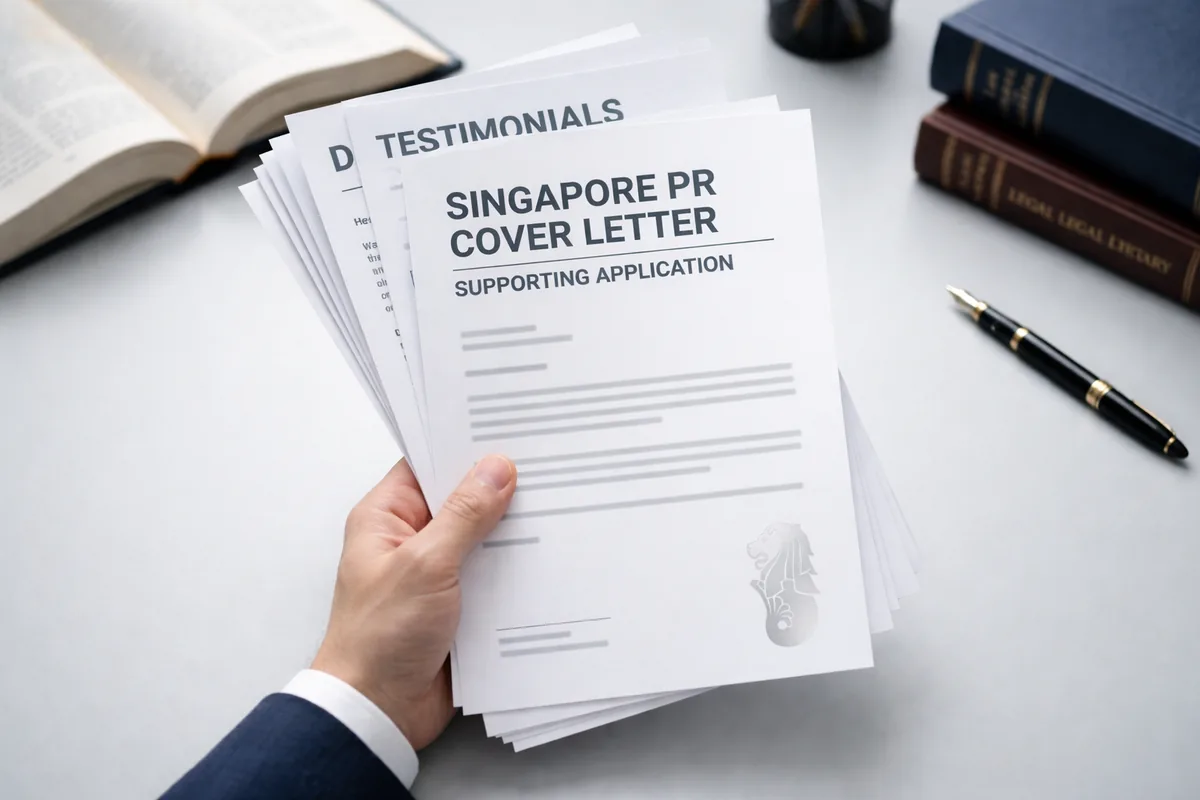
  • How to Write a Singapore PR Cover Letter

    How to Write a Singapore PR Cover Letter

    A Singapore PR cover letter can help present your case more clearly when it is written well. The purpose of the letter is not to repeat your forms or to make dramatic claims. Its job is to explain your profile, your ties to Singapore, and your long-term intentions in a clear, credible, and easy-to-follow way.

    Many applicants struggle because they either leave the letter too vague or turn it into a long life story. A strong letter sits in the middle. It gives useful context, shows stability, and explains why your application makes sense without sounding exaggerated or overly emotional.

    Bear in mind that ICA officers review a high volume of applications. A letter that is scannable, specific, and well organised respects the reader’s time and makes it easier for them to understand why your case is credible.

    In this guide, we will cover when a cover letter may help, what to include, how to structure it, common mistakes to avoid, and how different profiles such as Employment Pass holders and families can frame their letter more effectively.

    A cover letter should support the application, not try to replace the strength of the underlying profile.

    What Is a Singapore PR Cover Letter?

    A Singapore PR cover letter is a short supporting letter that helps explain your application in a more human and structured way. It gives you space to connect the facts in your profile — such as your work history, family situation, time spent in Singapore, and long-term plans — into a coherent narrative that the forms alone cannot always convey.

    Done properly, the letter can make your application easier to understand. Instead of leaving the reader to infer your motivations or how your profile fits together, the letter helps show why you are applying and why your case is serious and well thought out.

    What the letter should not do is repeat every field from your application form, list achievements with no context, or rely on generic statements that could apply to anyone.

    Do You Need a Cover Letter for Singapore PR?

    Not every PR applicant needs a cover letter. Some applications are already straightforward and well supported by the documents submitted. In those cases, a letter may not change much if it adds no real context.

    However, a cover letter can be useful when it helps explain the bigger picture. For example, it may help if you want to clarify your long-term plans in Singapore, explain your family situation, highlight your professional stability, or tie together different parts of your profile in a more readable way.

    The key point is that quality matters more than length. A short, specific, well-positioned letter is usually more useful than a long generic one.

    When a cover letter may help

    • You want to explain your long-term settlement plans in Singapore.
    • Your family situation is relevant to the overall logic of the application.
    • You have an established work history in Singapore and want to present it clearly.
    • You want to frame your contributions and ties to Singapore in a concise, structured way.

    When it may add little value

    • The letter repeats the application form without adding insight.
    • The wording is generic and could apply to almost any applicant.
    • It is too long, emotional, or poorly structured.

    What a Strong Singapore PR Cover Letter Should Achieve

    A good cover letter should help the reader quickly understand who you are, what your current situation looks like, and why your intention to build your future in Singapore is credible.

    It should show stability. That may come through your employment record, your family setup, your time living in Singapore, your responsibilities here, or your longer-term plans.

    It should also show seriousness. The tone should be respectful, measured, and factual. Strong letters usually sound calm and grounded. Weak letters often sound overly promotional or too focused on persuading through emotion alone.

    In practical terms, a strong cover letter should do four things:

    1. Introduce your profile clearly.
    2. Show your ties and contributions to Singapore.
    3. Explain why permanent residency fits your long-term plans.
    4. Leave the reader with a coherent and professional impression.

    What to Include in a Singapore PR Cover Letter

    Most strong PR cover letters follow a simple structure. They introduce the applicant, explain the current situation, highlight relevant ties or contributions, and close with a clear explanation of long-term intentions.

    1. Brief introduction of yourself

    Start with a short opening that states who you are, your current immigration status, your profession or role, and how long you have been in Singapore. Keep this direct and factual. The opening should orient the reader quickly.

    2. Your background and current situation

    Next, give a concise summary of your present situation. For a working professional, this may include your role, industry, and employment stability. For a family-based case, this may include your spouse, children, schooling arrangements, or family setup. The aim is to create context, not to tell your whole life story.

    3. Your ties and contributions to Singapore

    This section should explain why your relationship with Singapore is meaningful and long-term. Depending on your profile, that may include your work contributions, tax record, time spent living here, family ties, community involvement, or other signs of rootedness.

    4. Why you are applying for PR

    Explain why permanent residency supports your next stage of life in Singapore. Your reasons should be practical and forward-looking, grounded in specifics rather than vague aspiration. The ICA is looking for credible intentions, not emotional appeals.

    Here is a checklist of credible intentions that tend to carry weight:

    • Professional continuity and industry commitment — you intend to keep building your career in Singapore.
    • Family stability and long-term education planning for children already in the local school system.
    • Property ownership or long-term financial rootedness in Singapore (e.g. CPF contributions, tax history).
    • Community ties — meaningful involvement in local organisations, volunteering, or professional associations.
    • Long-term settlement intent — concrete plans that demonstrate Singapore is your home, not a temporary posting.

    5. A short professional closing

    End with a respectful closing. Thank the reader for considering the application and keep the tone measured. There is no need for dramatic statements or excessive praise.

    Good rule of thumb: If a sentence does not add context, clarity, or credibility, it probably does not need to be in the letter.

    Example Snapshots: What Strong Paragraphs Look Like

    It is one thing to know what to include and another to see it done well. Below are two short examples showing how a working professional and a family applicant might write a key body paragraph. These are illustrative snapshots, not templates to copy verbatim.

    Working professional example: “I have been employed with [Company Name] in Singapore since [Year] as a [Role]. Over the past [X] years, I have contributed consistently through my work, CPF contributions, and tax payments. My career is based here and my professional network is established in Singapore. I am applying for permanent residency because I intend to continue building my career and life here for the long term.”

    Family applicant example: “My family and I have been living in Singapore since [Year]. My children are enrolled in [School Name] and have grown up here. Our household is fully settled in Singapore and we have built our daily lives around this community. Permanent residency would give our family greater stability as we continue to grow and put down roots here.”

    Recommended Singapore PR Cover Letter Format

    A simple structure usually works best. You do not need an elaborate format. The letter should feel clean, professional, and easy to scan.

    Keep the format simple:

    • Use a clear opening with no unnecessary filler.
    • Keep the body focused on relevant facts and intentions.
    • Aim for clarity over length.
    • Make each paragraph do a specific job.

    Font size of 11 or 12 points, standard margins, and a clean sans-serif font such as Arial or Calibri work well. One to two pages is the right length. Anything beyond two pages is almost always too long.

    How to Upload Your Cover Letter

    Knowing what to write is only half the job. You also need to know where the letter goes in the actual application. The cover letter is typically uploaded as a supporting document within the ICA’s e-PR system, under the “Additional Documents” or “Supporting Documents” section.

    Practical tips for uploading:

    • Save the letter as a PDF before uploading. This preserves your formatting across devices.
    • Use a professional file name such as Cover_Letter_Full_Name.pdf. Avoid generic names like Document1.pdf or letter-final-v3.pdf.
    • Keep the file size reasonable. A one- to two-page letter saved as PDF should be well under any upload limit.
    • Double-check that the uploaded file opens correctly and is not a blank or corrupted file.

    A clean, well-named file signals professionalism from the moment it appears in the reviewer’s system.

    Singapore PR Cover Letter Sample Structure

    It is usually better to use a sample as a framework rather than copy one word for word. A letter becomes stronger when it sounds specific to the applicant’s own circumstances.

    Sample structure for a working professional

    A professional applicant might begin by stating their current role, work pass status, and number of years in Singapore. The body can then explain their employment stability, career development, contributions through work and taxes, and why they want to continue building their future in Singapore. The closing keeps it brief and respectful.

    Sample structure for a family applicant

    A family-based applicant may begin by introducing the household and current family circumstances. The body can then explain family stability, schooling or upbringing plans, the family’s established life in Singapore, and why PR supports a longer-term future here. The closing should remain short and measured.

    Tips for Employment Pass Holders

    Employment Pass holders should usually focus on stability, consistency, and long-term professional commitment. A strong letter should show more than job title alone. It should explain how your work life in Singapore has developed over time and why your future here is credible.

    Useful details may include how long you have lived and worked in Singapore, your role and industry, signs of career progression, and the practical reasons PR fits your long-term plans. If your profile includes family ties in Singapore as well, that can strengthen the overall narrative when handled naturally.

    Avoid making the letter sound as though income alone should determine the outcome. Salary can be part of context, but the overall impression should still be balanced and grounded.

    Good points to highlight for EP holders

    • Professional stability and consistent employment.
    • Meaningful career progression in Singapore.
    • Established life and long-term plans in the country.
    • Family or personal roots here where relevant.
    • A practical and respectful reason for applying for PR.

    Tips for Families Applying for PR

    Families should focus on stability, rootedness, and long-term settlement. A good family-oriented letter explains how the household is established in Singapore and why permanent residency supports a more stable future.

    Relevant details may include a spouse’s role, children’s schooling, the family’s daily life in Singapore, and long-term plans to live and grow here. The tone should remain factual. The goal is to show a settled and genuine connection, not to overstate personal emotion.

    Where children are part of the application logic, it can help to explain how Singapore fits into their education and family planning in a calm and practical way.

    Good points to highlight for families

    • Household stability and long-term settlement plans.
    • Children’s education or upbringing where relevant.
    • Spouse and family integration into life in Singapore.
    • Clear reasons PR would support family continuity.

    Common Singapore PR Cover Letter Mistakes to Avoid

    Many weak cover letters fail for simple reasons. They are too generic, too long, or too focused on sounding persuasive instead of sounding credible.

    Weak vs. Strong Writing: Quick Comparison

    Weak phrasingStronger alternative
    “I love Singapore and it has given me so much.”“I have lived and worked in Singapore for six years and intend to continue building my career here.”
    “I contribute greatly to the Singapore economy.”“I have been employed with the same company for four years, contributing consistently through CPF and income tax.”
    “I am very committed to Singapore.”“My children are enrolled in local schools and our family has built its daily life here over five years.”
    “Singapore is a great place with many opportunities.”“My professional role is Singapore-based and my career network is established here.”
    “I would be grateful for approval.”“I respectfully submit this application and look forward to the opportunity to contribute further as a permanent resident.”

    Writing a generic template

    If the letter could be copied and pasted onto almost any application, it is too generic. Every strong letter should reflect the applicant’s actual profile and specific circumstances.

    Repeating the application form

    The letter should not simply restate facts that are already obvious without showing why they matter together. Context is what adds value — not repetition.

    Making it too long

    A long letter often dilutes the message. A concise letter with clear paragraphs is usually stronger. Aim for one to two pages maximum.

    Sounding overly emotional

    Strong letters are respectful and sincere, but they should still feel measured and professional. Sentimentality is not persuasive in this context.

    Making unsupported claims

    Avoid broad claims about contribution or importance unless the letter gives context for them. Claims without supporting detail tend to undermine credibility rather than build it.

    Focusing only on what you want

    The letter should not read as a list of personal benefits. It should also reflect your ties, stability, and commitment — not just what PR would mean for you personally.

    Avoid this pattern: Long introductions, repeated praise of Singapore, and vague statements about wanting a better future often weaken the letter instead of strengthening it.

    Final Checklist Before You Submit

    Before submitting your PR cover letter, read it once from the perspective of someone seeing your application for the first time. The letter should make your situation easier to understand, not harder.

    • Does the letter clearly explain who you are and your current situation?
    • Does it show your ties or contributions to Singapore in a specific way?
    • Does it explain why PR fits your long-term plans?
    • Is it concise and free from repetition?
    • Does the tone sound calm, factual, and professional?
    • Would the letter still make sense if someone read it quickly in one sitting?
    • Is it saved as a PDF with a professional file name?

    Frequently Asked Questions

    Is a cover letter mandatory for Singapore PR?

    No. A cover letter is optional, but it can strengthen an application when it adds meaningful context that the forms alone do not convey.

    How long should a Singapore PR cover letter be?

    One to two pages is typical. Focus on relevance rather than length — a concise, well-structured letter is more effective than a lengthy one.

    Should I write the cover letter in English?

    Yes. English is the working language of the Singapore government and ICA. Submit your cover letter in clear, professionally written English.

    Where do I upload the cover letter in the e-PR system?

    The cover letter is uploaded as a supporting document within the ICA’s e-PR portal, typically under the “Additional Documents” or “Supporting Documents” section. Save it as a PDF with a professional file name.

    Should I use a template for my PR cover letter?

    A template can help with structure, but the final letter must be adapted to your own profile. Generic letters that read as though they could belong to anyone tend to be less effective.

    Can I include supporting documents alongside my cover letter?

    Yes. You can upload additional supporting documents such as recommendation letters, community involvement records, or tax contribution summaries alongside your cover letter in the e-PR system.


    Get Your PR Application Reviewed by a Professional

    Every PR case is different. A cover letter that works well for one profile may not suit another. Getting the framing right — especially how you present your employment background, family situation, and long-term plans — can make a meaningful difference to how clearly your application reads.

    If you would like a professional to review your cover letter or overall PR application strategy before you submit, the team at E&H is here to help. We work with applicants across a wide range of profiles and can give you honest, tailored advice on how to present your case effectively.

    Need help with your Singapore PR application? E&H Immigration’s our Singapore PR application service provides strategic, profile-tailored case building to maximise your approval chances.

  • Employment Pass vs S Pass in Singapore (2026): Key Differences

    Employment Pass vs S Pass in Singapore (2026): Key Differences

    If you are deciding between a Singapore Employment Pass (EP) and an S Pass, the choice usually comes down to five things: your job level, your fixed monthly salary, whether your employer faces quota and levy obligations, whether the EP candidate can pass the COMPASS points-based assessment, and whether you plan to bring family members or apply for Permanent Residency later.

    In simple terms, the EP is for higher-paid professionals in managerial, executive and specialist roles. The S Pass is for skilled mid-level workers in technical and associate professional positions. Employers generally prefer the EP where possible because it carries no quota or levy, but the right route depends on the role, salary, and candidate profile.

    EP vs S Pass at a Glance (2026)

    FactorEmployment Pass (EP)S Pass
    Best suited forProfessional, managerial, executive and specialist rolesSkilled mid-level technical and associate professional roles
    Minimum salary (2026)S$5,600/month (S$6,200 for financial services); rises with ageS$3,300/month (S$3,800 for financial services); rises with age
    COMPASS required?Yes — must score at least 40 points (exempt if salary ≥ S$22,500)No — COMPASS does not apply to S Pass
    Employer quotaNo quotaSubject to Dependency Ratio Ceiling (10–15% of workforce depending on sector)
    Employer levyNo levyS$650/month per S Pass holder (flat rate)
    Dependant’s PassEligible if fixed monthly salary ≥ S$6,000Eligible if fixed monthly salary ≥ S$6,000
    PR pathwayEligible under PTS scheme; generally viewed more favourably by ICAEligible under PTS scheme; approval typically more competitive

    Salary thresholds increase with the candidate’s age. Use our EP Salary Benchmarks tool to check the qualifying salary for your industry and age group.

    What Is the Employment Pass?

    The Employment Pass is designed for foreign professionals, managers, executives and specialists taking up higher-level roles in Singapore. It is typically the preferred route when the role is clearly professional and the salary level supports it.

    From an employer’s perspective, the EP is attractive because it is not subject to quota or levy. That makes workforce planning more straightforward compared with the S Pass route.

    The COMPASS Framework

    Since September 2023, all EP applicants must clear a two-stage eligibility framework. Stage 1 is the qualifying salary: a minimum fixed monthly salary of S$5,600 for most sectors (S$6,200 for financial services), rising progressively with the candidate’s age. Older candidates in their 40s may need to earn S$10,700 or more.

    Stage 2 is COMPASS (Complementarity Assessment Framework), a points-based system that requires at least 40 points across four foundational criteria and two bonus criteria:

    • C1 – Salary: how the candidate’s pay compares to local PMET salaries in the same sector. Earning at or above the 65th percentile scores 10 points; the 90th percentile scores 20.
    • C2 – Qualifications: a degree from a top-tier institution (QS top 100 or Singapore autonomous university) scores 20 points. Recognised degree-equivalent qualifications score 10.
    • C3 – Diversity: points are awarded if the candidate’s nationality makes up a small share of the employer’s PMET headcount.
    • C4 – Support for local employment: firms with a higher share of local PMETs relative to their sub-sector score more points.
    • C5 – Skills bonus (Shortage Occupation List): up to 20 bonus points for roles on MOM’s SOL. Selected infocomm technology roles on the SOL may qualify for a five-year EP if the candidate earns at least S$10,500/month.
    • C6 – Strategic economic priorities: up to 10 bonus points when the employer participates in approved government initiatives (e.g. with EDB or Enterprise Singapore).

    Candidates earning S$22,500 or more per month are exempt from COMPASS. Intra-corporate transferees under WTO commitments and short-term assignments of one month or less are also exempt.

    Not sure where you stand? Check your EP salary benchmark by industry and age group before you apply.

    What Is the S Pass?

    The S Pass is aimed at skilled mid-level workers in technical, operational and associate professional roles. It is the appropriate route where the role is legitimate and skilled, but the salary or seniority level does not comfortably fit an EP profile.

    The minimum qualifying salary for 2026 is S$3,300 per month for most sectors and S$3,800 for financial services. Like the EP, the required salary increases with the candidate’s age. COMPASS does not apply to S Pass applications.

    Quota and Levy: The Key Employer Trade-Off

    This is often the clearest operational difference between the two passes. Every S Pass holder counts against the employer’s Dependency Ratio Ceiling (DRC): 10% of the total workforce in the services sector, or up to 15% in other sectors such as manufacturing and construction.

    On top of quota limits, employers pay a monthly foreign worker levy of S$650 per S Pass holder (harmonised to a flat rate since September 2025). That levy cannot be deducted from the worker’s salary.

    For employers, these costs add up. Two candidates who both look viable on paper may produce very different outcomes depending on remaining quota capacity and total employment cost.

    From July 2026, the Local Qualifying Salary (LQS) rises from S$1,600 to S$1,800. Local employees earning below the new threshold will no longer count toward the employer’s local headcount for DRC calculations, which could reduce available S Pass quota for some firms.

    Which Pass Gives a Better Path to Permanent Residency?

    Both EP and S Pass holders are eligible to apply for Singapore Permanent Residency under the Professionals, Technical Personnel and Skilled Workers (PTS) scheme. In practice, however, the EP is generally considered the stronger foundation for a PR application.

    ICA does not publish detailed scoring criteria, but EP holders tend to be viewed more favourably due to the higher salary floor, the professional-level role, and the economic contribution associated with the pass. S Pass holders can and do receive PR, but the path is typically more competitive and may require a longer track record of employment and integration in Singapore.

    If long-term residency in Singapore is part of your plan, the type of pass you hold at the time of your PR application is one of several factors worth considering early — alongside salary trajectory, family ties, and community involvement.

    Which Pass Is Right for You?

    There is no universal “better” pass. The right choice depends on the role, the salary, the employer’s constraints, and the candidate’s long-term objectives. Here are some common scenarios:

    If the role is professional-level and the fixed monthly salary is S$5,600 or above, start with the EP route. This avoids quota and levy for the employer and generally positions the candidate more favourably for family pass eligibility and future PR applications.

    If the role is mid-level technical or operational and the salary falls between S$3,300 and S$5,599, the S Pass is usually the realistic route — provided the employer has quota available and is prepared for the ongoing levy cost.

    If the candidate’s salary is borderline between S Pass and EP thresholds, it is worth reviewing the COMPASS criteria carefully. A strong profile on qualifications, diversity, or the Shortage Occupation List can help a candidate clear the 40-point threshold even when the salary score is modest.

    Where family relocation is part of the plan, note that both EP and S Pass holders need a fixed monthly salary of at least S$6,000 to sponsor a spouse and children on a Dependant’s Pass. Consider salary trajectory early, not after the pass is issued.

    What’s Changing Beyond 2026?

    MOM has already announced the next round of salary increases. From January 2027 (new applications), the EP minimum rises to S$6,000 for most sectors (S$6,600 for financial services) and the S Pass minimum rises to S$3,600 (S$4,000 for financial services). Renewal applications will follow from January 2028.

    Employers and candidates should plan compensation and application timing with these scheduled increases in mind.

    Need Help Deciding?

    The 2026 eligibility criteria are more layered than they have ever been. Between COMPASS scoring, age-adjusted salary benchmarks, and quota planning, getting the right pass for the right candidate requires careful analysis upfront.

    Start by checking your salary position with our EP Salary Benchmarks tool. If you would like a full eligibility assessment for your situation, book a consultation with E&H — we can advise on the strongest route and help you prepare an application that reflects the current criteria.

  • Dubai vs Singapore for Entrepreneurs in 2026

    Dubai vs Singapore for Entrepreneurs in 2026

    The global macroeconomic landscape in 2026 is defined by a fundamental restructuring of capital deployment, talent mobility, and supply chain logistics. As venture capital markets recalibrate toward fundamental valuations and the artificial intelligence revolution forces a reevaluation of digital infrastructure, the competition among sovereign jurisdictions to attract high-yield enterprises has intensified. At the apex of this global competition stand two distinct ecosystems: the Republic of Singapore and the United Arab Emirates (UAE), specifically anchored by Dubai.

    Foreign entrepreneurs choosing to relocate or establish holding entities must strip away the marketing narratives and tourism-centric positioning of both jurisdictions. The most objective way to evaluate these two ecosystems is through a multi-dimensional analysis of the strategic sectors, capital architecture, logistical frameworks, human capital dynamics, and expatriate economics defining Singapore and the UAE in 2026. It is designed specifically for founders evaluating company incorporation in Singapore, the Singapore Employment Pass process, and long-term pathways to Singapore Permanent Residency (PR) — alongside the UAE alternative.

    Whether you are a fintech founder, an e-commerce operator, or a professional services consultant, the decision of where to base your company will shape your tax position, access to capital, hiring capabilities, and personal residency options for years to come.

    1. Strategic Sectoral Alignment and Economic Diversification

    Foreign founders moving to the United Arab Emirates typically focus on sectors that align with the country’s strategic geographic location, tax-friendly Free Zone infrastructure, and highly aggressive economic diversification goals aimed at post-oil sustainability.

    1.1 Technology, Artificial Intelligence, and Web3

    Dubai has deliberately positioned itself as the primary global hub for blockchain, cryptocurrency, and Web3 enterprises. This strategy is executed through the Virtual Assets Regulatory Authority (VARA), which provides legal clarity for digital assets that is often lacking in Western jurisdictions. Tech-focused Free Zones such as the DIFC Innovation Hub, Dubai Internet City, and Dubai Silicon Oasis provide the physical and legal infrastructure for these enterprises to scale rapidly.

    In contrast, Singapore’s technology sector is characterized by intense institutional depth. While it possesses a robust blockchain sector, Singapore’s regulatory apparatus — governed by the Monetary Authority of Singapore (MAS) — maintains a highly conservative, systemic-risk-averse approach to volatile retail cryptocurrency. Consequently, Singapore’s tech ecosystem heavily dominates in advanced deep-tech, biotechnology, and complex enterprise Software-as-a-Service (SaaS) models.

    1.2 Fintech and Financial Services

    Fintech consistently dominates venture capital investment in both ecosystems. Singapore dominates this sector at a global institutional level: as the 4th-ranked global financial centre (GFCI 38), Singapore hosts the regional headquarters of the world’s largest banks, sovereign wealth funds, family offices, and insurance conglomerates. The ASEAN financial services market, valued at approximately $60–70 billion in 2025 annual fintech deal flow, is predominantly accessible through Singapore as the primary gateway.

    Dubai operates through the Dubai International Financial Centre (DIFC), which functions as an independent common-law jurisdiction with English as its operating language. The DIFC’s DFSA serves as the primary hub for institutions targeting the MENA financial market, which manages an estimated $3.5–4 trillion in assets.

    1.3 E-commerce, Trading, and Logistics

    Singapore’s strategic value is its function as the primary e-commerce aggregation and logistics hub for Southeast Asia (ASEAN), a market comprising approximately 600 million consumers with a combined GDP of roughly $3.8 trillion in 2025. Singapore controls the primary maritime chokepoint through the Strait of Malacca and processes approximately 20–25% of global trade by volume.

    Dubai’s advantage is scale of geographic reach: the Dubai World Central and Jebel Ali Port create a combined air-sea logistics megacomplex that serves a catchment area of approximately 3 billion people across the Middle East, Africa, and South Asia (MEASA).

    1.4 Real Estate, PropTech, and Construction

    Dubai is an unambiguous winner for real estate investment from a purely financial returns perspective, offering gross rental yields between 6–10% on residential property (compared to 2–4% in Singapore), zero property capital gains tax, and zero foreign buyer restrictions. Singapore deliberately suppresses real estate speculation through the 60% Additional Buyer’s Stamp Duty (ABSD) levied on foreign nationals.

    1.5 Tourism, Hospitality, and Luxury Services

    Both ecosystems are global leaders in luxury hospitality and international tourism. Dubai welcomed approximately 17 million international visitors in 2023–2024; Singapore hosted approximately 15.5 million visitors in 2024. Neither market offers a decisive advantage, though Dubai’s lower VAT (5% vs 9% GST) marginally reduces operational friction for this sector.

    1.6 Consultancy and Professional Services

    Singapore’s advantage is institutional credibility: a registered Singapore Pte Ltd with an Employment Pass-holding director is immediately recognized by Fortune 500 companies and institutional investors worldwide as a credible, compliant entity. Dubai’s advantage is speed and cost: a DMCC or IFZA Free Zone company can be established in days at lower cost, with no local director requirement.

    1.7 Green Energy and Manufacturing

    Singapore’s government, through the Economic Development Board (EDB), is aggressively targeting advanced manufacturing as a strategic pillar, particularly in semiconductors, precision engineering, and biomedical manufacturing. The UAE has made a massive, state-directed emphasis on green energy, clean technology, and sustainability initiatives.

    1.8 The Strategic Function of UAE Free Zones

    When foreign founders move to the UAE, they typically establish their businesses within specific Free Zones tailored to their exact industry. These Free Zones allow for 100% foreign ownership, full and immediate repatriation of capital and profits, and significant tax exemptions.

    2. Technology, AI, and Fintech: The Venture Capital & Innovation Framework

    2.1 Venture Capital Deployment

    Singapore captured approximately $4.2 billion in VC deal value in 2024–2025, representing approximately 78.1% of total Southeast Asian VC activity. The concentration of capital reflects the dominance of Singapore as the de facto headquarters for SEA-focused venture funds: Peak XV Partners, Temasek, GIC’s venture arm, and Vertex Ventures all maintain primary operations in Singapore.

    Dubai’s VC ecosystem captured approximately $1.4 billion in 2024, though this figure is heavily skewed by mega-deal events. The primary VC sectors in Dubai are enterprise software, Web3/cryptocurrency infrastructure, and early-stage consumer technology.

    2.2 Sector Specialization Data

    Index / Metric (2025 Data) Singapore Dubai / UAE
    VC Deal Value Capture ~$4.2B (78.1% of SEA market) ~$1.4B (Heavily Mega-Deal Skewed)
    Primary VC Sector Focus Deep-tech, Biotech, Inst. FinTech Enterprise Software, Web3, Crypto
    StartupBlink Global Rank 4th Globally (National) 44th Globally (City)
    Global Innovation Index (GII) 5th Globally 30th Globally
    GFCI 38 Financial Rank 4th Globally (Rating: 763) 11th Globally (Rating: 748)

    3. Trading, E-commerce, and Logistics: The Infrastructure & Flow Framework

    3.1 Logistics Performance Index

    The World Bank’s Logistics Performance Index (LPI) serves as the gold standard for measuring trade execution. Singapore ranks #1 globally on the World Bank LPI. The UAE ranks #7 globally.

    Metric Singapore Dubai / UAE
    World Bank Logistics Performance Index #1 #7
    Primary Market Reach ASEAN (~600M population) Middle East, Africa, South Asia (~3B)

    4. Real Estate and Construction: The Yield & Tax Friction Framework

    4.1 Rental Yields and Market Dynamics

    Dubai offers gross rental yields of 6–10% on residential property, compared to 2–4% in Singapore. Dubai’s real estate market has experienced consistent capital appreciation since 2020.

    4.2 Tax Friction and Entry Barriers

    Singapore deliberately suppresses real estate speculation by foreign buyers through the 60% Additional Buyer’s Stamp Duty (ABSD). A foreign entrepreneur purchasing a $2 million SGD apartment must pay an additional $1.2 million SGD in unrecoverable tax.

    Real Estate Metric Singapore Dubai
    Gross Rental Yields 2%–4% (Capital Preservation Focus) 6%–10% (High Cash Flow Focus)
    Property / Capital Gains Tax Subject to standard capital frameworks 0%
    Foreign Buyer Tax Penalty 60% Additional Buyer’s Stamp Duty (ABSD) 0% (Standard 4% DLD Transfer Fee)

    5. Consultancy and Professional Services: The Talent & Ease of Business Framework

    5.1 Ease of Doing Business and Bureaucratic Friction

    Singapore consistently ranks as one of the world’s most business-friendly environments. ACRA’s BizFile+ portal allows a Pte Ltd company to be incorporated in as little as 1–3 business days. Dubai offers extraordinary speed for company setup within its Free Zones but involves more bureaucratic layers that routinely extend the setup timeline to 2–4 weeks.

    5.2 Talent Acquisition and the GTCI 2025

    The Global Talent Competitiveness Index (GTCI) 2025 ranks Singapore 1st globally for overall talent competitiveness. Dubai ranks 25th globally, though it achieves 3rd place on the “Attract” pillar — reflecting its ability to draw global talent through lifestyle and visa accessibility rather than educational infrastructure.

    5.3 The 2026 Dubai 10-Year Golden Visa Evolution

    Dubai’s Golden Visa programme has been significantly broadened in 2025–2026. Applicants holding a bachelor’s degree, classified as Level 1 or 2 professionals, and drawing a minimum monthly salary of AED 30,000 (approx. USD 8,100) are automatically eligible.

    Talent & Operational Metric Singapore Dubai / UAE
    GTCI 2025 Rank 1st Globally (Focus on Adaptive Skills) 25th Globally (3rd in “Attract” Pillar)
    Foreign Hiring Flexibility Strict quotas (COMPASS framework), High friction Unrestricted global hiring, Zero quotas
    Long-Term Visa Access Highly meritocratic, restricted permanent residency Broad 10-year Golden Visas (Property, Salary, Skills)
    2026 Property Visa Hurdle No visa through property acquisition No 50% upfront payment needed (AED 2M threshold)

    Company Incorporation: Dubai Free Zones vs Singapore Pte Ltd

    Singapore Company Incorporation (Pte Ltd)

    A Singapore Private Limited company (Pte Ltd) is incorporated through ACRA via its BizFile+ portal. Key requirements include: at least one locally resident director, a registered Singapore office address, a company secretary appointed within 6 months, and a minimum paid-up capital of S$1 (S$50,000+ recommended for Employment Pass). The incorporation process typically takes 1–3 business days.

    Dubai Free Zone Company Setup

    Dubai’s Free Zones offer 100% foreign ownership, full profit repatriation, and zero personal income tax. There is no requirement for a local Emirati sponsor or partner. The process typically takes 2–4 weeks.

    Side-by-Side Incorporation Comparison

    Factor Singapore (Pte Ltd) Dubai (Free Zone)
    Formation Time 1–3 business days 2–4 weeks
    Government Fees S$315 (~US$235) AED 15,000–35,000 (~US$4,000–9,500)
    Foreign Ownership 100% permitted 100% in Free Zones
    Corporate Tax 17% (effective ~8.5% for first S$200K with exemptions) 9% above AED 375,000 (0% below)
    Personal Income Tax 0–22% progressive 0%
    Local Director Required Yes (at least one resident) No
    Minimum Capital S$1 (S$50K+ recommended for EP) AED 0–50,000 (varies by zone)

    Employment Pass Salary Requirements (2026)

    For foreign entrepreneurs who plan to live and work in Singapore, the Employment Pass (EP) is the primary work visa pathway. An EP is tied to a specific Singapore-registered employer — meaning a foreign entrepreneur must incorporate a Singapore company and apply for an EP through that company.

    The minimum qualifying salary for an Employment Pass in 2026 is S$5,600 per month for most sectors. For the Financial Services sector, the threshold is higher at S$6,200 per month. These thresholds increase with age.

    The COMPASS Framework

    Since September 2023, all new EP applications are evaluated under the Complementarity Assessment Framework (COMPASS). COMPASS is a points-based system that evaluates candidates across four criteria:

    • C1 – Salary: Comparative salary against local PMET peers in the same occupation and sector.
    • C2 – Qualifications: Educational background assessed against benchmarks. Top-tier university graduates receive maximum points.
    • C3 – Diversity: Proportion of the company’s workforce from the same nationality as the applicant.
    • C4 – Support for Local Employment: Whether the company has a track record of employing and developing Singapore Citizen and PR employees.

    To pass, a candidate must score at least 40 points out of 80.

    Key EP Application Requirements

    • Company setup: A Singapore-registered company must apply on behalf of the candidate through MOM’s myMOM Portal.
    • Qualification verification: Mandatory for all EP applications since September 2023.
    • Application cost: S$105 (application) + S$225 (issuance).
    • Processing time: Approximately 10 business days for straightforward cases; up to 8 weeks for complex applications.
    • Validity: Up to 2 years for first-time applicants, renewable for up to 3 years.
    • Dependants: EP holders earning at least S$6,000 can sponsor immediate family members; S$12,000 for parents.

    EP vs Dubai Residency Visa

    Dubai’s residency visa system is significantly less restrictive. A Free Zone company formation automatically entitles the founder to apply for a UAE residence visa, with no salary threshold, no points-based assessment, and no requirement to advertise the role locally.

    However, Singapore’s stricter EP process is designed to attract high-calibre professionals and is widely recognised as a signal of credibility in international business. An approved EP also opens the pathway to Singapore Permanent Residency — a benefit unavailable through the UAE’s residence visa system.

    Pathways to Singapore Permanent Residency for Entrepreneurs

    The PTS Scheme (Professionals, Technical Personnel and Skilled Workers)

    The most common PR pathway for EP holders. Applications are submitted to the Immigration & Checkpoints Authority (ICA) and are assessed holistically, with no fixed points threshold. Most successful applicants apply after 2–3 years on EP, with a demonstrated track record of growing their Singapore-based business.

    The Global Investor Programme (GIP)

    The GIP is designed for established entrepreneurs and business owners prepared to make a significant economic commitment to Singapore. Under the GIP, applicants must invest a minimum of S$2.5 million into a new or existing Singapore company, or into a GIP-approved fund. Applicants must have a minimum three-year track record as a business owner with annual turnover exceeding S$200 million.

    EntrePass to PR

    Foreign entrepreneurs who qualify for the EntrePass (for venture-backed or innovative startups) can apply for PR after the second pass renewal, typically after approximately two years of active business operations.

    PR Benefits for Entrepreneurs

    • Freedom to change employers or start new ventures without a fresh work pass application
    • Access to CPF savings, public housing (HDB), and subsidised healthcare
    • Ability to sponsor family members for PR
    • Pathway to Singapore citizenship after two years of PR
    • Eligibility to serve as a locally resident director for your Singapore company

    Dubai comparison: The UAE’s Golden Visa programme offers 10-year renewable residency for investors, entrepreneurs, and specialised talent, but it does not provide a pathway to citizenship. Singapore’s PR system, by contrast, represents one of the world’s most valuable permanent residency pathways.

    Decision Framework: Which Ecosystem Is Right for You?

    Founder Type Key Decision Factors Recommended Hub
    Web3 / Crypto Regulatory flexibility, 0% tax Dubai
    Deep Tech / AI VC funding, R&D ecosystem, IP protection Singapore
    Fintech / Institutional Finance Banking infrastructure, global credibility Singapore
    Commodity Trading Logistics, tax efficiency, market access Dubai
    E-Commerce (ASEAN) Regional market access, tech talent Singapore
    E-Commerce (MENA/Africa) Logistics hub, 0% tax, regional proximity Dubai
    Real Estate Investment Yield, tax, foreign buyer access Dubai
    Professional Services Ease of setup, lifestyle, low cost Dubai (cost), Singapore (credibility)
    Long-Term Residency / PR Permanent settlement, citizenship pathway Singapore

    Choose Singapore if you need institutional venture capital, deep-tech R&D infrastructure, global financial credibility, strong rule of law, and a pathway to Permanent Residency and citizenship.

    Choose Dubai if you prioritise zero personal income tax, regulatory flexibility, global trading access, lifestyle and real estate investment, and faster company setup with fewer restrictions on hiring.

    Tax Comparison at a Glance

    Tax Type Singapore UAE
    Corporate Tax Rate 17% headline (effective ~8.5% on first S$200K under Startup Tax Exemption) 9% above AED 375,000 (0% below threshold)
    Personal Income Tax 0–22% progressive 0%
    Capital Gains Tax None None
    Dividend Tax None None
    GST / VAT 9% GST 5% VAT
    Double Tax Treaties 90+ agreements 100+ agreements
    Startup Tax Exemption 75% exemption on first S$100K for first 3 years No equivalent scheme

    Singapore’s tax regime, while higher on the headline corporate rate, offers substantial benefits for startups through its Tax Exemption Scheme for New Start-Ups (SUTE). Combined with no capital gains tax, no dividend tax, and an extensive network of double taxation agreements, Singapore remains highly competitive for companies generating significant revenue.

    Ready to Make Your Move? E&H Immigration Can Help

    Whether you’re weighing Dubai against Singapore, or you’ve already decided that Singapore is the right base for your next venture, the immigration and incorporation process requires careful planning to avoid costly mistakes.

    E&H Immigration specialises in:

    • Company Incorporation Services: Full ACRA registration, company secretary provision, registered office address, and nominee director services.
    • Employment Pass Applications: COMPASS scoring strategy, qualification verification, salary benchmarking, and submission through MOM’s portal.
    • Permanent Residency Planning: Long-term PR strategy and application support through the PTS Scheme.
    • Dependant’s Pass and Family Visas: Sponsorship for spouses, children, and parents of EP holders.

    Disclaimer: This article is intended for general informational purposes only and does not constitute legal, tax, or immigration advice. Regulations, fees, and requirements referenced in this article are subject to change. Readers should consult with qualified professionals before making any business or immigration decisions.

    Considering Singapore for your business? E&H Immigration’s our entrepreneur and founder residency service provides expert guidance tailored to your situation.

  • What Minister Gan’s 2026 Population Speech Means for Singapore PR and Citizenship Applicants

    What Minister Gan’s 2026 Population Speech Means for Singapore PR and Citizenship Applicants

    A Comprehensive Policy Analysis for Immigration Applicants

    E&H Immigration Consultancy  |  2 March 2026 | Tien Ho

    1. Introduction: Why This Speech Matters for Immigration Applicants

    On 26 February 2026, Deputy Prime Minister Gan Kim Yong stood before Parliament and delivered one of the most significant population policy speeches Singapore has seen in years. The occasion was the Committee of Supply debate, and the topic was Singapore’s future — or more precisely, whether Singapore would have enough people to sustain one.

    For anyone thinking about applying for Singapore Permanent Residency (PR) or citizenship, this speech deserves careful attention. It is the clearest public signal we have had in years about how the government views immigration, who it wants to bring in, and why. Top Tips for a Successful Singapore Citizenship Application

    The full speech is available at: population.gov.sg

    Here are the headline numbers that matter:

    •       25,000 to 30,000 new citizens per year over the next five years (up from roughly 25,000 in 2025)

    •       Approximately 40,000 new PRs per year (up from roughly 35,000 in 2025)

    •       Total Fertility Rate (TFR) has dropped to 0.87 — the lowest in Singapore’s recorded history

    These numbers matter. But the real value of this speech lies not in the headline figures, but in the policy signals buried within the language. What does the government mean when it says it will be “selective”? What does “some time” actually translate to? Who does the government consider an ideal immigrant?

    This article breaks down the speech section by section, explains what each part means for prospective applicants, and offers practical guidance on how to strengthen your application in light of these policy signals.

    A word of caution: The increased intake suggests greater structural demand for immigrants, but does not reduce individual selectivity thresholds. More slots exist, but the competition for each slot remains intense. This is not a relaxation of standards — it is an expansion driven by demographic necessity. Singapore’s Population Cools in 2025

    2. Singapore’s Demographic Crisis: The Strategic Imperative Behind Immigration

    “Our birth rate has reached a new low. Our preliminary resident total fertility rate for 2025 is 0.87. This is a significant drop from the TFR of 0.97 the year before, and much lower than the TFR of 1.24 just a decade ago.”

    — DPM Gan Kim Yong, Committee of Supply Debate, 26 February 2026

    These are not abstract statistics. They describe a country that is running out of people. To understand why Singapore is increasing immigration, you first need to understand how serious this crisis is.

    2.1 What the Numbers Show

    A TFR of 0.87 means that, on average, each woman in Singapore will have fewer than one child over her lifetime. This is roughly 40% below the replacement rate of 2.1 needed just to maintain the current population without immigration.

    “Assuming our TFR stays at 0.87 — based on a simplistic calculation, for every 100 residents today, we will have just 44 children, and a mere 19 grandchildren.”

    — DPM Gan Kim Yong, Committee of Supply Debate, 26 February 2026

    The Minister also pointed out that citizen population growth has already slowed — from an average of 0.9% per year over 2015–2020, to 0.8% over 2020–2025, and just 0.7% last year. Going forward, the government expects this to slow further to about 0.5% per year, even with increased immigration. Without new measures, Singapore’s citizen population would start shrinking by the early 2040s.

    Consider what one in five citizens being aged 65 or above means in practical terms. That ratio was one in eight just ten years ago. The speed of this shift is what makes it so challenging — there is very little time to adapt.

    Overall TFR down to 0.87 in 2025

    Source: Department of Statistics Singapore (SingStat)
    Resident Total Fertility Rate


    2.2 The Five Pressures Driving Immigration Policy

    “Fewer births today mean fewer young people over the next two to three decades. A smaller working-age base will have to support a rapidly growing elderly population; familial support networks will weaken as family sizes shrink. Each family member in the younger generation will have to carry a heavier load.”

    — DPM Gan Kim Yong, Committee of Supply Debate, 26 February 2026

    This single paragraph from the speech captures the cascading nature of the crisis. It is not one problem but five interconnected pressures, each reinforcing the others:

    • Workforce shrinkage. Fewer young people means fewer workers. A smaller working-age base must support an ever-growing elderly population. The old-age support ratio — the number of working-age citizens per elderly citizen — is projected to fall from 3.3 in 2025 to just 2.4 by 2030.

    • Fiscal sustainability. Singapore’s Central Provident Fund (CPF) system is built on the assumption that a large working population contributes regularly to fund retirement, healthcare (MediSave), and housing. When the working-age base shrinks, the entire model comes under structural strain. Immigration of working-age adults directly supports this system.

    • Healthcare workforce gap. An ageing population needs more healthcare workers, eldercare professionals, and migrant domestic workers to care for the elderly. Demand for these roles will only grow, and Singapore already relies heavily on foreign workers to fill them.

    • National defence. The Minister touched on this directly: “with fewer citizens, it will become increasingly difficult to meet our national security and national defence needs.” Smaller male birth cohorts mean smaller National Service (NS) intakes, weaker reserve forces, and reduced deterrence capacity. The Singapore Armed Forces (SAF) manpower model depends on population scale.

    • Economic vitality. A declining population risks slower GDP growth, lower income growth, and a loss of Singapore’s competitive edge as a global business hub. The city’s ability to attract multinational headquarters, sustain its financial sector, and drive innovation all depend on a critical mass of talent and economic activity.

    2.3 The “Ready-Made Tax Base”: Why Working-Age Immigrants Are So Valuable

    There is one economic dimension the speech does not state explicitly, but which underpins much of the government’s preference for working-age immigrants.

    When Singapore grants PR to a 30-year-old professional, it gains an immediate taxpayer and CPF contributor without having spent two decades subsidising their childhood education, housing, healthcare, or development. The country of origin bore those costs. Singapore receives the return on investment.

    By contrast, raising a citizen from birth to working age costs the government substantially — education subsidies from primary school through university, healthcare, housing grants, and other social investments. A working-age immigrant who becomes a PR starts contributing to CPF on the very first day of their PR approval. This is, in effect, direct fiscal support for the social security system. Inside Singapore’s World-Class Education System: The Secrets Behind Its Success

    This helps explain why the Minister emphasised that “the majority of our immigrants are also of working age, contributing to our economy.” It is not just about GDP growth. It is about fiscal efficiency.

    What this means for applicants: Demonstrating strong, immediate economic contribution is valuable because it aligns with the government’s structural fiscal logic, not just your individual profile.

    2.4 What the Speech Implies But Does Not State

    Several additional pressures are implied but left unsaid, likely because they are politically sensitive:

    Housing market stability. Population stability contributes to long-term housing demand and economic planning. Most Singaporeans’ retirement savings are tied up in their Housing Development Board (HDB) flat. The value of those flats depends on sustained demand.

    Innovation and enterprise. A young, diverse, skilled population generates more startups, more research and development, and more entrepreneurial energy. An ageing, shrinking population tends toward economic conservatism.

    Geopolitical relevance. Singapore’s influence within ASEAN, in global trade, and in international finance depends partly on its economic dynamism relative to its small size.


    3. The New Immigration Numbers: What Was Announced

    “We expect to take in between 25,000 and 30,000 new citizens annually, over the next five years, depending on our demographic trends including our TFR. We will also have to adjust our PR intake… We estimate an intake of about 40,000 PRs annually in the next five years, slightly higher than the 35,000 PRs we granted last year.”

    — DPM Gan Kim Yong, Committee of Supply Debate, 26 February 2026

    Here is how the announced targets compare to recent history:

    Metric Details
    New citizens per year (2026–2030 target) 25,000–30,000
    New PRs per year (2026–2030 target) ~40,000
    Citizenships granted in 2024 (actual) 22,766
    PRs granted in 2024 (actual) 35,264
    5-year avg citizenships (2020–2024) 21,300 per year
    5-year avg PRs (2020–2024) 33,000 per year
    5-year avg citizenships (2015–2019) 20,500 per year
    5-year avg PRs (2015–2019) 31,700 per year
    Citizen population growth target ~0.5% per annum
    Review timeline By 2030

    The numbers speak clearly. The new citizenship target of 25,000 to 30,000 per year is 17% to 41% higher than the 2020–2024 average of 21,300 per year. The PR target of 40,000 is about 21% above the five-year average of 33,000. These are meaningful increases by any measure.

    Looking at the longer trend from the Immigration & Checkpoints Authority (ICA) data, the government significantly tightened immigration in late 2009. PR grants dropped from a peak of 59,460 in 2009 to about 29,000 by 2010 and have remained in a relatively narrow band since. Citizenship grants similarly dropped and stabilised around 20,000 per year. The 2026–2030 targets represent the most significant upward adjustment in over 15 years.

    Number of Citizenships and Permanent Residencies granted

    Source: Immigration & Checkpoints Authority
    The figures are based on the full calendar year (January to December)


    However, there are important caveats:

    • These are targets, not guarantees. The government will adjust actual numbers yearly based on TFR trends, applicant quality, and infrastructure capacity.

    • A 2030 review is planned. These numbers are not permanent. If public sentiment shifts or if TFR recovers, intake may be adjusted downward.

    • More slots does not mean easier approvals. The applicant pool is also growing. Each individual application is still assessed on its own merits against undisclosed criteria.

    4. What This Speech Does NOT Mean

    Before we go further, it is worth addressing some common misconceptions that may arise from the headline numbers. Misreading this speech could lead to poor planning or false expectations.

    It does not mean PR approvals will become easy. The government has increased the volume of intake, not lowered the bar. ICA continues to evaluate each application individually against criteria it does not publicly disclose. Competition remains fierce.

    It does not mean having a baby in Singapore guarantees residency. Children can strengthen a family’s application, but they are not a standalone pathway. Importantly, Singapore does not have birthright citizenship (jus soli). A child born in Singapore to non-citizen parents does not automatically receive citizenship, PR status, or any immigration advantage from the birth event itself. The advantage comes from integrating that child into the local system — enrolling in Ministry of Education (MOE) schools, building community ties, and demonstrating family rootedness over time. “Adding Value” to Singapore: What ICA Looks For (and How You Can Show It)

    It does not mean salary is irrelevant. Economic contribution is still a core assessment factor. The Complementarity Assessment Framework (COMPASS) qualifying salaries continue to rise, and the government clearly values strong economic contributors.

    It does not mean ethnicity alone determines your outcome. The government manages ethnic composition at the macro level (more on this in Section 7), but individual applications are evaluated across multiple dimensions.

    It does not mean the numbers will hold beyond 2030. DPM Gan explicitly committed to a review by 2030. If public concerns about job competition or cultural change intensify, tightening is possible.

    It does not mean all profiles benefit equally. Families with deep roots, stable professionals, and well-integrated individuals are structurally favoured. Short-term or single-dimension profiles face a harder path regardless of the overall intake increase.


    5. What Does “Selective” Mean? Decoding the Selection Criteria

    “We will also continue to be selective about who we bring in. As Mr Edward Chia noted, many of the immigrants we take in today either share family ties with Singaporeans or have studied, worked or lived in Singapore for some time. The majority of our immigrants are also of working age, contributing to our economy.”

    — DPM Gan Kim Yong, Committee of Supply Debate, 26 February 2026

    This short paragraph contains four distinct selection signals. Let us examine each one.

    5.1 Family Ties with Singaporeans

    This is mentioned first in the speech, and the ordering is likely deliberate. Family ties are arguably the strongest commitment signal an applicant can have.

    If you are married to a Singaporean citizen or PR, if your children are Singapore citizens or enrolled in local MOE schools, or if you have extended family here, these connections create bonds that are difficult to unravel. From the government’s perspective, someone with deep family ties is far less likely to leave Singapore than someone without them.

    The speech also highlights the example of Bipule Jain, an immigrant who arrived in 2007, volunteered in the community, joined the SAF Volunteer Corps, and whose son is now serving National Service. This is the government’s ideal narrative: an immigrant whose entire family has become woven into the fabric of Singaporean life.

    5.2 Studied in Singapore

    If you completed a substantial portion of your education in Singapore — a full polytechnic diploma, a university degree, or several years of primary and secondary school — this carries significant weight. Singapore’s education system is a powerful socialisation engine. Students who go through it absorb the cultural norms, build local friendships, and develop an understanding of Singaporean society that is difficult to acquire any other way.

    A one-year master’s programme is not the same as a four-year undergraduate degree. Formative years matter more than credential-collecting. Students who then transition into the local workforce represent especially strong combination profiles.

    5.3 Worked in Singapore

    Stable, continuous employment over several years — typically three to six or more — is one of the most important signals. The government is not just looking at whether you work here, but how you work here. Career progression within Singapore, a track record of contributing to the economy through taxes and (once a PR) CPF, and a deepening relationship with your employer all matter.

    Job stability is so significant for applicants that we dedicate the entire next section to it.

    5.4 Lived in Singapore for “Some Time”

    The phrase “some time” is deliberately vague, which is typical of ministerial language on immigration policy. The government does not want to commit to specific thresholds publicly, so it can preserve discretion.

    But reading it in context, “some time” clearly signals years, not months. The entire thrust of this passage is about deep ties and commitment. Different profiles have different implied timelines:

    Profile What “some time” like
    New citizens per year (2026–2030 target) 25,000–30,000
    New PRs per year (2026–2030 target) ~40,000
    Citizenships granted in 2024 (actual) 22,766
    PRs granted in 2024 (actual) 35,264
    5-year avg citizenships (2020–2024) 21,300 per year
    5-year avg PRs (2020–2024) 33,000 per year
    5-year avg citizenships (2015–2019) 20,500 per year
    5-year avg PRs (2015–2019) 31,700 per year
    Citizen population growth target ~0.5% per annum
    Review timeline By 2030

    Passive presence — simply being physically located in Singapore — is not enough. The government is increasingly looking for active, demonstrable integration.


    6. Job Stability vs. Job Hopping: Why Your Employment Pattern Matters More Than Your Salary

    Of all the factors that applicants worry about, job stability is one of the most discussed — and the most misunderstood. Many applicants believe that a high salary is the most important factor. The speech suggests otherwise.

    The government’s emphasis on immigrants who have “worked in Singapore for some time” is a signal about stability, not just presence. Let us look at why this matters so much.

    6.1 Why Employers Matter: The Annex A Endorsement

    When an employer submits an Employment Pass (EP) application through the Ministry of Manpower (MOM), they complete what is known as Annex A — a declaration that the role is genuine, that the foreign professional is needed, and that fair hiring practices were followed. This employer endorsement is not a one-time formality. It is a recurring signal of your value to the Singapore economy.

    The weight of this endorsement changes over time:

    • After 6 months: The endorsement is procedural. Your employer needed to fill a role and selected you. It says little about deep integration.

    • After 2–3 years: The endorsement carries real weight. Your employer has renewed your pass, invested in your development, and continued to validate your role. This suggests genuine need.

    • After 4–5+ years: The employer’s ongoing commitment becomes a powerful implicit signal. They have promoted you, expanded your responsibilities, and embedded you into the organisation. Your removal would create a meaningful gap. This is qualitatively different from a fresh hire.

    Every time an employer renews your EP and completes Annex A, they are effectively vouching for your continued contribution. Job-hopping resets this clock with every move.

    6.2 How Your Employment Pattern Is Likely Read

    Metric Details
    New citizens per year (2026–2030 target) 25,000–30,000
    New PRs per year (2026–2030 target) ~40,000
    Citizenships granted in 2024 (actual) 22,766
    PRs granted in 2024 (actual) 35,264
    5-year avg citizenships (2020–2024) 21,300 per year
    5-year avg PRs (2020–2024) 33,000 per year
    5-year avg citizenships (2015–2019) 20,500 per year
    5-year avg PRs (2015–2019) 31,700 per year
    Citizen population growth target ~0.5% per annum
    Review timeline By 2030

    6.3 The Six Signals of Stability

    Job stability is not just one signal — it communicates six things simultaneously:

    • Economic reliability. Predictable tax and CPF contribution. A steady income stream the government can count on.

    • Employer endorsement depth. A company that retains and promotes you over years is implicitly saying this person is worth keeping.

    • Reduced flight risk. Someone who hops frequently is statistically more likely to leave Singapore when a better offer comes elsewhere.

    • Social rootedness. Same company often means same neighbourhood, same school for children, same social networks. Stability breeds community ties.

    • Workforce development. A stable employee who grows within a company is more likely to mentor local colleagues and transfer skills, aligning with the COMPASS philosophy that foreign workers should complement, not compete with, Singaporeans.

    • Commitment signalling. Job stability is the employment equivalent of buying property versus renting. It signals you are staying.

    Practical advice: If you are contemplating a job switch close to a PR or citizenship application, the new role must clearly represent upward career progression — not a lateral move. If the timing can wait, staying with your current employer through the application period strengthens your stability narrative.

    7. The Ethnic Balance Factor: How CMIO Composition Affects Applications

    “We will maintain the broad ethnic balance of our citizen population, and continue to carefully manage the impact of immigration on our population composition, to preserve the overall texture of our society.”

    — DPM Gan Kim Yong, Committee of Supply Debate, 26 February 2026

    This confirmation from the Minister means that immigration intake is calibrated to preserve Singapore’s existing Chinese-Malay-Indian-Others (CMIO) ethnic ratios. For a detailed analysis of how this system works, including historical trends over 30 years and estimated grant breakdowns by ethnicity, see our full article: Uncovering the Ethnic Quota for PR and Citizenship in Singapore.

    7.1 The Latest CMIO Data

    Chinese Malays Indians Others
    75.5% 15.1% 7.6% 1.8%
    (2015: 76.2%) (2015: 15.0%) (2015: 7.4%) (2015: 1.4%)

    Resident population including PRs (as at June 2024, Department of Statistics):

    Chinese Malays Indians Others
    73.99% 13.52% 9.04% 3.45%
    10Y average: 74.24% 10Y average: 13.47% 10Y average: 9.02% 10Y average: 3.27%
    10Y std dev: 0.13% 10Y std dev: 0.10% 10Y std dev: 0.05% 10Y std dev: 0.08%

    7.2 What This Means for Applicants

    The extremely low standard deviations — ranging from 0.05% to just 0.13% — confirm that the government manages ethnic composition very tightly. There is almost no year-to-year variation, which means each ethnic group effectively has its own implicit quota.

    Some important observations:

    •       Chinese applicants benefit from the largest quota in absolute terms. The slight decline in the Chinese share over the past decade also creates ongoing demand to replenish this proportion.

    •       Malay applicants have a moderate quota. Minister K Shanmugam noted in 2023 that senior Malay community leaders want to maintain the Malay population at around 14–15%. Growth is likely to remain moderate, partly because the supply of Malay applicants is smaller compared to other groups.

    •       Indian applicants face the most competitive pool relative to their quota. The absolute number of grants is significantly smaller, while the global pool of Indian applicants is very large. Competition is primarily within the Indian applicant pool, not across ethnic groups.

    •       Others have a small quota but one that has shown the most consistent growth over both 10 and 20 years.

    Key insight: Since the tightening in 2010, competition is primarily within ethnic groups rather than across them. A highly qualified Indian national may face a structurally tighter pathway than an equally qualified Chinese national, purely due to macro composition management — not individual merit.


    8. The Integration Imperative: What “Preserving the Texture of Society” Means

    “Will the Singapore that my children grow up in feel vastly different from the one I grew up in? I understand these concerns. We take these concerns over competition and our social fabric seriously.”

    — DPM Gan Kim Yong, Committee of Supply Debate, 26 February 2026

    The word “texture” is a deliberate and interesting choice. It goes beyond ethnic ratios to encompass language, social norms, public behaviour, food culture, neighbourhood character, and the general feel of daily life in Singapore.

    The government is building formalised integration infrastructure to ensure new immigrants assimilate:

    •       Singapore Citizenship Journey — mandatory for all new citizens aged 16 to 60, covering Singapore’s history, norms, values, and community ties.

    •       PR Journey programme — piloted in 2025 and now being scaled up through the People’s Association (PA) to help new PRs settle in and integrate.

    •       1,500+ Integration and Naturalisation Champions across the PA’s grassroots network, driving integration efforts in local communities.

    The direction of travel is clear: integration is moving from a soft expectation to something more structured and measurable. Countries like Canada and Australia already have points-based systems that score language ability and community ties. Singapore does not have a published points system, but the trajectory in this speech suggests something analogous may develop over time, even if it remains behind the scenes. Short Guide for Indians Moving to Singapore: Company Incorporation, Employment Pass, PR, and CECA Benefits Incorporating a Company in Singapore and Obtaining an Employment Pass (EP): Your Step-by-Step Guide

    What this means for applicants: Your application narrative should demonstrate cultural integration — community volunteering, participation in grassroots organisations, familiarity with local norms, social connections with Singaporeans. Passive residence is no longer enough. Active, demonstrable integration will carry increasing weight in years ahead.


    9. PR vs Citizenship: How the Policy Signals Differ

    “We will also have to adjust our PR intake, as permanent residence is the pathway to work towards citizenship.”

    — DPM Gan Kim Yong, Committee of Supply Debate, 26 February 2026

    This single line is important. The government explicitly frames PR as the gateway and citizenship as the destination. They are evaluated on overlapping but distinct criteria:

    Dimension PR Application Citizenship Application
    Primary emphasis Economic contribution, employment stability Long-term embeddedness, cultural assimilation
    Duration expectation 3–6+ years for competitive profiles Typically several years as PR first
    Integration depth Developing integration acceptable Strong integration evidence expected
    Narrative scrutiny Moderate — focused on facts Higher — why Singapore, why permanence
    Community participation Positive signal Increasingly important differentiator
    Family dimension Strengthens application Strongly favoured — signals permanence
    NS implication Second-gen males will serve Direct commitment to national obligations
    Key risk factor Economic inactivity or flight risk “Convenience citizenship” perception

    The key difference is narrative scrutiny. For PR, ICA is primarily asking: does this person contribute to Singapore’s economy? For citizenship, the question shifts to: has this person genuinely chosen Singapore as their permanent home? Citizenship applications that feel opportunistic — motivated by passport convenience rather than genuine belonging — are likely to face a harder path.

    10. Which Applicant Persona Are You? Profile-Based Scenarios

    Every applicant’s situation is different, but most fall into recognisable patterns. Below are seven common personas based on the policy signals in the speech. Identify which one best matches your situation.

    🟡 The Early Starter — 2-Year EP Holder, Single, Mid-Level Salary

    Profile: 2 years in Singapore, one job change, no family ties, renting, limited community involvement.

    Policy Signal Alignment: Limited “some time.” Weak rootedness. Moderate economic contribution. Higher mobility risk.

    Relative Competitiveness: Lower–Moderate.

    Why: Duration and integration depth are still early-stage. The employer endorsement is still procedural rather than deeply embedded.

    Path Forward: Focus on accumulating years. Deepen your employer relationship. Begin community involvement now.

    🟢 The Economic Contributor — 5-Year EP Holder, Stable Employment, No Family

    Profile: 5 years continuous employment, promoted internally, strong salary progression, no family ties yet.

    Policy Signal Alignment: Meets “worked for some time.” Strong economic stability. Deep employer endorsement.

    Relative Competitiveness: Moderate–Strong.

    Why: Economic embeddedness compensates for the lack of family ties. Career progression is a powerful stability signal. A “ready-made tax base” profile.

    Path Forward: Strengthen your integration narrative with community involvement. Consider timing your application during a promotion window.

    🟢🟢 The Gold Standard — 7-Year Resident (Study + Work), Married, Child in Local School

    Profile: 4 years local university plus 3 years work. Married. Child enrolled in an MOE primary school.

    Policy Signal Alignment: Studied + worked + family ties. Demographic contribution. Long-term anchoring. Multi-dimensional integration.

    Relative Competitiveness: Strong.

    Why: This profile aligns with every signal in the speech: family ties, working age, integration, commitment. This is the Bipule Jain archetype the government highlighted.

    Path Forward: Ensure your application narrative captures the full breadth of your ties. This profile largely speaks for itself.

    🟢 The Family Anchor — Foreign Spouse of Citizen, Child Is Citizen

    Profile: Married to a Singapore citizen. Child is a Singapore citizen. 3+ years in Singapore. Moderate income.

    Policy Signal Alignment: Family unity. Citizen child. Long-term stability. Irrevocable ties.

    Relative Competitiveness: Strong (subject to background and stability checks).

    Why: Family ties are the first selector mentioned in the speech. A citizen child creates irreversible anchoring.

    Path Forward: Demonstrate integration beyond the family unit — community involvement, cultural familiarity.

    Note: Remember: the child’s citizenship comes through the Singaporean parent, not birthplace. If neither parent is a citizen, a Singapore-born child does not automatically receive citizenship (jus soli does not apply).

    🟠 The High Flyer — High-Income Professional, Frequent Job Changes

    Profile: High salary, 3 jobs in 4 years, no family, limited local social integration.

    Policy Signal Alignment: Strong economic value but weak stability signal. Annex A endorsement resets with each move. Optionality mindset.

    Relative Competitiveness: Moderate.

    Why: Salary helps, but volatility undermines commitment perception. The speech emphasises commitment over income.

    Path Forward: Stabilise employment for 2–3+ years before applying. Build non-work integration evidence.

    🔵 The Premature Applicant — PR Applying for Citizenship After 2 Years

    Profile: 2 years as PR, stable employment, minimal community involvement.

    Policy Signal Alignment: Duration may be short. Citizenship requires deeper rootedness and integration evidence.

    Relative Competitiveness: Lower for citizenship at this stage.

    Why: PR to citizenship is a separate evaluation with higher narrative scrutiny. Two years as PR with minimal integration is early.

    Path Forward: Invest 1–2 more years in demonstrable community involvement, grassroots participation, and deepening ties.

    🟣 The Assimilator — Former International Student, Now Working

    Profile: Completed local university degree. 2–3 years working post-graduation. Active social integration.

    Policy Signal Alignment: Studied + worked. Formative years in Singapore. Cultural familiarity through the education system.

    Relative Competitiveness: Moderate–Strong.

    Why: Having studied in Singapore provides deep cultural integration that work-only profiles lack. Singapore’s education system is a powerful socialisation engine.

    Path Forward: Continue accumulating work years. The combination of study + work creates a strong narrative even without family ties yet.

    11. Common Risk Factors in 2026 Applications

    ICA does not publish rejection reasons. But the policy signals in the speech — combined with observed approval patterns — point to several common risk factors:


    Risk Factor Why It Weakens Your Application
    Short stay (<2–3 years) Falls below the implied “some time” threshold
    Frequent job switching (3+ jobs in 3–4 years) Signals volatility; resets employer endorsement
    Weak or flat salary progression Limited career development and economic growth
    No local family ties Misses one of the four key selection signals
    Children in international school only Signals portability rather than commitment
    No tax/CPF contribution consistency Reduces economic reliability signal
    Limited community involvement Weak integration evidence
    Sector where Singaporeans are abundant “Competes with locals” perception
    Expat-bubble lifestyle Minimal local integration
    Application near contract end May signal opportunistic timing


    Any single risk factor may be manageable on its own. But when multiple factors stack up, they can significantly weaken a profile. Addressing these proactively — both in your life decisions and in your application narrative — is the best way to mitigate them. 

    12. Timing and Window of Opportunity

    This is perhaps the most actionable section of this analysis.

    The annual targets of 40,000 PRs and 25,000–30,000 citizenships are well above historical averages. According to ICA data published in the Population in Brief 2025, the five-year average from 2015–2019 was just 20,500 citizenships and 31,700 PRs per year. Even the more recent 2020–2024 average was 21,300 citizenships and 33,000 PRs. The new targets represent a step-change:

    •       Citizenship target: 25,000–30,000 per year is 17–41% above the 2020–2024 average

    •       PR target: 40,000 per year is approximately 21% above the 2020–2024 average

    This is the most significant upward adjustment in immigration intake since the post-2009 tightening. The government has, in effect, told Parliament and the public that it needs more immigrants than it has been taking in.

    But here is what makes timing critical:

    “We will review again by 2030, taking into account further changes in our TFR and other demographic trends.”

    — DPM Gan Kim Yong, Committee of Supply Debate, 26 February 2026

    The 2030 review clause introduces real uncertainty. If public backlash intensifies, if Singaporeans become more vocal about job competition or cultural change, or if the TFR unexpectedly recovers, the government has already pre-committed to adjusting intake. This could mean tightening.

    The practical implication is straightforward: the 2026–2030 window is a confirmed period of elevated intake. These are the highest annual targets for both PRs and citizenships in over 15 years. Applicants who are ready now — or who can become ready within this window — are operating in a structurally more favourable environment than at any point in the last decade.

    This does not mean rushing an application before you are ready. A weak application submitted during a high-intake period is still a weak application. But if your profile is strong and you have been considering when to apply, the current window is difficult to argue against.


    13. How Families with Children Are Positioned

    “Last year, we welcomed around 27,500 resident births. We celebrate each and every child born to us. They are the future of our country. However, this is the lowest number ever in our recorded history.”

    — DPM Gan Kim Yong, Committee of Supply Debate, 26 February 2026

    While this line is about the fertility crisis, the broader demographic logic of the speech strongly supports the idea that families with children — especially those integrated into the local system — have a stronger profile.

    At a TFR of 0.87, every child represents scarce demographic value: a future citizen, taxpayer, economic contributor, and if male, a future National Service-eligible Singaporean. A family with children in local schools is making a commitment that is very difficult to reverse. That child’s friendships, educational trajectory, and identity are being formed in Singapore.

    There is an important distinction between local and international schooling. Enrolling your child in a Ministry of Education (MOE) school signals a committed educational trajectory — you have tied your child’s future to Singapore’s system. International school enrolment, while understandable for some families, signals optionality. The curriculum is portable, the qualifications are globally transferable, and the social circle is often more transient. From the government’s perspective, this is a weaker commitment signal.

    13.1 Important: Singapore Does Not Have Birthright Citizenship

    This is a misconception we encounter regularly in our consulting work. Unlike the United States or certain other countries, Singapore does not operate a jus soli (right of the soil) citizenship system.

    A child born in a Singapore hospital to parents who are not Singapore citizens does not automatically receive citizenship, PR status, or any immigration advantage from the birth event itself. Citizenship for a child requires at least one parent to be a Singapore citizen at the time of birth. For non-citizen parents, the child takes the nationality of the parents.

    Where the advantage lies is integration. If a child born to non-citizen parents is subsequently enrolled in local MOE schools, grows up in Singapore, builds local friendships, and becomes embedded in the community, then the family’s application for PR or citizenship is strengthened by the child’s integration — not by their birthplace.

    We strongly advise applicants not to plan births in Singapore as an immigration strategy. ICA evaluates the totality of your integration, not individual events.

    13.2 The Gender Dimension

    The speech does not explicitly favour male or female immigrants, but the structural logic cuts both ways:

    Male children of immigrant families who become citizens will serve National Service. This is a direct, tangible contribution to Singapore’s defence — but it is delayed by 18 years. Women of childbearing age, meanwhile, address what the Minister himself identified as the most fundamental bottleneck: the shrinking pool of potential mothers. The government assesses family units holistically rather than expressing a preference for one gender over another. Young married couples of childbearing age represent high-potential cases from a demographic perspective.


    14. Key Takeaways: Strengthening Your Application in 2026

    Drawing everything together, here is what the speech tells us about building a strong application:

    • 1. Demonstrate commitment across multiple dimensions. Family ties, employment stability, community involvement, and duration of stay. The more of the Minister’s selection signals you can activate, the stronger your case.

    • 2. Prioritise stability over salary maximisation. Consistent employment with career progression. Let the Annex A endorsement deepen over time. Avoid job switches near application windows unless they represent clear upward moves.

    • 3. Invest in integration. Community volunteering, children in local schools, grassroots participation, social connections with Singaporeans. This is increasingly weighted by the system.

    • 4. Understand your position within the CMIO framework. Your application exists within a macro ethnic composition framework, not just an individual merit assessment.

    • 5. Frame your narrative around complementarity. Emphasise skills Singapore needs. Position yourself as someone who complements rather than competes with Singaporeans, consistent with the COMPASS framework.

    • 6. Consider timing. The 2026–2030 window offers the highest confirmed intake targets in over 15 years. This window is confirmed but not permanent.

    • 7. Think in terms of family units. Couples and families have structural advantages in the current policy environment. 

    15. Conclusion

    Minister Gan’s 2026 Committee of Supply speech makes one thing unmistakably clear: Singapore needs immigrants. The demographic maths is stark — a TFR of 0.87, a shrinking citizen population on the horizon, an ageing society requiring more support, and a defence apparatus that needs bodies. Immigration is not a nice-to-have; it is a structural necessity.

    But the government is equally clear that it will not open the doors indiscriminately. Selectivity remains high. The ideal immigrant, as described in this speech, is someone who has put down genuine roots in Singapore — through family, through work, through education, and through community participation. Someone who is committed to staying, not just passing through.

    The 2026–2030 window represents the most favourable intake environment in over 15 years. The annual targets for both PR and citizenship grants are meaningfully above historical averages. For applicants who are ready or can become ready within this period, the timing is as good as it has been in a generation.

    The strongest applications will be the ones that tell a clear, consistent story: I chose Singapore. I built a life here. I contribute to this society. And I am staying.


    If you would like a personalised assessment of your profile, contact E&H Immigration Consultancy for a free consultation.

    16. Frequently Asked Questions

    Below are concise answers to the most common questions we receive. These are based on our interpretation of the policy signals in DPM Gan’s speech and our experience as immigration consultants.

    How many years should I work in Singapore before applying for PR?

    There is no published minimum. However, the speech signals that “some time” means years, not months. In practice, applicants with 3–6 or more years of stable, continuous employment present significantly stronger profiles. The employer’s endorsement also carries more weight after several years of retention and career progression.

    Is Singapore tightening PR approvals in 2026?

    No. The 2026 Committee of Supply speech announced an increase in PR intake from approximately 35,000 to 40,000 per year. Individual selectivity has not decreased — the government has increased the number of slots while maintaining high standards. Competition remains intense.

    Does ethnicity affect Singapore PR approval?

    Yes, at the macro level. DPM Gan confirmed the government maintains the “broad ethnic balance” of the citizen population. Intake is calibrated to preserve existing CMIO ratios (citizen population: approximately 75.5% Chinese, 15.1% Malay, 7.6% Indian, 1.8% Others as of June 2025), creating varying competition levels depending on background.

    Are families prioritised over single applicants?

    The speech does not explicitly say so. However, the selection signals DPM Gan identified — family ties, children in local schools, long-term rootedness — structurally favour family applicants. Single applicants are viable but must compensate with strong economic contribution, sector relevance, and longer duration of stay.

    Is salary the most important factor for Singapore PR?

    No. Salary matters but is not the most important factor. The speech emphasises commitment, integration, family ties, and duration of stay alongside economic contribution. A mid-level professional with 8 years in Singapore, children in local schools, and community involvement may present a stronger profile than a high-earning banker who has been here for 2 years with no local ties.

    How many PRs will Singapore grant in 2026?

    Approximately 40,000 PRs annually over the next five years (2026–2030), up from approximately 35,000 in 2025. Actual numbers are adjusted yearly based on TFR trends, applicant quality, and infrastructure capacity.

    How many new citizens will Singapore grant per year?

    Between 25,000 and 30,000 new citizenships annually over the next five years, depending on demographic trends including TFR.

    Does having a child born in Singapore improve my PR chances?

    Families with children, especially those enrolled in local MOE schools, present stronger commitment signals. However, Singapore does not have birthright citizenship (jus soli). A child born to non-citizen parents does not automatically receive citizenship. The advantage comes from integrating the child into the local system, not the birth event.

    Is job-hopping bad for my PR application?

    Frequent job changes can significantly weaken an application. Stable employment signals economic reliability, deepens the employer’s Annex A endorsement, and demonstrates long-term commitment. If switching, ensure it clearly represents career progression.

    What is the difference between PR and citizenship requirements?

    PR emphasises economic contribution and employment stability. Citizenship requires deeper evidence of long-term embeddedness, cultural assimilation, and community participation. PR is the pathway; citizenship is the destination. Eligibility Criteria for Singapore PR

    What sectors give the best chance for PR approval?

    Sectors with genuine talent shortages — technology, biomedical sciences, aerospace, specialised finance, advanced manufacturing — are structurally favoured. The COMPASS framework reinforces this by evaluating whether foreign workers complement Singaporean talent.

    Why was my Singapore PR application rejected?

    ICA does not disclose specific rejection reasons. Common risk factors include: short duration of stay, frequent job changes, weak salary progression, no local family ties, children in international schools only, limited community involvement, and applying in sectors where Singaporeans are widely available.

    Will immigration policy become more restrictive after 2030?

    Uncertain. DPM Gan committed to a formal review by 2030. If public concerns persist, tightening is possible. If TFR continues declining, intake may increase further.

    References

    [1] Speech by Deputy Prime Minister Gan Kim Yong, Committee of Supply Debate, 26 February 2026. National Population and Talent Division, Singapore.

    [2] Population in Brief 2025. National Population and Talent Division, Singapore.

    [3] Immigration & Checkpoints Authority (ICA), Singapore. Historical data on citizenships and permanent residencies granted, 2009–2024.

    [4] Department of Statistics, Singapore. Resident population by ethnicity, 2015–2024.

    [5] Department of Statistics, Singapore. Ethnic mix of citizen population, as at June 2015–2025 (Table 3, Population in Brief 2025).

    [6] K Shanmugam, Minister for Home Affairs and Minister for Law, panel discussion on “Revisiting Pluralism,” Institute of Policy Studies, June 2023.

    [7] “Uncovering the Ethnic Quota for PR and Citizenship in Singapore,” EH Immigration Consultancy (eh-immigration.com).


    Disclaimer: This article is published by E&H Immigration Consultancy for informational purposes only. It represents our analysis and interpretation of publicly available policy statements and data. It does not constitute legal advice, and the Immigration & Checkpoints Authority (ICA) does not publicly disclose its assessment criteria. Individual outcomes depend on the specific circumstances of each application. For personalised advice, please consult a qualified immigration professional.

    Planning your Singapore PR application? E&H Immigration’s our Singapore PR application service provides expert guidance tailored to your situation. Also see: E&H Immigration’s our Singapore Citizenship service.

  • Short Guide for Indians Moving to Singapore: Company Incorporation, Employment Pass, PR, and CECA Benefits

    Short Guide for Indians Moving to Singapore: Company Incorporation, Employment Pass, PR, and CECA Benefits

    Table of Contents

    1. Introduction

    2. Why Singapore? Benefits for Indian Professionals and Entrepreneurs

    3. Company Registration in Singapore for Foreigners

    4. Employment Pass and Work Visas in Singapore

    5. How CECA Supports Indian Nationals and Businesses in Singapore

    6. Path from Employment Pass to Permanent Residency (PR)

    7. Progressing from PR to Singapore Citizenship

    8. Conclusion

    9. References

    1. Introduction

    At E&H Immigration, we specialize in guiding Indian professionals and entrepreneurs through every step of relocating to Singapore.

    What Minister Gan’s 2026 Population Speech Means for Singapore PR and Citizenship Applicants class=””>With its strategic location, world-class infrastructure, and open economy, Singapore remains a top destination for Indians looking to establish a business or advance their careers.

    This comprehensive guide covers the full journey — from setting up a company and obtaining an Employment Pass, to progressing toward Permanent Residency and eventual citizenship.

    We’ve also included a dedicated section on how the India–Singapore Comprehensive Economic Cooperation Agreement (CECA) benefits you.

    2. Why Singapore? Benefits for Indian Professionals and Entrepreneurs

    • Ease of Business: Ranked consistently among the world’s easiest places to do business

    • 100% Foreign Ownership: Indian nationals can fully own Singapore companies

    • Efficient Tax System: Low corporate tax rate (17%), no dividend or capital gains tax Inside Singapore’s World-Class Education System: The Secrets Behind Its Success

    • Cultural Familiarity: Large Indian diaspora, English widely spoken, Tamil as an official language

    • Global Access: Ideal hub for regional expansion across ASEAN

    3. Company Registration in Singapore for Foreigners

    • Legal Structure: Most Indian founders choose a Private Limited Company

    • Resident Director: Required; may be fulfilled via Employment Pass or nominee director

    • Paid-Up Capital: Minimum S$1

    • Registered Address & Company Secretary: Must have a local business address and appoint a qualified secretary

    • Processing Time: Typically 1–3 business days

    • Common Sectors: IT, finance, logistics, trading, consulting

    E&H Immigration assists clients in managing local directorship, compliance, and bank account setup.

    4. Employment Pass and Work Visas in Singapore

    • Employment Pass (EP): For professionals earning S$5,600+ per month (S$6,200+ in finance)

    • EntrePass: For startup founders in tech/innovation sectors

    • S Pass: For mid-level roles; subject to quota

    • Dependent’s Pass: Available for spouses/children of EP holders earning S$6,000+

    • Application Time: 3–8 weeks, depending on employer profile and documentation

    We help Indian professionals optimize their EP applications by aligning with MOM’s COMPASS framework and preparing full academic and employment documentation.

    5. How CECA Supports Indian Nationals and Businesses in Singapore

    What is CECA?
    The Comprehensive Economic Cooperation Agreement (CECA) is a bilateral trade agreement signed in 2005 between India and Singapore. It covers goods, services, investment, and the movement of professionals.

    Benefits for Indian Professionals

    • Defined Work Categories: CECA outlines entry categories like Intra-Corporate Transferees and Short-Term Service Providers

    • Visa Facilitation: Simplified work pass processing under CECA for qualifying Indian professionals

    • Mutual Recognition: Framework for recognizing Indian qualifications in fields such as nursing and accountancy

    • No Quotas or Caps: CECA ensures no nationality-based quotas for Indian professionals under agreed categories

    Benefits for Indian Companies

    • Services Liberalization: Sectors like IT, engineering, finance, architecture, and healthcare opened to Indian firms

    • Financial Services Access: Indian banks such as SBI and ICICI granted Qualifying Full Bank (QFB) status

    • Market Entry Certainty: CECA grants Indian companies national treatment and most-favored-nation status in many sectors

    • Regulatory Cooperation: Agreements on telecom, electronics testing, and standards harmonization reduce red tape for Indian exporters

    What CECA Does Not Guarantee

    • No Automatic Work Passes: All applicants must still meet MOM’s Employment Pass criteria (salary, qualifications, employer profile)

    • No PR or Citizenship Guarantee: CECA facilitates entry but does not promise residency status

    At E&H Immigration, we help Indian clients leverage CECA’s provisions when structuring job offers, company setups, and sectoral entry strategies.

    6. Path from Employment Pass to Permanent Residency (PR)

    • Scheme: Professionals/Technical Personnel & Skilled Workers (PTS)

    • Eligibility: Typically after 6–12 months of working on an EP

    • Inclusions: Spouse and children under 21 may be included

    • Factors Considered: Salary, qualifications, length of stay, employer reputation, integration

    • Processing Time: 4–12 months

    PR allows long-term stay, job mobility, CPF contributions, and housing access.
    E&H Immigration assists with PR profiling, documentation, and ICA submission.

    7. Progressing from PR to Singapore Citizenship

    • Eligibility: After 2+ years of PR (for adults)

    • Benefits: Full rights, travel privileges, public housing, and social support

    • Requirements: Must renounce Indian citizenship (dual citizenship is not allowed)

    • National Service: Male PRs and citizens are liable for NS (important for families with sons)

    We guide clients in evaluating the long-term implications of citizenship, managing renunciation, and preparing for ICA interviews.

    8. Conclusion

    Singapore remains one of the most accessible and attractive destinations for Indian professionals and business owners.

    Through tools like the Employment Pass, CECA-driven cooperation, and a clear PR/Citizenship path, you can plan a successful long-term relocation.

    At E&H Immigration, we specialize in company registration, Employment Pass processing, PR strategy, and citizenship transition for Indian nationals.

    9. References

    1. Ministry of Trade and Industry Singapore — CECA Overview

    2. Ministry of Manpower — Employment Pass, COMPASS, Dependant’s Pass criteria

    3. Accounting and Corporate Regulatory Authority (ACRA) — Company Incorporation Framework Incorporating a Company in Singapore and Obtaining an Employment Pass (EP): Your Step-by-Step Guide

    4. Immigration & Checkpoints Authority (ICA) — PR and Citizenship Eligibility

    5. Ministry of Commerce and Industry India — India-Singapore CECA Documentation

    FAQ

    Applying for an Employment Pass in Singapore? E&H Immigration’s our Work Pass service provides expert guidance tailored to your situation. Also see: E&H Immigration’s our Singapore PR application service.

  • “Adding Value” to Singapore: What ICA Looks For (and How You Can Show It)

    “Adding Value” to Singapore: What ICA Looks For (and How You Can Show It)

    Singapore welcomes new residents selectively. As the Minister for Home Affairs put it: “We take you in if you’re going to add value. If not, you can’t come in.”

    But what does “adding value” really mean when you apply for Permanent Residence (PR) or Citizenship? Below is a cleaned-up, easy version of the idea: why it matters, what kinds of value ICA cares about, and how you can show your strengths.

    Why “Adding Value” Matters

    ICA (Immigration & Checkpoints Authority) says it looks at your whole profile, not just one thing. They check your family ties in Singapore, your economic contributions, your qualifications, how long you have lived here, your ability to integrate, and your commitment to making Singapore your home.

    In short: the question isn’t just “Can you live here?” — it’s “Will you grow with Singapore and make it stronger over time?”

    On a bigger level, Singapore controls population growth carefully and gives priority to people who can integrate and contribute when granting PR or Citizenship.

    The Four Lenses of Value

    Note: ICA does not publish a points table or fixed weights. These four lenses are derived from what they say publicly and how policies signal priorities.

    Value Lens

    What It Means

    What Shows It

    Economic Value

    You bring skills, jobs, growth

    A job in an in-demand sector, senior role, starting a company, investing locally, paying taxes regularly

    Societal Value

    You become part of the community

    Family ties (spouse, children, parents), long stay, school ties, sustained volunteering in local groups

    Cultural Value

    You add to Singapore’s shared life

    Respecting multi-racial harmony, contributions in arts, sports, culture, civic harmony, local norms

    Long-Term Value

    You intend to stay and put down roots

    Owning/residing in home (wisely), children going to local schools, long-run career, willingness for sons to serve National Service

    You’ll often hear “short-term” value versus “long-term” value.

    • Short-term value: contribution in the first 1–2 years — good employment, clean conduct, early community involvement.

    • Long-term value: over 3–10+ years — raising a family here, stable home, leadership in community, deep integration.

    Do Some Factors Count More?

    Officially, no. ICA says each application is judged in context, not via a rigid scorecard.

    Still, Singapore’s policies (for example, the COMPASS framework for Employment Pass holders) hint at what skills and roles are especially valued — those that complement the local workforce, not just the highest-paying jobs. So aligning your profile with those themes strengthens your case.

    (Unofficial) Planning Weights for Applicants

    You can use these as a mental guide (not an official formula) to balance your efforts:

    Dimension

    Suggested “Weight”

    Focus Areas

    Economic & Skills

    ~ 40–50%

    Jobs in key sectors, leadership, creating jobs, capability building, steady taxes

    Societal Integration

    ~ 30–40%

    Family ties, schooling, sustained volunteering, local relationships

    Cultural & Civic

    ~ 10–20%

    Contributions to harmony, arts/sports/culture, clean conduct record

    This helps you decide which documents or activities to highlight more — but don’t overdo one area at the expense of the others.

    Volunteer contributing to community activities in Singapore

    How to Prove “Value” — Your Evidence Checklist

    Economic & Skills

    • Employer letter: detail your role, leadership, how you trained locals or built teams

    • Tax records, CPF data (if managing local hires), involvement in national-priority projects (e.g. green, digital, biomedical)

    Societal Integration

    • Marriage to a Singaporean, children in local schools, long residence

    • Letters from VWOs, grassroots groups or social service agencies showing sustained volunteering (roles, hours, accomplishments)

    Cultural & Civic Harmony

    • Records of public service, mentoring, arts/sports roles, leadership in community groups

    • A clean compliance record: immigration history, law, regulatory records

    Long-Term Rooting

    • A personal statement: why Singapore is your home, your family goals, your long-term career here

    • If relevant, details about property, children’s schooling plans, commitment to community long-term

    Common Mistakes to Avoid

    • Relying on one thing: e.g. a high salary doesn’t usually outweigh weak integration or no roots.

    • Last-minute volunteering: a burst of activity just before applying looks superficial.

    • Inconsistencies: make sure your forms, declarations, and supporting letters all tell a coherent story.

    Putting It All Together: A Simple Flow

    1. Tell a consistent story: From your employment, to community work, to your family and future plans — make them connect.

    2. Balance across lenses: Don’t put all your energy into just one area.

    3. Show continuity and sincerity: Long-term, steady commitment beats flashy one-offs.

    4. Be realistic and clear: Use simple, verifiable evidence.

    Activity Type Examples How it Adds Value
    Episodic Volunteering
    • Participating in a one-day beach clean-up.
    • Helping at an animal shelter for a weekend.
    • Assisting at a community event like a National Day celebration or a local festival.
    A good starting point to understand the local community and discover causes you are passionate about.
    Skills-Based Volunteering (Short Project)
    • Offering your professional skills (e.g., IT, marketing, accounting) for a short-term project with a non-profit organization.
    Demonstrates a willingness to use your expertise to benefit the community.
    Donations in Kind
    • Donating books, toys, or clothes to organizations like The Salvation Army.
    • Contributing to food drives organized by local charities.
    Shows a tangible effort to help those in need.
    Cultural and Community Event Participation
    • Attending events at your local Community Club (CC).
    • Joining guided tours of heritage sites.
    Shows an interest in understanding and embracing Singapore’s multicultural society.

    Final Thought

    “Adding value” isn’t about just paying more taxes or holding a fancy job. It’s about fitting into Singapore’s economy, participating in society, and making this place your home — with respect, responsibility, and a real stake in its future.

    References

    1. ICA — PR and Citizenship pages (frameworks like holistic assessment, integration, rooting)

    2. MHA written replies (criteria; length of stay is only one factor among many)

    3. Minister for Home Affairs’ remarks at Asia Future Summit 2025 (on “add value”)

    4. Population in Brief, population growth & integration policies

    5. MOM COMPASS policy (hiring rules & complementarity)

    FAQ

    Want to present the strongest possible PR profile? E&H Immigration’s our Singapore PR application service provides strategic, profile-tailored case building to maximise your approval chances.