Author: eh_admin

  • How to Improve and strengthen Your LTVP Application

    How to Improve and strengthen Your LTVP Application

    Submitting the basic documents is a necessary step, but to stand out from other applicants, you’ll need to go the extra mile. With many compulsory documents to prepare, it can feel overwhelming to consider additional supporting steps. Here are key strategies to enhance and strengthen your Long-Term Visit Pass (LTVP) application:

    1. Thorough Preparation

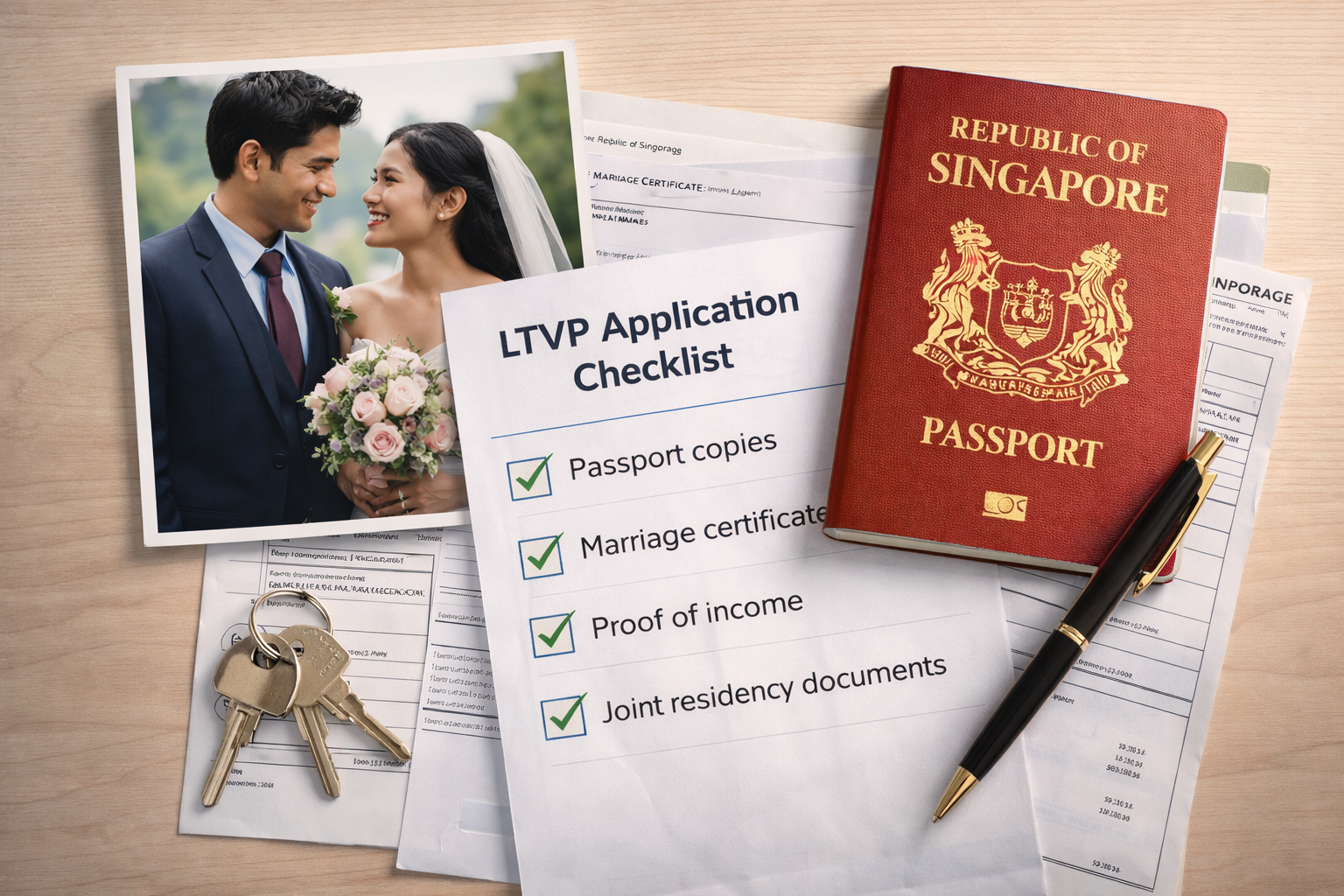
    Start preparing your application well in advance. Organize all necessary documents meticulously and ensure their accuracy. Use a checklist to verify that you have included every required piece of documentation and supporting evidence. Rushed applications are more likely to have errors or missing information. What Minister Gan’s 2026 Population Speech Means for Singapore PR and Citizenship Applicants

    2. Additional Supporting Documents

    Beyond the basic required documents, include additional supporting evidence to bolster your application. This can include:

    • Financial Statements: Provide detailed bank statements, proof of income, investment portfolios, and any other financial documentation to demonstrate your financial stability.

    • Relationship Evidence: Provide character reference letters from family and friends to prove the authenticity of your relationship.

    • Health Records: Ensure your health records are up to date and include your personal health insurance to showcase long-term planning and personal stability

    3. Detailed Cover Letter

    Write a comprehensive cover letter that clearly explains your reasons for applying for the LTVP, your relationship with your sponsor (if applicable), and your plans in Singapore. This letter should provide context and clarity to your application, helping the ICA understand your situation better.

    4. Address Previous Immigration Issues

    You might worry that declaring previous immigration offences on your application form will lead to an immediate rejection, and you might even consider not disclosing them at all. However, if the ICA discovers that you have intentionally withheld this information, it will give them a stronger reason to reject your application for dishonesty, and your future chances of approval could be significantly hindered.

    Uncovering the Ethnic Quota for PR and Citizenship in Singapore Inside Singapore’s World-Class Education System: The Secrets Behind Its Success Short Guide for Indians Moving to Singapore: Company Incorporation, Employment Pass, PR, and CECA Benefits style=”text-align: justify; font-family: Pontano Sans;”>Solution:

    If you have any history of visa overstays, deportations, or violations of immigration laws, address them honestly in your application. Explain any mitigating circumstances and provide evidence of your compliance with immigration regulations since those incidents.

    5. Professional Consultation

    Consider seeking the expertise of an agency. These professionals can provide invaluable advice, ensure every detail of your application is meticulously completed, and help you navigate common pitfalls. By leveraging their knowledge, you can significantly enhance the strength and success of your LTVP application.

    6. Stay Informed.

    The authorities have changed policies without prior notice to the public. Hence, staying updated on any changes in immigration policies or requirements can help you stay abreast with ICA’s regulations. Eligibility Criteria for Singapore PR: A Complete Overview

    Conclusion

    Receiving a rejection for your Long-Term Visit Pass (LTVP) application can be frustrating, but it doesn’t mean the end of your journey. By understanding the common reasons for rejection and following the provided solutions, you can significantly improve your chances of approval in future applications. Take the time to prepare thoroughly, provide accurate and comprehensive documentation, and seek professional advice if needed. With the right approach, you can navigate the LTVP application process successfully and enjoy your extended stay in Singapore.

    Ready to strengthen your LTVP application? E&H Immigration’s our LTVP service provides expert guidance tailored to your situation.

  • Why My Long-Term Visit Pass (LTVP) Application Was Rejected: Key Reasons and Solutions

    Why My Long-Term Visit Pass (LTVP) Application Was Rejected: Key Reasons and Solutions

    Applying for a Long-Term Visit Pass (LTVP) in Singapore can be a challenging process, and receiving a rejection can be disheartening despite following all the guidelines and submitted all the required documents. Understanding the common reasons for rejection and knowing how to address them can improve your chances of success in future applications. How to Improve and strengthen Your LTVP Application

    Choosing between LTVP or PR for Residency in Singapore. Inside Singapore’s World-Class Education System: The Secrets Behind Its Success style=”text-align: justify; font-family: Pontano Sans;”>In this article, we will explore the top reasons why LTVP applications are often rejected, provide an insight on ICA’s decision making process, and provide actionable solutions to help you navigate the process more effectively.

    Common Reasons for LTVP Rejection

    1. Insufficient Documentation One of the primary reasons for LTVP rejection is the submission of incomplete or incorrect documentation. The Immigration and Checkpoints Authority (ICA) requires a comprehensive set of documents to assess your eligibility.

    Solution: Ensure that you provide all necessary documents, including a valid passport, marriage certificate, birth certificates (for parents), and any other relevant paperwork. Documents not in English must be translated and notarised by a notary public in Singapore or the country that issued the document. How Can I Bring My Foreign Aged Parent Into Singapore? Exploring the Available Immigration Passes

    2. Inaccurate Information Providing incorrect or inconsistent information on your application can lead to rejection. This includes discrepancies in personal details, employment history, or relationship status.

    Solution: Carefully review your application before submission. Ensure all information is accurate and matches your supporting documents. Any discrepancies can raise red flags and lead to a denial. For example, the start and end dates of your employment should tally with what is stated in your resume and official employment documents.

    3. Financial Insufficiency The ICA needs assurance that you can financially support yourself and your family members during your stay in Singapore. If your financial proof is deemed insufficient, your application may be rejected.

    Solution: Provide clear evidence of your financial stability. This can include bank statements, employment letters, or proof of income. If sponsored by a Singaporean spouse or parent, include their financial details as well.

    4. Health Concerns Applicants must meet certain health standards. If there are significant health issues that were not disclosed or inadequately addressed, it might result in rejection.

    Solution: Undergo the required medical examinations and provide accurate health reports. Address any health concerns transparently and ensure all medical documentation is up to date. You may also provide ICA with you personal health insurance policies to showcase long-term financial planning.

    5. Previous Immigration Issues Any history of visa overstays, deportations, or violations of immigration laws can negatively impact your LTVP application.

    Solution: Maintain a clean immigration record. If you have previous issues, address them in your application and explain any mitigating circumstances. Demonstrating compliance with immigration regulations can bolster your case.

    6. Relationship Authenticity For applications based on marital or familial relationships, proving the length of your relationship is crucial. If the ICA doubts the authenticity, your application may be denied.

    Solution: Provide ample evidence of your relationship. This can include testimonials from family and friends. The more evidence you provide, the stronger your case

    Please note that the Immigration and Checkpoints Authority (ICA) does not disclose specific reasons for application rejections, and the outcome of your application is at the sole discretion of the authorities. This article aims to provide general guidance and should not be considered as a guarantee of approval. For personalized advice, please contact E&H Immigration Consultancy to understand the reasons behind your rejection.

    Had an LTVP application rejected? E&H Immigration’s our LTVP service provides expert guidance tailored to your situation.

  • Timing your Singapore PR or Citizenship submission to gain an edge.

    Timing your Singapore PR or Citizenship submission to gain an edge.

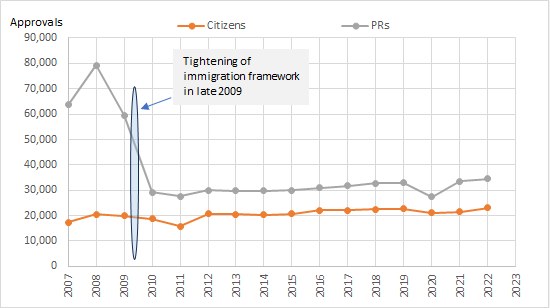
    Getting approved for Singapore Permanent Residency (PR) or Citizenship (SC) is notoriously hard with numerous stories of multiple failed attempts over many years. One reason for this is that the yearly approvals have moved to about an average of about 30,000 for PRs and 20,000 for SCs due to the Singapore government moving to a more restrictive and controlled immigration framework in late 2009. We are expecting these approvals to increase by around 1% on average per year as the population grows. What Minister Gan’s 2026 Population Speech Means for Singapore PR and Citizenship Applicants Short Guide for Indians Moving to Singapore: Company Incorporation, Employment Pass, PR, and CECA Benefits Singapore’s Population Cools in 2025: Deeper Insights for Residency Applicants

    Inside Singapore’s World-Class Education System: The Secrets Behind Its Success “Adding Value” to Singapore: What ICA Looks For (and How You Can Show It) class=””>Chart 1: ICA approvals of Singapore PRs and Citizens

    Source: Singapore Immigration and Checkpoints Authority

    Based on the latest data in Jun 2023[i], there is a pool of around 540,000 of PRs that could, taken to the extreme, apply to be citizens. However, since not all PRs want to be citizens and only some may make the decision to apply, we think the amount of new applications each year is perhaps 60,000 to 100,000 each year. For PRs, there are around 662,000[ii] of non-residents are eligible to be PRs. From this eligibility pool we think maybe 80,000 to 120,000 will apply for PR each year. This means the path to Singapore residency is a highly competitive one. Given this backdrop, applicants need to find any kind of edge they can to get ahead. We think one of these edges comes from timing your submission to periods when there will be potentially be less competition with fewer submissions in those periods.

    Using Google search trends of “Singapore PR applications” and “Singapore citizenship applications” as a proxy for lagged submissions we can make some judgements on when best to submit your application. Before continuing, we would like to note that we have made the assumption that final submissions will on average happen 1 month after the search of these keywords are done as people will still need to collate the appropriate documents before submitting to the ICA. 

    The best periods to submit your application

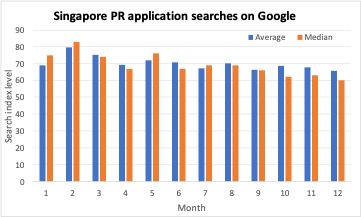
    Using the latest 10 years of data from Google we find that the last two months of the year and January looks like a better period to submit applications for Singapore PR applications as the median total of searches bottom out in December. In contrast the most competitive periods and least favourable periods looks to be around March and June. Please remember we have used a 1 month lag to make the conclusion e.g. if searches peak in February each year then 1 month later, in March, people will submit their applications.

    Chart 2: Monthly Google searches for “Singapore PR applications” from 2013 to 2023

    Source: Google

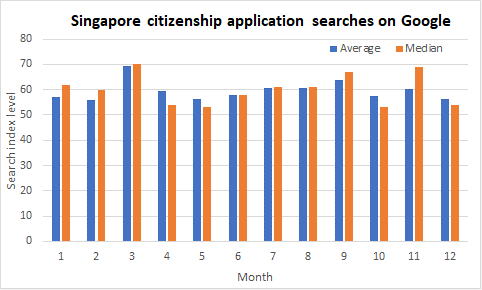
    Again, using the last 10 years of data from Google, we think the best time to make submissions for Singapore citizenship applications is during May, Jun, Nov, and January. Whereas, the least favourable months for submissions are potentially around April, October and December.

    Chart 3: Monthly Google searches for “Singapore citizenship applications” from 2013 to 2023

    Source: Google

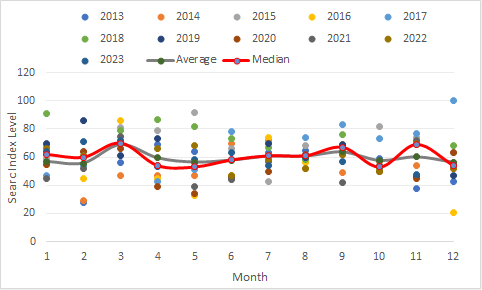
    However, we would caveat that due to wide variability in the data in some months, or in geek speak the distribution is not normally distributed, our confidence level in making these conclusions during these months are weaker. We have shown this variability in the chart below with data points for each year plotted for each month along with the averages and medians. These months include the October, November, January, February, April and March as the difference between the average and median is quite large, implying a less normal or skewed distribution of data points. Therefore, assuming a 1 month lag for submissions then we are less confident about our conclusions for November, December, February, May and April. Similar adjustments to our conclusions to PR applications also need to be made.

    Chart 4: Detailed monthly Google searches for “Singapore citizenship applications” from 2013 to 2023

    Source: Google

    If you like to boost your chances of success using this edge and other methods please reach out to E&H Immigration Consultancy for a complimentary 60 minute 1 on 1 session with our expert consultants.

    [i] See population-in-brief-2023.pdf

    [ii] This is based on data from the Singapore Department of Statistics and Ministry of Manpower comprised of 194,700 of Employment Passes, 177,000 of S-Passes, 283,200 of Dependent Passes, and 7,100 of Student Passes. Note, we have assumed only 10% of all 71,000 Student Pass holders are eligible as they need to have studied in Singapore for at least 2 years, pass at least one national exam (PSLE and either GCE or an Integrated Programme).

    Ready to time your Singapore PR application? E&H Immigration’s our Singapore PR application service provides expert guidance tailored to your situation. Also see: E&H Immigration’s our Singapore Citizenship service.

  • Denied? Don’t Despair! Navigate Your Singapore Citizenship Application Rejection and Master the Appeal Process

    Denied? Don’t Despair! Navigate Your Singapore Citizenship Application Rejection and Master the Appeal Process

    You’ve applied for Singapore citizenship and have waited months, even more than a year and finally you get a mail you’ve been eagerly waiting for but the result from the ICA is a rejection. “Adding Value” to Singapore: What ICA Looks For (and How You Can Show It)

    Inside Singapore’s World-Class Education System: The Secrets Behind Its Success Short Guide for Indians Moving to Singapore: Company Incorporation, Employment Pass, PR, and CECA Benefits style=”text-align: justify; font-family: Pontano Sans; font-size: calc((var(–large-text-size-value) – 1) * 1.2vw + 1rem);”>Many Singapore permanent residents aspire to obtain Singaporean Citizenship, but the process is more challenging than expected. While the government states that Singapore PRs can apply for citizenship after two years, the selection criteria for new citizens are stringent.

    Rejections for Singapore citizenship applications are common, with more cases of rejection than approval. If you’re facing rejection and seeking guidance, you’re in the right place.

    Before hastily preparing an appeal letter, it’s essential to pause and consider your options carefully.

    In this article, we’ll delve into the components of the Singapore citizenship application, potential reasons for rejection, and key factors the ICA evaluates when considering an appeal.

    Common Causes for Rejected Singapore Citizenship Applications

    Experiencing a rejection can be disheartening, especially when it comes to your Singapore citizenship application. Unfortunately, the Immigration & Checkpoints Authority (ICA) typically does not disclose specific reasons for rejections. However, there are common factors that could lead to such outcomes:

    1. Incomplete Application Steps: Missing out on any required steps during the application process can result in rejection.

    2. Incorrect Documentation: Submitting incorrect or incomplete documentation can lead to your application being turned down.

    3. Essential Documents Omitted: Failing to submit essential documents as part of your application can be a reason for rejection.

    4. Form Errors: Errors or inaccuracies in filling out application forms can also lead to rejection.

    5. Criminal Record: Any criminal convictions, even minor ones, can negatively impact your application.

    6. Security Concerns: If the ICA has any reason to believe that you may pose a security risk to Singapore, your application will likely be rejected.

    If you believe your application was error-free, rejection may stem from other factors. For instance, the ICA may seek more convincing evidence of your financial stability and commitment to Singapore in your application. Understanding these potential reasons can help you prepare a stronger application in the future.

    Key Changes to Highlight in Your Appeal Letter

    When writing an appeal letter for your Singapore citizenship application, it’s essential to highlight significant changes in your profile that warrant reconsideration. Here are some key points to include:

    1. Salary Increment: Demonstrate a significant increase in your monthly salary to show stronger financial stability.

    2. Promotion at Work: Highlight any recent promotions to indicate career advancement and the value you bring to your organization. What Minister Gan’s 2026 Population Speech Means for Singapore PR and Citizenship Applicants Singapore’s Population Cools in 2025: Deeper Insights for Residency Applicants

    3. Change in Marital Status and Newborn: Mention any changes in your marital status or the birth of a child, which signify your long-term plans in Singapore and align with the country’s focus on family growth.

    4. Property Ownership: Emphasize any recent property purchases in Singapore, showing your long-term commitment and investment in the country.

    Ensure to back up your appeal with relevant evidence, such as pay slips, appraisals, and birth certificates.

    If none of these changes apply to you, it might be best to wait and strengthen your profile before reapplying for Singapore citizenship.

    Consult a Professional Immigration Expert

    Before making your next move, seek professional advice. If your applications have been repeatedly rejected, it’s evident that expert guidance is needed to identify the missing elements.

    At E&H Immigration Consultancy, we thoroughly review your profile, documents, and past applications. We provide tailored recommendations to enhance your chances of a successful appeal.

    Citizenship application rejected? E&H Immigration’s our appeal and reapplication service provides expert guidance tailored to your situation. Also see: E&H Immigration’s our Singapore Citizenship service.

  • How important is your level of education when applying for Singapore residency (PR and citizenship)?

    How important is your level of education when applying for Singapore residency (PR and citizenship)?

    It turns out your parents were right about staying in school and going to university, at least that is the case for applicants for Singapore residency. Data from the Immigration and Checkpoints Authority (ICA), Singapore’s government agency in charge of granting Singapore Permanent Residency (SPR) and Citizenship (SC), shows that for 4 out of 5 people that are granted PR and citizenship have had education beyond secondary school level.

    “Adding Value” to Singapore: What ICA Looks For (and How You Can Show It) Short Guide for Indians Moving to Singapore: Company Incorporation, Employment Pass, PR, and CECA Benefits What Minister Gan’s 2026 Population Speech Means for Singapore PR and Citizenship Applicants>Education Profile of SCs and PRs granted in 2022

    New PRs New SCs
    Total approvals 34,493 23,082
    By highest qualification attained among those aged 20 & over (%)
    Post-secondary 81.3 78.2
    Secondary and below 18.7 21.8

    Source: ICA

    Is the ICA approving people to become citizen or PR because they spent more time learning beyond secondary school or is the pool of applicants already consist of 4 times more people with education beyond secondary shooling? We suspect it could be a combination of the two and, honestly, we will never really know unless the ICA shares more detailed breakdown of applicant profiles over the past decade. However, we do think that education is an important component in your profile because studies have shown more educated people tend to have higher incomes and higher incomes along with more education tends to lead to higher wealth.

    Education* Percentage of families Median income (2013) Median wealth (2013) Wealth-to-income ratio** Millionaires (family wealth)
    No high school diploma 12% $22,320 $37,766 1.43 1 in 110
    High school diploma 50% $41,190 $95,072 2.15 1 in 18
    Two- or four-year degree 25% $76,293 $273,488 3.45 1 in 4.6
    Advanced degree 13% $116,265 $689,100 5.58 1 in 2.6

    NOTE: *Based on the education level of a family headed by someone 40 years of age or older. **This ratio shows how much wealth each group has per dollar of income. For example, the ratio for families without a high school degree was 1.43, which means that, on average, for every $1 of income there was $1.43 of wealth. The ratio is a measure of how efficient people are at turning income into wealth.

    SOURCE: Boshara, Ray; Emmons, William R. and Noeth, Bryan. “The Demographics of Wealth: How Age, Education and Race Separate Thrivers from Strugglers in Today's Economy.” Essay No. 2: Education and Wealth, Federal Reserve Bank of St. Louis, May 2015, pp. 4, 5, 9, and 13. Singapore’s Population Cools in 2025: Deeper Insights for Residency Applicants

    Source: US Federal Reserve

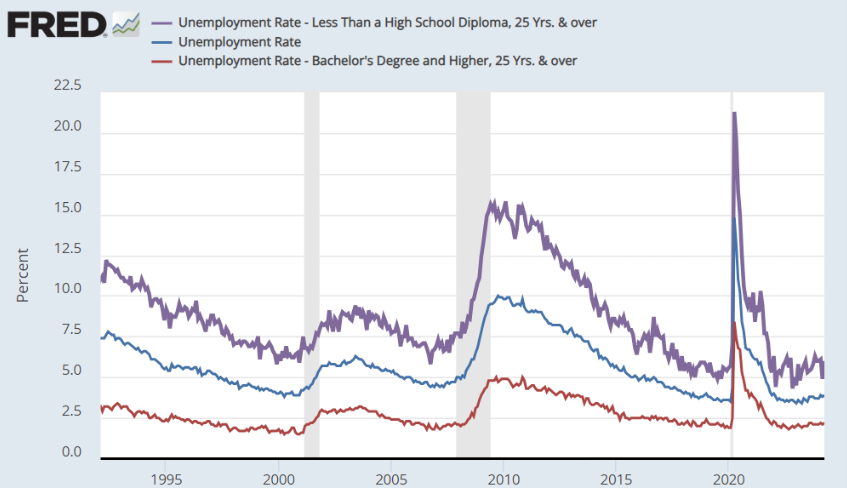
    People who are more educated also tend to have better job opportunities with lower rates of unemployment.

    Unemployment declines as education increases

    Source: US Federal Reserve

    More importantly, we have seen the government recognise the importance of education through the introduction of the Complementarity Assessment Framework (COMPASS[i]) points system on 1 September 2023, where the level of education and the ranking of the school can give you up to 20 points out of 40 needed to get an Employment Pass (EP). Having an EP is one pathway to get a PR. While COMPASS is not directly used to evaluate PR or citizenship applications, we do think some elements of it, such as the level of education, continue to play a significant factor in the application process. Inside Singapore’s World-Class Education System: The Secrets Behind Its Success

    What can you do if you think you score poorly for education?

    Fortunately, education is not the only determining factor for your Singapore PR or citizenship application. There are a multitude of other factors that also determine the success of your application. Come speak to E&H Immigration Consultancy if you need help with your application and please leave a comment if you have had issues with your application due to a weak education profile.

    [i] COMPASS has 6 criteria, where each criterion can earn up to 20 points, comprising the applicant’s: salary, qualifications, skills, company employee diversity, company strategic economic priorities (see https://www.mom.gov.sg/passes-and-permits/employment-pass/eligibility).

    Planning your Singapore PR or citizenship application? E&H Immigration’s our Singapore PR application service provides expert guidance tailored to your situation. Also see: E&H Immigration’s our Singapore Citizenship service.

  • Will approvals for Singapore residency decline ahead of General Elections next year?

    Will approvals for Singapore residency decline ahead of General Elections next year?

    If you were to speak to people in the immigration industry there is a common belief that the Singapore government will tighten immigration policy ahead of General Elections. Are these beliefs well founded? We will try to answer this question by taking a deep dive into approvals of Singapore permanent residency (PR) and Citizenship (SC) into and out of General Elections. Unfortunately, we only have access to a limited dataset covering the last 3 elections so one should bear this in mind when taking in the results.

    Inside Singapore’s World-Class Education System: The Secrets Behind Its Success “Adding Value” to Singapore: What ICA Looks For (and How You Can Show It) Short Guide for Indians Moving to Singapore: Company Incorporation, Employment Pass, PR, and CECA Benefits>Some bias towards tighter immigration policy ahead of elections

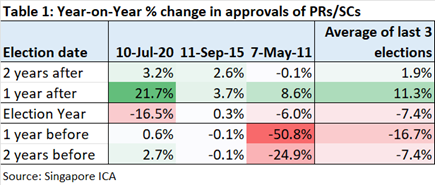
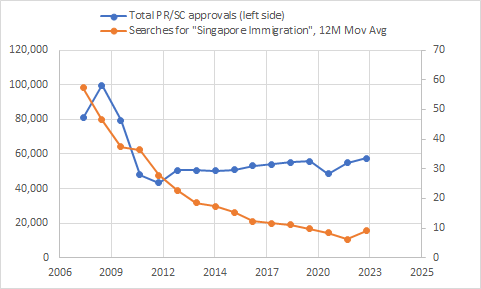
    As we can see from the table below there is a tendency for approvals of Singapore residency (PR/SC) to decline up to 2 years before the year of the General Elections.

    However, we would caveat that this downward bias would be a lot less resounding if it weren’t for the fact that a) the world was exiting a generational meltdown in financial markets and economic growth, aka “The Great Financial Crisis (GFC)” in early 2009, b) the declines in the lead up to the 2015 election were relatively modest, even arguably flat, and c) we think there was a lot of political pressure (measured through Google searches for “Singapore immigration”) to drastically tighten immigration and slow down residency approvals as job growth took a substantial hit lower due to the GFC. Since then, we think the government has taken a more measured approach to growing the population through net inward migration. However, there is a stronger case to be made that approvals decline in the year of the election as those years (2011, 2015, 2020) were not marred by any significant global or local financial/economic crisis. What Minister Gan’s 2026 Population Speech Means for Singapore PR and Citizenship Applicants

    Chart 1: Singapore residency approvals vs Google searches for “Singapore immigration”

    Source: Singapore ICA, Google Trends

    Approvals normalise after elections and resume trend growth

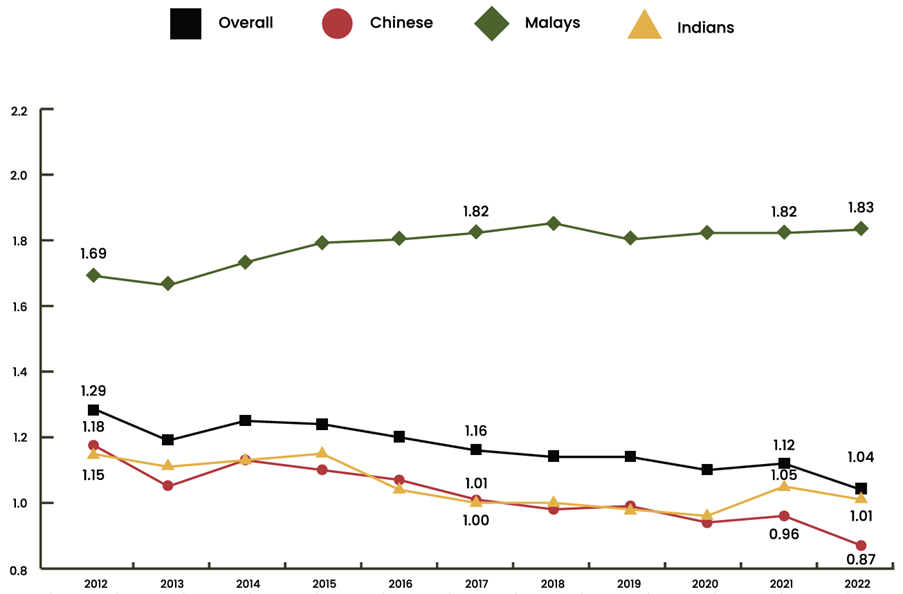
    In contrast, in the following two years after the election year there is a clear bias for approvals to rebound and normalise back to trend levels of around 1.5% annual growth[1]. With resident fertility rates at historic lows of 1.04 we think any declines in approvals will be swiftly reverted back to trend positive growth to help offset the critically low birth rates in the resident population (see chart below).  

    Chart 2: Total fertility rate in Singapore’s resident population by ethnic group

    Source: Singapore Department of Statistics

    What about the next General Election?

    With Prime Minister Lee Hsien Loong passing the leadership reins to Deputy PM Lawrence Wong on 15th May 2024 the expectation is for the next General Elections to be held sometime between November 2024 to November 2025 since the next General Election has to be called by November 2025. If we were to guess, we think the most probable time would be sometime in mid to late 2025 to give the new PM, Lawrence Wong, some time to adjust to his new position. Given our findings above, we think there is some risk that immigration will tighten over the next 12 months. It is therefore critical for prospective PR/SC applicants to ensure their applications are completed at a high and meticulous standard. For expert advice and help on residency applications please contact E&H Immigration Consultancy (www.eh-immigration.com). Singapore’s Population Cools in 2025: Deeper Insights for Residency Applicants

    [1] We use the last 10 years of data to calculate the average annual growth rate of 1.5%.

    Planning your Singapore PR application? E&H Immigration’s our Singapore PR application service provides strategic, profile-tailored case building to maximise your approval chances.


  • Your Path to Becoming a Singapore Permanent Resident: Simplifying the Journey

    Your Path to Becoming a Singapore Permanent Resident: Simplifying the Journey

    Singapore’s global business and cultural allure makes it a sought-after destination for professionals and entrepreneurs. For those aspiring to call this vibrant city-state their permanent home, the Singapore Permanent Residency application process offers a clear pathway. Becoming a Singapore Permanent Resident provides numerous benefits, including access to employment opportunities, education, healthcare, and social security. However, navigating the Application for Permanent Residency in Singapore can be complex due to various requirements and guidelines. Firms like E&H Immigration Consultancy, are experts in guiding applicants through the complex process.

    Application for Permanent Residency in Singapore: Process and Requirements

    Short Guide for Indians Moving to Singapore: Company Incorporation, Employment Pass, PR, and CECA Benefitster-gans-2026-population-speech-means-for-singapore-pr-and-citizenship-applicants”>What Minister Gan’s 2026 Population Speech Means for Singapore PR and Citizenship Applicantsify; font-family: Pontano Sans; font-size: calc((var(–large-text-size-value) – 1) * 1.2vw + 1rem);”>Applying for Singapore Permanent Residency involves several steps. Initially, you must submit necessary documents such as your birth certificate, marriage certificate (if applicable), and proof of residency. Additionally, you will need to provide evidence of your employment status, income, and contributions to Singapore’s society. The Immigration and Checkpoints Authority (ICA) evaluates your application based on these factors, considering each case individually. The entire process may take several months, and you can check the status of your application online. Getting a free Consultation may be a good choice to know your chances. Singapore’s Population Cools in 2025: Deeper Insights for Residency Applicants What Minister Gan’s 2026 Population Speech Means for Singapore PR and Citizenship Applicants

    Benefits of Becoming a Singapore Permanent Resident

    Comprehensive Benefits

    As a Singapore Permanent Resident, you will receive a Singapore identity card, granting you various privileges, including access to education, healthcare, public housing, and employment opportunities. Additionally, second-generation male permanent residents are required to serve National Service (NS), similar to male Singapore citizens.

    Financial Security Through CPF

    Permanent residents contribute to the Central Provident Fund (CPF) scheme, a robust social security system that provides retirement, healthcare, and housing benefits. A monthly minimum amount is deducted from your salary, ensuring long-term financial security for you and your family. Inside Singapore’s World-Class Education System: The Secrets Behind Its Success

    Emphasis on Social Integration

    Building a Strong Community

    Social integration is crucial for new permanent residents transitioning into Singaporean society. Singapore offers a dynamic cultural environment that promotes social connections among residents. By participating in cultural activities, community events, and social initiatives, new permanent residents can significantly contribute to society while enjoying a strong sense of belonging. “Adding Value” to Singapore: What ICA Looks For (and How You Can Show It)

    Post Application for Permanent Residency: What to Expect Next

    Once you have submitted your Singapore Permanent Residency application, you might wonder about the subsequent steps. The ICA will review your application thoroughly. During this period, regular updates can be checked online, and you should be prepared for any additional document requests or interviews that may arise.

    E&H Immigration Consultancy: Your Partner in the PR Journey

    Navigating the complexities of the Singapore Permanent Residency application can be challenging. E&H Immigration Consultancy is here to help. Our team of experts provides comprehensive assistance, guiding you through every step of the application process. With personalized support and in-depth knowledge of Singapore’s immigration policies, we ensure a smooth and hassle-free experience for our clients.

    Conclusion

    Becoming a Singapore Permanent Resident is a significant step toward full integration into society and enjoying the numerous benefits it offers. Social integration plays a crucial role in making your transition smoother and more fulfilling. For expert assistance, consider E&H Immigration Consultancy, where our team is dedicated to helping you navigate the Singapore Permanent Residency application process seamlessly. Book a free consultation to learn more about how we can support your journey to becoming a Singapore Permanent Resident.

    Ready to begin your Singapore PR journey? E&H Immigration’s our Singapore PR application service provides strategic, profile-tailored case building to maximise your approval chances.