Author: eh_admin

  • A Brief Overview of MOM’s Latest ONE Pass

    A Brief Overview of MOM’s Latest ONE Pass

    Overview of ONE Pass

    Singapore introduced the Overseas Networks & Expertise Pass (ONE Pass) on January 1, 2023, aiming to strengthen its position as a global talent hub. This pass is designed for top talents in various sectors, including business, technology, science, arts, culture, sports, academia, and research. The ONE Pass allows eligible individuals to manage and work for multiple companies in Singapore simultaneously.

    Why Singapore Should Be Your Next Safe and Secure Home Inside Singapore’s World-Class Education System: The Secrets Behind Its Success Short Guide for Indians Moving to Singapore: Company Incorporation, Employment Pass, PR, and CECA Benefits> The ONE Pass is valid for five years and may be renewed indefinitely for additional five-year periods as long as the renewal criteria are met. Successful applicants can also apply for Dependant Passes for their spouses and children, and Long-Term Visit Passes for their parents. Spouses on Dependant Passes are eligible to live and work in Singapore with a Letter of Consent (LOC). Incorporating a Company in Singapore and Obtaining an Employment Pass (EP): Your Step-by-Step Guide

    Eligibility for ONE Pass

    Candidates undergo a thorough assessment to determine their eligibility, focusing on their potential to significantly contribute to Singapore’s economy and society. The application routes include:

    1. By Salary – Candidates must meet either of the following criteria:

    • Current work pass holders or overseas residents who have earned a fixed monthly salary of at least S$30,000 (or its equivalent in foreign currency) over the past 12 months with their current company in Singapore.

    • Overseas candidates must have worked for an established company overseas for at least one year. The company must have a market capitalization or valuation of at least US$500 million or an annual revenue of at least US$200 million.

    • Future employment in Singapore must offer a fixed monthly salary of at least S$30,000.

      *The fixed monthly salary must be derived from a single employer, though other income sources may be considered on a case-by-case basis.

    2. Outstanding Achievements:

    Individuals with significant accomplishments in arts, culture, sports, academia, or research can qualify without meeting the salary criteria. These applicants must provide a detailed Curriculum Vitae (CV) and endorsement letters from local host research institutions such as the Autonomous Universities or A*STAR.

    Benefits of ONE Pass

    • Starting a Company: ONE Pass holders can easily incorporate a company in Singapore and enjoy benefits such as a longer tenure and more flexibility compared to EntrePass holders. They can act as directors and shareholders in multiple companies.

    • Employment Flexibility: The pass is tied to the individual, not a company, allowing holders to start, operate, and work for multiple companies without needing to reapply for a new pass when changing jobs.

    • Family Benefits: Dependents, including spouses and children, can reside in Singapore. Spouses on Dependant Passes can work with an LOC.

    • Permanent Residency: Candidates and their family members are eligible for Singapore Permanent Residency after they have resided in Singapore for a minimum of 6 months.

    Procedures for ONE Pass Application

    Applications for the ONE Pass can be submitted by the applicant, a prospective employer, or an employment agency. The processing time is approximately four weeks, though additional documents and information may be requested by the Ministry of Manpower (MOM). Understanding The Employment Pass Process In Singapore

    There is a non-refundable submission fee of SGD $105 per application, and if the application is approved, there is the issuance fee of SGD $255 for each applicant

    Documents Required for ONE Pass

    – For candidates meeting the S$30,000 salary criterion in Singapore:

    • Current Employment Pass

    • Monthly payslips for the past 12 months

    • Latest tax statements from the Inland Revenue Authority of Singapore

    – For candidates meeting the S$30,000 salary criterion overseas:

    • Biodata page of the travel document

    • Monthly payslips for the past 12 months

    • Employment verification proof

    • Company valuation or revenue documentation

    – For candidates with a prospective employer in Singapore:

    • Biodata page of the travel document

    • Monthly payslips for the past 12 months

    • Employment contract or letter of offer

    • Company valuation or revenue documentation

    – For candidates with outstanding achievements:

    • Biodata page of the travel document

    • Latest month’s payslips

    • Comprehensive CV highlighting key achievements

    • Endorsement letter from a local host institution for academia and research

    Renewal Criteria

    To renew the ONE Pass, the holder must either:

    • Maintain an average monthly salary of at least S$30,000 over the past five years in Singapore; or

    • Operate a company in Singapore that employs at least five local employees, each earning a minimum salary of S$5,000.

    Annual submissions of income details and professional activities are required for MOM’s assessment.

    We recommend calculating your chances of approval prior to submitting the ONE pass application. For more information on the ONE Pass, consider consulting with E&H Immigration Consultancy. Visit www.eh-immigration.com for more information.

    Interested in the ONE Pass? E&H Immigration’s our Work Pass service provides expert guidance tailored to your situation.

  • Boost Your Singapore PR Application: The Ultimate Guide to Recommendation Letters

    Boost Your Singapore PR Application: The Ultimate Guide to Recommendation Letters

    For many foreigners hoping to establish a permanent home in Singapore, applying for Singapore Permanent Residence (PR) is the first step towards that goal. The recommendation letter is one of the most important documents needed for a successful Singapore PR application, and it may really help you make your case. This article will guide you through the complexities of acquiring and writing a strong recommendation letter.

    1. Recommendation Letters Explained: Key to Your PR Success

    A recommendation letter for your Singapore PR application is a formal document written by someone who can vouch for your character, skills, and potential contribution to Singapore. This letter serves as third-party validation of your qualifications and suitability as a potential permanent resident.

    Inside Singapore’s World-Class Education System: The Secrets Behind Its Success Short Guide for Indians Moving to Singapore: Company Incorporation, Employment Pass, PR, and CECA Benefits What Minister Gan’s 2026 Population Speech Means for Singapore PR and Citizenship Applicants>Key points: Singapore’s Population Cools in 2025: Deeper Insights for Residency Applicants

    • Letters of recommendation are essential to your Singapore PR application since they offer a distinct perspective of your personality and skills.

    • These documents provide an outsider’s viewpoint, which gives a more holistic picture of who you are than just your credentials and accomplishments.

    • A strong recommendation letter can add a great deal of credibility to your application by highlighting your personal traits, work ethic, and future contributions to Singapore society.

    • Having endorsements from reputable individuals can greatly enhance your chances of acceptance and improve your odds in the competitive PR application process.

    2. Choosing the Right Recommender: Who Can Make Your Application Stand Out

    It is essential to choose the right person to write your letter of recommendation. The ideal person should understand your abilities and be able to speak to your potential value as a Singapore permanent resident.

    Consider the following when choosing a recommender:

    • Singaporeans or Permanent Residents

    • Professional supervisors or managers who can attest to your work ethic and skills

    • Academic mentors or professors who can speak to your intellectual capabilities

    • Community leaders or prominent figures who can vouch for your character and social contributions “Adding Value” to Singapore: What ICA Looks For (and How You Can Show It)

    • Family members or close friends who can vouch for your family ties in Singapore

    3. Writing an Effective Recommendation: Essential Components

    A well-structured recommendation letter should include several key elements to make it effective and persuasive.

    Essential components include:

    • Introduction: The recommender’s relationship to you and the context of your association. This includes the author’s occupation and employment details

    • Body: Specific examples of your skills, achievements, and character traits, or instances that are commendable

    • Relevance to Singapore: How your qualities align with Singapore’s values and needs

    • Conclusion: A strong endorsement of your suitability for permanent residency

    4. Highlighting Strengths: Balancing Praise with Objectivity

    While the goal is to present you in the best light possible, it’s important that the recommendation letter maintains credibility through objectivity.

    Tips for achieving this balance:

    • Use concrete examples to illustrate your strengths

    • Include specific achievements or situations that demonstrate your capabilities

    • Acknowledge areas of growth, but focus on how you’ve improved or overcome challenges

    • Avoid overly effusive language that might seem insincere

    5. Recommendation Letter Best Practices: What You Need to Know

    To ensure your recommendation letter makes the strongest impact possible, keep these best practices in mind:

    • Provide your recommender with a clear outline of what should be included

    • Ensure the letter is tailored specifically for a Singapore PR application

    • Request the letter well in advance of your application deadline

    • Review the letter (if possible) to check for any errors or misrepresentations

    • Submit the letter in the required format as specified by the Immigration & Checkpoints Authority (ICA)

    The success of a Singapore PR or Citizenship application depends on numerous factors, both direct and indirect. A well-crafted recommendation letter can significantly enhance an applicant’s prospects of approval. To maximize your chances, applicants may benefit from seeking guidance from experienced immigration consultants.

    For detailed guidance on the crafting a strong recommendation letter, consider consulting with E&H Immigration Consultancy. Visit www.eh-immigration.com for more information.


    Ready to build your PR application? E&H Immigration’s our Singapore PR application service provides strategic, profile-tailored case building to maximise your approval chances.

  • [UPDATED] Major Changes to Singapore’s Citizenship, PR and LTVP Application Procedures

    [UPDATED] Major Changes to Singapore’s Citizenship, PR and LTVP Application Procedures

    On 26th June 2024, the Immigration and Checkpoints Authorities (ICA) has streamlined procedures and improved transparency by implementing multiple modifications to its Citizenship and Permanent Residence (PR) application processes. Below is a detailed summary of the major modifications that may impact applicants:

    Changes to PR Application Processes

    ·         Removal of the Offline Form 4A:

    “Adding Value” to Singapore: What ICA Looks For (and How You Can Show It) Short Guide for Indians Moving to Singapore: Company Incorporation, Employment Pass, PR, and CECA Benefits What Minister Gan’s 2026 Population Speech Means for Singapore PR and Citizenship Applicants>Applicants submitting their PR applications no longer have access to the offline Form 4A, following a process similar to the previous Citizenship application system. This implies that all necessary documents and information must be prepared in advance before they login to ICA’s e-services portal to complete the online form. The system allows applicants to save their form as a draft for up to 7 days before it is automatically discarded if not submitted. Singapore’s Population Cools in 2025: Deeper Insights for Residency Applicants

    ·         Additional Information on Family Members:

    Providing detailed information about your immediate family member is now a crucial part of your PR application. This includes information regarding their job status, company address, salary, and job description. This supplementary data attempts to provide a clearer picture of the applicant’s family background and financial stability.

    ·         Annex A Document Update:

    Your current company’s Annex A is no longer required for submission, but you must still provide financial details about both your past and present employers on the online application form. Specifically, applicants need to fill out information regarding the company’s turnover for the last three years, paid-up share capital, and manpower strength.

    ·         Streamlined PR Eligibility for Student Pass Holders:

    Previously, Student Pass holders could only apply for Singapore Permanent Residency (PR) after residing in Singapore for a minimum of 2 years and sitting for at least one of Singapore’s national examinations, such as the Primary School Leaving Examination (PSLE), Singapore-Cambridge General Certificate of Education (GCE) N Level, O Level, A Level, or being enrolled in the Integrated Programme (IP). Inside Singapore’s World-Class Education System: The Secrets Behind Its Success

    With the recent changes, Student Pass holders no longer need to meet the 2-year residency requirement. They can now apply for Singapore PR as long as they have passed at least one national examination.

    Changes to the Long-Term Visit Pass (LTVP) Processes:

    ·         Expanded Family Eligibility for Student Pass Holders

    Fathers and grandfathers can now accompany foreign students holding a valid Student Pass in Singapore. Previously, only mothers and grandmothers were permitted to apply for the LTVP to accompany their child studying in Singapore on a Student Pass. Please note that either the parent or grandparent may apply for the LTVP.

    ·         Sponsorship Now Available for Foreign Parents of Younger Singaporean or PR Children

    Singaporean or PR children under the age of 21 can now sponsor their aged foreign parents for the LTVP. Previously, only children above the age of 21 could sponsor their aged parents for this LTVP. But the caveat is, younger Singaporean or PR children must find a local sponsor to apply for their parent’s LTVP. The local sponsor must be Singapore or a PR and aged 21 and above.

    Changes to Citizenship Application Processes

    ·         Enhanced Transparency On The Eligibility Criteria:

    The ICA has provided further clarification on the eligibility criteria for aged parents and spouses of Singapore Citizens.

    Previously, aged parents could apply for citizenship directly through their Singaporean child. However, the ICA now requires that aged parents first obtain Permanent Resident (PR) status before they are eligible to apply for citizenship.

    Similarly, for spouses of Singapore Citizens, the ICA now mandates that they must be PRs for at least 2 years and have been married for at least 2 years before they can apply for citizenship. Previously, PR spouses of Singaporeans could apply for citizenship after residing in Singapore for 2 years.

    Changes to LTVP, PR and Citizenship Application Processes

    ·         Extended Validity of Certificate of Employment (COE):

    The validity period for the Certificate of Employment has been extended from 1 month to 3 months. This modification gives applicants more time to obtain and submit their COE. Moreover, accompanying applicants are now required to submit their six months’ worth of payslips and overseas tax assessments, enabling ICA to conduct a more thorough verification of income and employment history.

    ·         NS Deferment Eligibility Clarification:

    The Immigration and Checkpoints Authority (ICA) has clarified its stance on National Service (NS) deferment eligibility by adding a new section to its website. This update offers applicants a clearer understanding of the requirements and criteria for deferring NS obligations.

    ·         Disclosure of Overseas Residency:

    An applicant must now specify the reason for their international travels if they have spent more than six months living abroad in the previous six years. This requirement seeks to shed more light on the applicant’s overseas activities.

    Other Notable Changes

    ·         CIT Application Submission PDFs:

    Applicants who submitted their Citizenship applications before the recent changes will recall that ICA did not provide downloadable PDFs of the submitted forms. But now, the submitted application forms are available for download in PDF format.

    ·         Application Fees for Multiple Products:

    Applicants eligible to apply for multiple products, such as the Long-Term Visit Pass and Permanent Residence, within a single application will now pay a combined application fee of S$130. This fee structure is introduced to streamline the process and reduce individual application costs. Applicants will be informed of this option at the start of their application

    ·         Processing Time Adjustments:

    Applications will generally be processed within six months, provided all required documents are correctly submitted. For applications involving multiple products, the processing time will be based on the product with the longer processing duration. Some applications may experience extended processing times depending on their complexity and the number of products applied for.

    For detailed guidance on the changes imposed by ICA, consider consulting with E&H Immigration Consultancy. Visit www.eh-immigration.com for more information.


    Navigating the latest changes for your PR application? E&H Immigration’s our Singapore PR application service provides expert guidance tailored to your situation. Also see: E&H Immigration’s our Singapore Citizenship service. Also see: E&H Immigration’s our LTVP service.

  • Comprehensive Guide to Work Passes in Singapore

    Comprehensive Guide to Work Passes in Singapore

    Foreigners intending to work in Singapore must have a valid work pass (commonly known as a work visa) before starting work. Employers must ensure their foreign employees hold the appropriate pass. The type of work pass required depends on the nature of the work. This guide provides an overview of the various work passes available in Singapore.

    Employment Pass (EP):

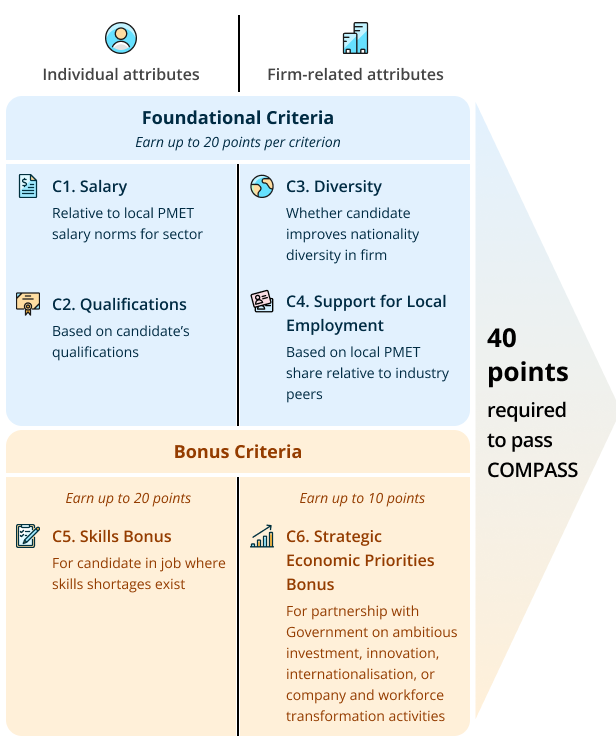
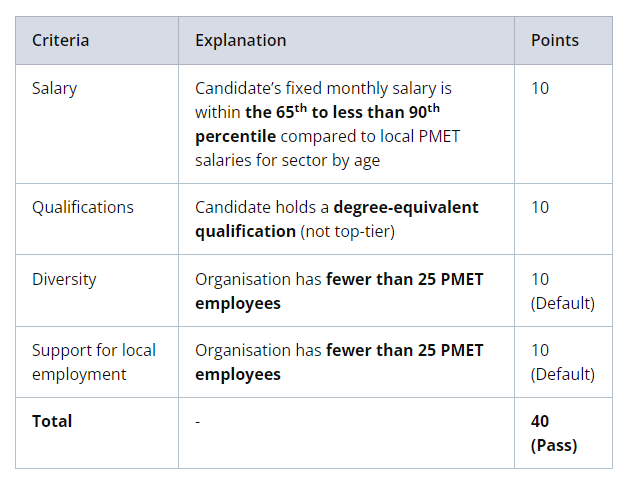
    As of now, foreign professionals, managers, and executives earning at least S$5,000 a month and the qualifying salary increases progressively with age. Applicants must pass the Complementarity Assessment Framework (COMPASS). Under the COMPASS framework, applicants need to score the requisite 40 points across 6 broad categories. Three of the categories involves individual attribute and the other three involves the hiring firm’s attributes. Passes are for a duration of up to 2 years for first time candidates and renews for up to 3 years. Key features of the pass are the availability of passes for eligible family members and employers do not have to pay a foreign worker levy or be subjected to quotas.

    EntrePass:

    For foreign entrepreneurs looking to start and operate a venture-backed or innovative technology business in Singapore. More specifically, the applicant needs to have raised funding for a past or current business, has been supported by a government recognised or internationally renowned incubator or accelerator, founded and sold a technology business, holds intellectual property or have a research collaboration in Singapore. There is no minimum salary required but the term for new passes and first time renewals are 1 year in duration. On the other hand, subsequent renewals are for 2 year duration. While the ICA has final say on the approval, Enterprise Singapore will periodically contact pass holders for engagement (such as hosting/speaking at workshops, organising deal-making or networking session, or provide mentorship for other startups) and audit purposes so applicants and pass holders should ensure they keep MOM updated on any significant changes to their profile. The key benefits of this pass are the flexibility for applicants to start and operate a business in Singapore, availability of passes for eligible family members, no quotas for the pass. The ability to get passes for family members will be based on the annual turnover of the business, local workers hired, funding raised, and experience of the applicant in starting/running companies, or the intellectual properties held. What Minister Gan’s 2026 Population Speech Means for Singapore PR and Citizenship Applicants

    Personalised Employment Pass (PEP):

    For high-earning existing EP holders or overseas foreign professionals, this pass offers greater flexibility than a standard Employment Pass. However, the requirements can be tougher with applicants needing to have a monthly salary of at least S$22,500. For overseas foreign nationals, this will be the last drawn salary within the last 6 months of the application. The duration of the pass is up to 3 years and there is no ability to renew it. To continue working in Singapore after expiry, applicants need to get another type of work pass. Other features of the pass include not needing to reapply for a pass when there is a change in job, availability of passes for eligible family embers and employers do not have to pay a foreign worker levy or be subjected to quotas. PEP holders can also apply for Singapore Permanent Residency (PR).

    Overseas Networks & Expertise (ONE) Pass:

    For top talent in business, arts and culture, sports, and academia and research. The Immigration and Checkpoints Authority (ICA) generally assesses each ONE Pass candidates on a case-by-case basis. Each applicant needs to have a fixed monthly salary of at least S$30,000 or its equivalent currency, for the past 12 months. If you are an overseas candidate, you must be able to demonstrate that you worked for a company that has a market capitalisation or valuation of US$500 million or an annual revenue of at least US$200 million, and to have worked in the company overseas for at least 1 year. Alternatively, if the salary criteria are not met, candidates need to show outstanding achievements in either sports, arts/culture or academia and research. The ONE Pass is renewable for 5 years each time. Other benefits of this pass are that candidates are exempted from the COMPASS framework and employers do not need to comply with the Consideration Framework job advertising requirements, employers also do not need to pay foreign worker levy and there is no quota, availability of passes for eligible family members and spouses are able to apply to work on a Letter of Consent (LOC).

    Next Steps and How We Can Help

    Choosing the right work pass is crucial for a smooth employment experience in Singapore. For detailed guidance on the application process and eligibility criteria, consider consulting with E&H Immigration Consultancy. Visit www.eh-immigration.com for more information.

    Why Singapore Should Be Your Next Safe and Secure Home Inside Singapore’s World-Class Education System: The Secrets Behind Its Success Short Guide for Indians Moving to Singapore: Company Incorporation, Employment Pass, PR, and CECA BenefitsIncorporating a Company in Singapore and Obtaining an Employment Pass (EP): Your Step-by-Step Guide

    Need help with a Singapore work pass? E&H Immigration’s our Work Pass service provides expert guidance tailored to your situation.

  • 5 Ways to Become a Singapore Permanent Resident (PR)

    5 Ways to Become a Singapore Permanent Resident (PR)

    Obtaining Permanent Residency (PR) status offers numerous benefits, including easier travel in/out of Singapore, access to cheaper but highly regarded top-tier local educational institutions, and the freedom to live and work freely in Singapore and much reduced stamp duties when purchasing residential property. Here are five main pathways you can consider:

    Short Guide for Indians Moving to Singapore: Company Incorporation, Employment Pass, PR, and CECA Benefits What Minister Gan’s 2026 Population Speech Means for Singapore PR and Citizenship Applicants class=””>1. Employment Routes: Singapore’s Population Cools in 2025: Deeper Insights for Residency Applicants

    Professionals, Technical Personnel & Skilled Workers Scheme (PTS): This popular option is suitable for professionals with a valid work pass in Singapore. These work passes include Employment Pass (EP), S Pass, EntrePass (Entrepreneurship Pass), Personalised Employment Pass (PEP), and Overseas Networks & Expertise Pass (ONE Pass). You must have held the pass for at least six months and possess strong qualifications, potentially with a good salary, to increase your chances of success.

    2. Family Ties:

    Sponsored Scheme: This route allows Singapore Citizens (SCs) or existing PRs to sponsor their legally married spouse, unmarried or adopted children (under 21 years old), or aged parent(s) of a Singapore citizen for PR. This is a great way to reunite with family and build a life together in Singapore.

    3. Education Pathway:

    Students studying in Singapore that have passed at least one national exam (i.e. PSLE, GCE ‘N’/’O’/’A’ levels), or are in the Integrated Programme (IP) can also apply for Singapore PR.

    4. Talent Attraction Schemes:

    The Foreign Artistic Talent Scheme (ForArts) is designed for established foreign artists who have significantly contributed to Singapore’s vibrant art scene. This program is open to renowned artists, sculptors, musicians, dancers, filmmakers, and literary figures with notable achievements. While jointly administered by the Singapore Immigration & Checkpoints Authority (ICA) and the National Arts Council (NAC), the ICA remains the final authority on all PR applications. ForArts focuses on professional experience, achievements, and a commitment to advancing the arts and cultural landscape in Singapore.

    Eligibility Criteria for ForArts:

    • Relevant training and education in your artistic field.

    • Professional experience and outstanding achievements in Performing Arts, Visual Arts, Literary Arts, Design, or Media.

    • A strong track record of contributions to Singapore’s arts and cultural scene, including leadership-level engagements.

    • Concrete future plans to be actively involved in Singapore’s arts and cultural sector.

    • Demonstrated ability to play a critical role in advancing local arts and culture, with good character and the capacity to serve as a role model.

    ForArts prioritizes applicants who have a proven record of engaging with the local public and arts community, distinguishing it from direct applications to the ICA, where such specific criteria are not emphasized. This scheme offers a unique pathway to PR for those committed to enriching Singapore’s cultural landscape. “Adding Value” to Singapore: What ICA Looks For (and How You Can Show It)

    5. Investment Pathway:

    Global Investor Programme (GIP): This is the fastest route to PR, but with the rapid influx of wealthy families in recent years the investment requirement has increased significantly. Here’s a breakdown of the current investment options as of July 2024:

    • Option A: Invest a minimum of S$10 million (Singapore Dollars) in a new business entity or the expansion of an existing business operation in Singapore. This investment must be in an approved business sector as determined by the Singapore government. Additionally, the applicant must have at least 30% shareholding in the company and must be part of the management team either at the C-suite or Board of Directors level.

    • Option B: Invest S$25 million in a GIP-approved fund that also invests in Singapore-based companies. These funds are carefully selected by the Singapore government to ensure they contribute to the growth of the Singaporean economy. (Source: Singapore Economic Development Board (EDB))

    • Option C: Establish a Singapore-based Single-Family Office with Assets-Under-Management (AUM) of at least S$200 million. Out of this, a minimum of S$50 million must be actively deployed in one or more of the following approved investment categories below. Additionally, detailed 5 year business plan with projected employment and annual financial projections are required.

      • Equities, Real Estate Investment Trusts (REITs), Business trusts listed on Singapore-approved exchanges.

      • Qualifying debt securities: These are bonds or other debt instruments issued by governments or corporations, and listed on the Monetary Authority of Singapore’s (MAS) enquiry system. MAS is the central bank of Singapore. Inside Singapore’s World-Class Education System: The Secrets Behind Its Success

      • Funds distributed by Singapore-licensed/registered managers or financial institutions: These are investment funds managed by professionals in Singapore.

      • Private equity investments in non-listed, Singapore-based operating companies: Investments in companies that are not publicly traded but are actively engaged in business operations in Singapore.

    Additional Considerations for GIP Applicants:

    Beyond the minimum investment amounts, the GIP program has additional requirements depending on your applicant category:

    1. Established Business Owners: The applicant must have a strong track record of managing a successful business of at least 3 years and a clear plan for your Singapore venture are crucial.

    2. Next Generation Business Owners: The applicant’s immediate family should have at least 30% shareholding or is the largest shareholder in the company used in the application.

    3. Founders of Fast Growth Companies: The applicant must be a founder and one of the largest individual shareholders of a non-publicly listed company with a valuation of at least S$500 million and have investors from a reputable Venture Capital or Private Equity firms.

    4. Family Office Principals: The applicant must have at least 5 years experience as an entrepreneur, investor or manager, and have investible assets of at least S$200 million.

    Ready to Start Your Journey to Singapore PR?

    Navigating the pathways to Singapore Permanent Residency can be complex, but you don’t have to do it alone. At E&H Immigration Consultancy, we specialize in guiding clients through the intricacies of the PR application process. Whether you’re applying through employment, family ties, education, talent, or investment, our experienced consultants are here to help you every step of the way.

    Why Choose E&H Immigration Consultancy?

    • Expert guidance tailored to your unique profile

    • Comprehensive support, from document preparation to application submission

    • In-depth knowledge of the latest immigration policies and criteria

    Take the Next Step Today! Visit our website at www.eh-immigration.com to learn more about our services and schedule a consultation. Let us help you unlock your Singapore dream and make your PR application a success.

    Ready to take the next step toward PR? E&H Immigration’s our Singapore PR application service provides strategic, profile-tailored case building to maximise your approval chances.

  • Unlock Your Singapore Dream: 7 Reasons to Use an Immigration Consultant for your PR Application

    Unlock Your Singapore Dream: 7 Reasons to Use an Immigration Consultant for your PR Application

    Navigating the Singapore PR application process can feel like trying to solve a complex puzzle, especially the government doesn’t share its framework for approvals. Most of the time, for the untrained applicant, after parsing the Immigration and Checkpoints Authority’s, ICA, website you are left to make educated guesses on what the ICA are seeking in an ideal PR profile. Along with numerous requirements, strict criteria, and subtle nuances, it’s easy to feel overwhelmed. This is where expert guidance becomes invaluable. Immigration consultants have in-depth knowledge of the system, understanding both the written rules and the unwritten expectations. Their expertise can be the difference between a successful application and a disappointing rejection. Here’s why this strategy could be your key to unlocking a future in Singapore. Inside Singapore’s World-Class Education System: The Secrets Behind Its Success

    Short Guide for Indians Moving to Singapore: Company Incorporation, Employment Pass, PR, and CECA Benefits class=””>1.     Lots of Competition and Low Number of Approvals

    The path to becoming a Singapore Permanent Resident (PR) can be complex and challenging with likely well over 100,000-150,000 applicants each year and growing. From the large applicant pool only around 30,000-34,000 are granted PR each year. Given long preparation and wait times for the result, high stakes of a rejection and fierce competition, many applicants are turning to professional consultants to boost their chances of success. Unless the applicant is already highly versed and knowledgeable in Singapore immigration matters, applications submitted by non-professional consultants’ risk being thrown in the heap of mediocrity when compared to the submissions prepared by experienced and skilled consultants.

    2. Simplify Your Singapore PR Journey, Save Time and Reduce Stress with Professional Assistance

    The Singapore PR application process can be very daunting at the best of times. From gathering the right documents to filling out forms correctly, every step matters. A seasoned consultant can guide you through this maze, ensuring you don’t miss crucial details or make common mistakes. They’ll help you understand each requirement, assist in collecting and organizing necessary documents, and ensure your application is complete and error-free. This not only saves you time but also significantly reduces stress and uncertainty. The consultant will also help guide you when you have missing documents or if your profile is more complex, and requires more strategic planning and execution. What Minister Gan’s 2026 Population Speech Means for Singapore PR and Citizenship Applicants Singapore’s Population Cools in 2025: Deeper Insights for Residency Applicants

    3. Navigating Nuanced Criteria for PR Success

    While the basic eligibility criteria for Singapore PR are publicly available, the actual evaluation process is more nuanced. Consultants have insights into the less obvious factors that can influence your application’s success. They understand what the ICA looks for beyond the basic requirements. This insider knowledge allows them to help you highlight your strengths and address potential weaknesses in your application, significantly improving your chances of approval. This often involves deep profiling of the applicant and actively working with the consultant to follow proven protocols that help increase chances of success.

    4. Enhance Your PR Profile with Expert Strategies

    Singapore’s PR application process is highly competitive, with a substantial rejection rate. Many applicants, despite meeting the basic criteria or seemingly having strong profiles, face disappointment. Consultants bring strategies to the table that can help you stand out from other applicants are working alone or with other consultants. They know how to present your profile in the best light, emphasizing aspects that align with Singapore’s long-term goals and values. Their experience with numerous applications gives them insight into what works and what doesn’t, allowing you to avoid common pitfalls that lead to rejection. Strategising is especially crucial when your profile is complex with missing documents, uncommon but unique lived experiences for yourself and/of family members. “Adding Value” to Singapore: What ICA Looks For (and How You Can Show It)

    5. Stay Updated with Ever-Changing PR Application Rules

    Immigration policies and application procedures are subject to frequent updates. Keeping track of these changes can be challenging for individual applicants. PR consultants make it their business to stay informed about the latest developments. They can alert you to new requirements, changing priorities, or shifts in evaluation criteria. This up-to-date knowledge ensures your application is always in line with current expectations, preventing delays or rejections due to outdated information. They also apply best practices to your submission. Sometimes as an outsider or uninitiated to immigration matters, you don’t know what you don’t know.

    6. Developing a Standout PR Application Package

    Your PR application and the accompanying documents submitted is your opportunity to make a compelling case for why you should be granted permanent residency. A consultant can help you craft a standout application package by including information/documents that are not in the standard ICA checklist. One such document is the cover letter, which will highlight your unique contributions, potential value to Singapore and bring together all the important elements of your profile to the forefront of the submission. They can also advise on which supporting documents will strengthen your case and how to present them effectively. With their guidance, you can create an application that not only meets all requirements but also leaves a lasting positive impression.

    7. Expert Analysis and Guidance Post-Rejection

    In the event of a rejection, consultants can offer valuable insights and assistance on the path forward following such unfortunate news. They will analyse 1) the reasons for rejection, if any are given, 2) previous submission, 3) changes to the applicant’s circumstances. Following the analysis, they will address any deficiencies and provide guidance on how to improve future submission. Depending on the requirements and constraints of the applicant, the consultant will also advise on whether it is more appropriate to appeal or lodge a new submission. This support can be crucial in achieving PR status on subsequent attempts while working within any constraints or goals the applicant may have such as time constraints.

    Secure Your Future in Singapore: Take the Next Step with Confidence

    Applying for Singapore PR is a significant step towards building your future in this vibrant city-state. While it’s possible to navigate the process on your own, working with a consultant can give you a significant advantage. Their expertise, insights, and personalized guidance can maximize your chances of success, saving you time, reducing stress, and bringing you closer to your dream of calling Singapore home, and apprising yourself to the many benefits that come with a PR status.

    Remember, your PR application is more than just paperwork – it’s your gateway to new opportunities and a new life. With the right support, you can approach this challenge with confidence, knowing you’ve given yourself the best possible chance of success. Take the first step towards your Singapore future today and contact E&H Immigration Consultancy for expert guidance on your PR application

    Ready to apply for Singapore PR with expert support? E&H Immigration’s our Singapore PR application service provides strategic, profile-tailored case building to maximise your approval chances.

  • Case Study: A Journey to Singapore Permanent Residency

    Case Study: A Journey to Singapore Permanent Residency

    Background

    Meet a South Korean national who had lived overseas since he was 2 years old. After moving to Singapore, he found a place where he truly felt accepted and decided to pursue his studies here. Little did he know, this decision would mark the beginning of a challenging yet rewarding journey toward becoming a Singapore Permanent Resident (PR). Short Guide for Indians Moving to Singapore: Company Incorporation, Employment Pass, PR, and CECA Benefits

    The Challenge

    He had already been living in Singapore for 10 years when he decided to apply for PR status. Despite his deep connection to the country, his first three PR applications were rejected. Undeterred, he continued to study, maintaining a valid Foreign Student Pass throughout his education. Feeling the weight of multiple rejections, he was on the brink of giving up. Inside Singapore’s World-Class Education System: The Secrets Behind Its Success

    The Turning Point

    Determined to make Singapore his permanent home, He decided to engage the services of an immigration specialist. This decision was crucial in changing the trajectory of his application process. The specialist guided him in crafting a compelling application that highlighted his dedication to Singapore, his stable employment, and his long-term intentions.

    The Application Process

    He submitted his fourth PR application in March. This time, his application was meticulously prepared, detailing his contributions and future plans among many other factors:

    • Commitment to Citizenship: He expressed his intention to apply for Singapore Citizenship in the future.

    • Economic Contribution: He emphasized his stable job and ongoing contributions to the Central Provident Fund (CPF).

    • Appreciation for Safety: He highlighted how Singapore’s safety and stability were key factors in his desire to settle down long-term.

    The Outcome

    After a 7-month wait, his persistence and the expertise of his immigration specialist paid off. He received the long-awaited news that his PR application had been approved.

    Conclusion

    His journey to Singapore PR status is a testament to the power of perseverance and the importance of seeking professional guidance when needed. His story serves as an inspiration to many who face similar challenges, demonstrating that with determination and the right support, success is within reach.

    What Minister Gan’s 2026 Population Speech Means for Singapore PR and Citizenship Applicants class=””>He is now enjoying life as a Singapore Permanent Resident, contributing to the community, and planning his future as a Singapore citizen. His story underscores the value of never giving up on your dreams and the impact that expert assistance can have on navigating complex immigration processes. “Adding Value” to Singapore: What ICA Looks For (and How You Can Show It) Singapore’s Population Cools in 2025: Deeper Insights for Residency Applicants

    Ready to start your own PR journey? E&H Immigration’s our Singapore PR application service provides strategic, profile-tailored case building to maximise your approval chances.

  • Singapore PR or Citizenship Rejected? Here’s Your Comeback Strategy (Appeal or Reapplication)

    Singapore PR or Citizenship Rejected? Here’s Your Comeback Strategy (Appeal or Reapplication)

    Facing a Singapore PR or Citizenship application rejection? Don’t lose hope! This guide explores your options for a successful comeback: appealing the decision or submitting a stronger reapplication.

    Short Guide for Indians Moving to Singapore: Company Incorporation, Employment Pass, PR, and CECA Benefits What Minister Gan’s 2026 Population Speech Means for Singapore PR and Citizenship Applicants class=””>Appealing Your Rejection (Limited Timeframe!) Singapore’s Population Cools in 2025: Deeper Insights for Residency Applicants

    Did the ICA reject your application? Here’s how to fight back with a well-crafted appeal letter:

    • Act Quickly! You only have 6 months from the rejection date to submit an appeal.

    • Highlight Significant Changes: Showcase improvements since your initial application (promotion, marriage, increased community involvement).

    • Personalize Your Appeal: Ditch generic templates. Explain why your unique skills and commitment make you a valuable addition to Singapore.


    Winning Appeal Strategies:

    • Quantify Your Value: Don’t just say “promotion.” Mention your new position and salary increase to demonstrate your economic contribution. “Adding Value” to Singapore: What ICA Looks For (and How You Can Show It)

    • Focus on Long-Term Commitment: Getting married or buying property in Singapore shows you plan to stay for the long haul.

    • Address Feedback (if any): Use your appeal letter to demonstrate how you’ve addressed any weaknesses identified in your initial application.


    Reapplication: A Fresh Start

    If you haven’t had major changes, reapplying might be a better option:

    • Self-Assessment: Evaluate your profile to identify areas where you can improve your eligibility score by using our Singapore residency eligibility calculator here.

    • Strengthen Your Profile: Gather missing documents or certifications that could strengthen your application.

    • Consider Professional Help: Immigration specialists can analyze your situation and suggest strategies for a stronger application.

    Unsure which path is right for you, or need help crafting a winning appeal letter? E&H Immigration Consultancy can guide you through the entire process. Our experienced team understands the complexities of Singapore’s immigration system and can help you navigate your comeback strategy. Inside Singapore’s World-Class Education System: The Secrets Behind Its Success

    Don’t let a rejection stop you from achieving your Singapore dream! Contact E&H Immigration Consultancy today for a free consultation. We’ll help you maximize your chances of success.

    Visit us online: https://www.eh-immigration.com/

    Email us: info@eh-immigration.com

    Remember: High Standards for Both Options

    The Immigration & Checkpoints Authority (ICA) holds both appeals and reapplications to rigorous standards. Careful preparation and understanding the eligibility criteria are crucial.

    Achieve Your Singapore Dream!

    By crafting a compelling appeal or a robust reapplication, you can significantly increase your chances of securing Singapore PR or Citizenship.

    Considering an appeal or reapplication? E&H Immigration’s appeal service helps you re-strategise and build a stronger case for re-submission.

  • Choosing between LTVP or PR for Residency in Singapore.

    Choosing between LTVP or PR for Residency in Singapore.

    Choosing the right residency option for yourself depends on your individual needs and goals. This article compares the Long-Term Visit Pass (LTVP) and Singapore Permanent Residency (PR) for spouses of existing Singaporeans or PR holders.

    Short Guide for Indians Moving to Singapore: Company Incorporation, Employment Pass, PR, and CECA Benefits What Minister Gan’s 2026 Population Speech Means for Singapore PR and Citizenship Applicants class=””>Decision Framework for LTVP vs PR: Singapore’s Population Cools in 2025: Deeper Insights for Residency Applicants

    Source: ICA

    Long Term Visit Pass (LTVP)

    Pros:

    • Faster Application: Easier and quicker application process compared to PR. On average around 4 weeks.

    • Flexibility: Allows extended stay in Singapore with renewals from 6 months onwards.

    • Work Option: You can apply for an LOC to work in Singapore.

    Cons:

    • Limited Benefits: LTVP holders don’t enjoy the same benefits as PRs, such as subsidies and social programs.

    • Renewal Requirements: You need to renew the LTVP periodically.

    Permanent Residency (PR)

    Pros:

    • Stability: Provides greater long-term residency and stability in Singapore.

    • Extensive Benefits: PRs have access to various social benefits like healthcare subsidies, lower school fees for children at public schools (see appendix 1), eligibility to purchase re-sale public housing (HDB flats), stay for extended period (up to end of the Re-entry Permit) to search for employment, and can contribute to the Central Provident Fund (CPF) retirement savings scheme. “Adding Value” to Singapore: What ICA Looks For (and How You Can Show It)

    • Pathway to Citizenship: PR can be a stepping stone to applying for Singapore citizenship in the future.

    Cons:

    • Stringent Application: The PR application process is more complex and requires meeting specific criteria. Approval can be more challenging and take on average between 6-12 months to receive an outcome.

    • National Service (NS) Liability: Male children of PRs may be subject to NS obligations when they reach adulthood.

    Choosing the Right Option for You

    • Immediate Needs: If you need to be in Singapore quickly, the LTVP might be the better short-term option.

    • Long-Term Plans: If you plan to settle in Singapore for the long term and enjoy more benefits, applying for PR is more advantageous.

    • Eligibility and Preparedness: Consider your eligibility for PR and preparedness for the application process, which requires detailed documentation and can take time.

    Example:

    John and Mary, a married couple, recently moved to Singapore when John received a job offer. Mary, as John’s spouse, initially applied for an LTVP due to the faster processing time. However, after settling in and enjoying life in Singapore, they decided on a long-term stay. John and Mary are now preparing their application for Singapore PR to access the wider range of benefits and opportunities Singapore offers.

    Navigating the complexities of immigration processes in Singapore can be challenging. E&H Immigration Consultancy, a trusted immigration specialist, can guide you through the LTVP or PR application process for spouses of PR holders.

    Our experienced consultants can:

    • Help you determine the best residency option for your individual needs and goals.

    • Assist you with gathering required documentation and completing the application process.

    • Offer ongoing support and answer your questions throughout the application journey.

    Don’t navigate Singapore’s immigration system alone! Contact E&H Immigration Consultancy today for a free consultation and discuss your residency options.

    Appendix 1: Public school fees for International Students (IS) and students on PR

    Considering Singapore PR over LTVP? E&H Immigration’s our Singapore PR application service provides expert guidance tailored to your situation. Also see: E&H Immigration’s our LTVP service.

  • The Pros and Cons of Singapore Citizenship in Short

    The Pros and Cons of Singapore Citizenship in Short

    Singapore, renowned for its strategic location, economic strength, and vibrant multicultural environment, attracts many to its shores, both as tourists and as potential residents. Acquiring Singaporean citizenship offers numerous benefits, but it also comes with certain challenges. Here, we explore the pros and cons of becoming a citizen of the Lion City.

    Advantages of Singapore Citizenship

    High Standard of Living

    What Minister Gan’s 2026 Population Speech Means for Singapore PR and Citizenship Applicants>Singapore boasts one of the highest standards of living in the world. It offers world-class infrastructure, social stability, open trade policies, excellent healthcare, a robust education system, and a safe environment, making it an attractive place to live and raise a family. Singapore’s Population Cools in 2025: Deeper Insights for Residency Applicants

    Strong Economy

    As a global financial hub, Singapore provides ample economic opportunities. Its stable economy, low unemployment rate, and business-friendly environment make it a favorable place for both entrepreneurs and professionals.

    World-Class Education

    Singapore’s education system is globally acclaimed, with its universities and schools consistently ranked among the best. Citizens have access to quality education from primary to tertiary levels, often with government subsidies and financial aid through schemes like CDAC, SINDA, MENDAKI, Edusave Pupils Fund, Edusave Grants, and Edusave Scholarships & Awards. Inside Singapore’s World-Class Education System: The Secrets Behind Its Success

    Healthcare Excellence

    The country’s healthcare system is among the best in the world, offering high-quality medical services. Citizens benefit from substantial government subsidies, making healthcare more affordable.

    Worlds Strongest Passport

    A Singaporean passport is one of the most powerful in the world, providing visa-free or visa-on-arrival access to numerous countries. This significantly eases international travel for Singaporean citizens. According to the VisaGuide Passport Index, the Singaporean passport holds the top position, offering visa-free entry to 196 countries, making it one of the most sought-after passports globally.

    Multicultural Society

    Singapore is celebrated for its diverse cultural mix, with people from various backgrounds living harmoniously. This blend of Chinese, Malay, Indian, and other cultures enriches everyday life, from languages spoken to the food enjoyed. Festivals such as Chinese New Year, Hari Raya, Deepavali, and Christmas bring people together, showcasing Singapore’s cultural richness through shared celebrations and culinary delights. Short Guide for Indians Moving to Singapore: Company Incorporation, Employment Pass, PR, and CECA Benefits

    Safety and Cleanliness

    Singapore’s low crime rate is a testament to its efficient law enforcement and high public awareness. Advanced security measures, including extensive surveillance and proactive policing, contribute to the safety of its citizens and residents. The city-state is also renowned for its cleanliness, maintained through rigorous public policies. “Adding Value” to Singapore: What ICA Looks For (and How You Can Show It)

    Parenthood Subsidies

    Singapore provides various parenthood benefits and subsidies to support families. These include the Baby Bonus Scheme, childcare and infant care subsidies, and parental leave entitlements, making it more affordable to raise children in the country.

    Affordable Housing

    Citizens have the exclusive opportunity to purchase Built-To-Order (BTO) flats from the Housing and Development Board (HDB). These government-subsidized flats are significantly more affordable than private housing, providing citizens with a cost-effective option for homeownership.

    Disadvantages of Singapore Citizenship

    Mandatory National Service

    Male citizens and second-generation permanent residents are required to serve in the National Service for two years, followed by reservist duties. They must also undertake up to 40 days of Operationally Ready National Service each year until they reach 50 years old for officers or 40 years old for non-officers. This commitment can be a significant consideration for families.

    No Dual Citizenship

    Singapore does not allow dual citizenship. Individuals wishing to become Singaporean citizens must renounce their citizenship in any other country. This can be a significant drawback for those who have strong ties to their country of origin or who wish to retain the benefits of their previous nationality.

    High Cost of Living

    According to the Economist Intelligence Unit (EIU) Cost of Living survey on the cost of living, housing, transportation, and daily expenses in Singapore can be considerably higher than in many other countries, which can be a challenge for some residents. 

    Limited Natural Resources

    Singapore is a small island nation with very few natural resources, relying heavily on imports for water, food, and energy. This dependence on external sources makes the country vulnerable to global supply chain disruptions and geopolitical tensions. Despite efforts like desalination plants, NEWater, urban farming, and high-tech agriculture, Singapore’s reliance on imports remains a critical issue.

    Singapore Citizenship offers a wealth of advantages, from economic opportunities and educational excellence to global mobility and a high standard of living. However, potential citizens must also weigh these benefits against the challenges, such as mandatory national service, high living costs, and strict regulations. Ultimately, the decision to pursue Singaporean citizenship depends on individual priorities and circumstances, balancing the country’s unique offerings with its inherent challenges. If you would like to know more about how to become a Singapore citizen, please visit E&H Immigration Consultancy. 

    Weighing up Singapore citizenship? E&H Immigration’s our Singapore Citizenship service provides expert, profile-tailored guidance at every step of the process.