
Category: Immigration Advice

Practical advice for Singapore immigration applicants

  • Singapore PR Approval Rate Myth: Why 90% Claims Don’t Survive Basic Math

    Singapore PR Approval Rate Myth: Why 90% Claims Don’t Survive Basic Math

    If an immigration agency promises you a 90% chance of getting your Singapore PR, ask them to show you the math.

    Key Facts at a Glance

    • Singapore granted 35,264 PRs in 2024 (Population in Brief 2025).
    • The 5-year average is approximately 33,000 PR grants per year.
    • Singapore has 382,200 EP and S Pass holders alone — before counting spouses, students, parents, and investors.
    • Minister Gan’s 2026 speech projects approximately 40,000 PR grants annually over the next five years.
    • A nationwide 90% approval rate would require fewer than 37,000 total annual applicants — a figure inconsistent with the size of the eligible pool.

    If you have been comparing immigration consultancies in Singapore, you have probably seen big claims about “high approval rates.” Some agencies hint at 90%, 95%, or even 99% success. Those numbers sound comforting, but once you compare them against Singapore’s actual PR grant numbers and the size of the potential applicant pool, they become extremely hard to believe.

    That does not mean all agencies are the same. Good Singapore immigration consultants can improve a client’s chances — by choosing better timing, presenting a stronger narrative, avoiding documentary mistakes, and highlighting the factors Singapore cares about. But there is a major difference between improving someone’s odds and marketing a result that suggests approval is almost guaranteed.

    The better way to think about Singapore PR is this: approval is constrained by national policy, demographic needs, infrastructure limits, and the number of places the Government is prepared to grant each year. No consultancy, however polished, controls that ceiling.

    Official Singapore PR Approval Statistics (2024–2026)

    The Singapore Government’s Population in Brief 2025 publication states that 35,264 people were granted permanent residence in 2024. It also notes that the average number of permanent residencies granted per year over the last five years was approximately 33,000.

    At the same time, the Immigration and Checkpoints Authority (ICA) PR eligibility page shows that the main categories include spouses of Singapore Citizens or PRs, Employment Pass holders, S Pass holders, students in certain circumstances, aged parents of Singapore Citizens, and foreign investors.

    On the work-pass side alone, MOM’s Foreign Workforce Numbers show that as of December 2025, Singapore had 203,300 Employment Pass holders and 178,900 S Pass holders, or 382,200 in total. That already gives us a very large pool of potentially eligible adult applicants before we even count foreign spouses, students, investors, and repeat applicants.

    Why a 90% Singapore PR Approval Rate Is Mathematically Unlikely

    Let’s keep this simple. If Singapore grants approximately 33,000 PRs per year, then the math runs like this:

    • A 90% approval rate would imply only ~36,700 total applicants nationwide.
    • A 95% approval rate would imply only ~34,700 applicants.
    • A 99% approval rate would imply only ~33,300 applicants.

    That already looks strange. Why? Because the EP and S Pass population alone is 382,200 people. If just 10% of that group applied in a year, that would already produce about 38,220 applicants — and that is before counting foreign spouses, students, aged parents, investors, and repeat applicants.

    In other words, you do not even need heroic assumptions to see the problem. The official PR grant numbers and the official size of the work-pass population already make 90% or above look mathematically weak.

    A Simple School-Prize Example

    Imagine a school has 100 students trying to win 33 prizes. A tutor may help some students perform better. A good tutor may even help more of its students win than average. But if a tuition centre tells you that almost everyone who joins them wins, you would naturally ask how that can be true when the total number of prizes is limited.

    Singapore PR works in a similar way. A good agency can improve the quality of the application. But the country still controls the number of approvals.
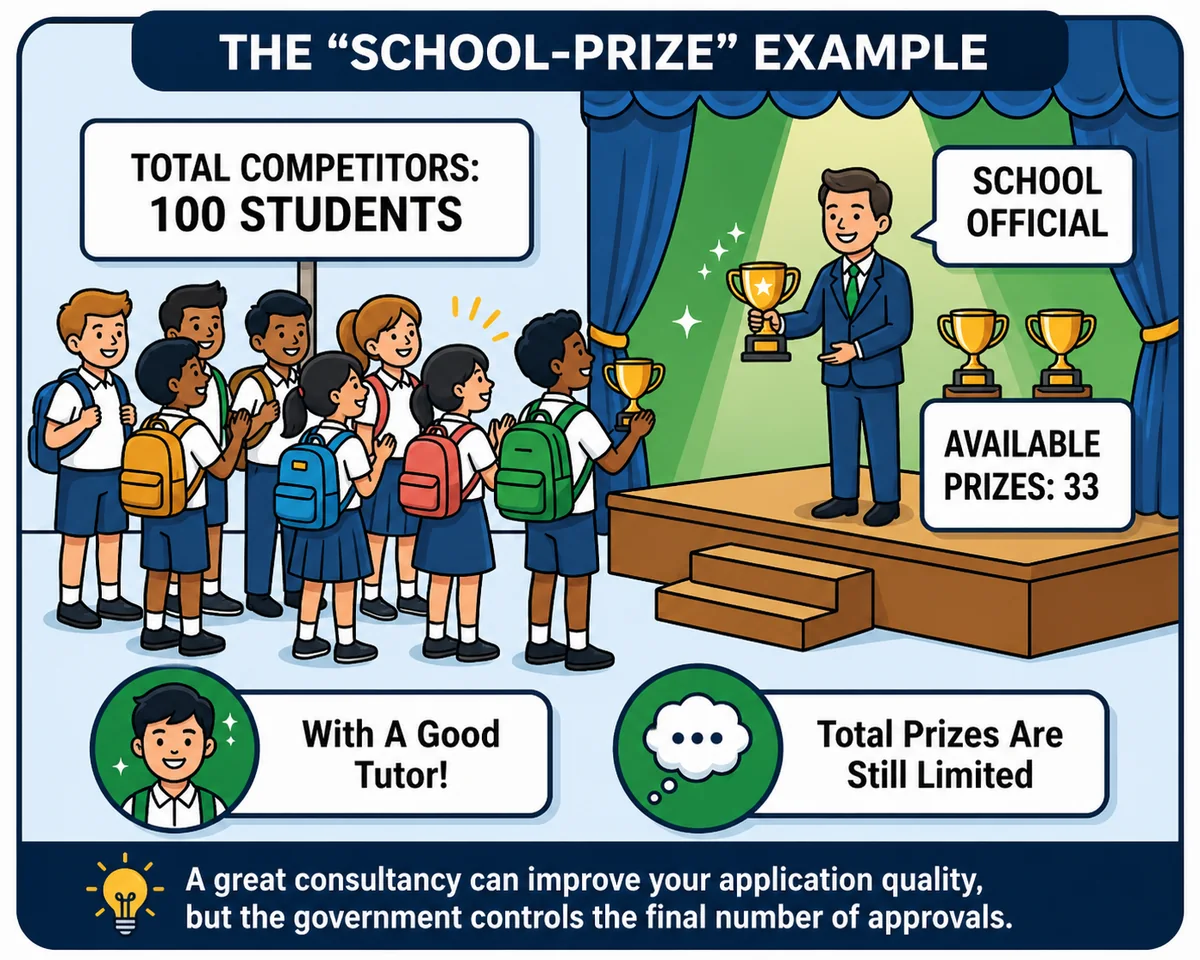
    School prize analogy illustrating how Singapore PR approval numbers work — limited places regardless of tutor quality
    The school-prize analogy: a good tutor improves student performance, but cannot increase the total number of prizes available — just as a good consultancy cannot increase Singapore’s annual PR intake.

    What Is the Realistic Singapore PR Approval Rate?

    Because Singapore does not publicly publish a simple nationwide headline figure for total PR applications, no outsider can honestly claim to know the exact overall approval rate. The most defensible approach is to use scenario analysis.

    Estimated annual PR applicantsImplied approval rate (33,000 PRs granted)Implied approval rate (40,000 PRs granted)
    75,00044%53%
    100,00033%40%
    125,00026%32%
    150,00022%27%
    200,00017%20%
    Scenario-based illustrations only. Not official approval rates. Sources: Population in Brief 2025; DPM Gan Kim Yong, Committee of Supply 2026.

    These are not official approval rates. They are scenario-based illustrations. But they show the same basic point: once you compare the number of grants with a realistic applicant pool, the broad national approval rate is much more likely to sit somewhere far below 90%.

    Curious where your profile actually stands? Request a free initial assessment and get an honest read on your Singapore PR chances.

    Minister Gan’s 2026 Population Speech: What It Means for PR Applicants

    Deputy Prime Minister Gan Kim Yong said in his 2026 Committee of Supply speech that Singapore estimates an intake of about 40,000 PRs annually in the next five years, slightly higher than the roughly 35,000 PRs granted last year.

    That is important. It suggests approval chances may improve at the margin. Put plainly, the door may be opening a little wider. But a slightly wider door is not the same as an open door. Even if PR grants rise from around 33,000 a year to around 40,000, the numbers still do not support blanket claims that 90%, 95%, or 99% approval rates are normal or likely.

    Minister Gan also made clear that actual intake will still be adjusted depending on fertility trends, the number and suitability of applicants, and Singapore’s infrastructure and society’s capacity to absorb immigrants. That means Singapore is still balancing immigration against housing, transport, public services, and social cohesion.

    Why Singapore Has a Selective PR Approval Process

    Singapore needs immigration because of ageing and a very low birth rate. Minister Gan noted that the resident total fertility rate was 0.87 in 2025. But Singapore is also a small city-state with limited land and finite infrastructure capacity. That creates a permanent balancing act.

    The Government wants to keep the economy vibrant, maintain a stable citizen core, and support long-term demographic sustainability. At the same time, population growth cannot outrun housing supply, transport, healthcare, or schools. Public acceptance is also critical.

    This is one of the key reasons PR approval rates are not naturally high. Singapore is not trying to approve every decent application. It is trying to approve the right number of suitable applicants at a pace the country can absorb.

    Can an Immigration Consultancy Improve Your Singapore PR Chances?

    Yes. This is the part that should be said clearly and fairly: a good immigration consultancy can improve a client’s chances. Strong advisors spot timing issues, identify weak evidence, and organise documents persuasively. They reduce contradictions, highlight integration factors, and present the applicant’s economic, family, and social case more clearly.

    Local experience matters. Case pattern recognition matters. Knowing what tends to work — and what often undermines a case — matters.

    So the right question is not whether agencies add value. Many do. The real question is how much value they can add within a system where final decisions and annual intake remain controlled by the Government. For more on how to evaluate a consultancy honestly, see our guide on what to watch out for when choosing an immigration consultancy in Singapore.

    Why Smaller Immigration Firms May Report 60–70% PR Approval Rates

    A 60% to 70% approval rate is not automatically impossible. A smaller or younger firm may genuinely report numbers in that range for a period of time. That can happen because the company is highly selective, only accepts stronger profiles, is still founder-led, has tight quality control, or simply has a small enough sample size that luck has more influence on the headline number.

    Think of flipping a coin. If you flip it 10 times, getting 7 heads is possible. But if you flip it 1,000 times, getting 700 heads is much harder to explain. As a firm handles more and more completed cases, luck matters less and the true long-run performance becomes more visible.

    That is why clients should never judge an approval-rate claim without asking how many cases it is based on, what client mix it reflects, and whether weaker or discouraged cases were excluded before the calculation was made.

    Why Larger Immigration Firms Tend Toward Average PR Approval Rates

    As agencies grow, they usually take on a wider spread of clients. They also face more variation in staff, review quality, and operating discipline. And once the number of cases becomes large, luck has far less room to flatter the results.

    That does not mean every mature firm must collapse to the national average. A well-run company can still outperform the market. But it does mean that older, bigger firms should usually show a more stable, explainable long-term rate rather than a spectacular number that sounds too good to be true.

    In short, smaller firms can sometimes look unusually good for a while because of selectivity, case mix, and luck. Larger firms eventually have less room to hide behind luck.

    How Elite Singapore Immigration Firms Sustain Above-Average Approval Rates

    There is, however, one important exception to the idea that bigger firms always drift close to the average. Some elite consulting companies can sustain meaningfully above-average approval rates — sometimes in the 60% to 70% range — even as they grow older and larger.

    That is usually because they do not rely only on luck or founder charisma. They build institutional strength: strong screening frameworks, standard operating procedures, senior review layers, knowledge databases, and specialist workflows for different applicant types. They also enforce rigorous quality control over how each case is framed and documented.

    In practice, that can mean using structured eligibility scoring, insisting on documentary completeness, escalating nuanced files for senior review, refusing to oversell weak cases, and continuously learning from patterns across hundreds of outcomes.

    A firm with that kind of disciplined operating model may remain well above the broader market average for a long time. But even elite firms do not escape national constraints. Singapore still controls PR intake. ICA still decides. Policy still moves with demographic, economic, and social priorities. So while an elite firm may credibly sustain 60% to 70% in a strong client segment, that is very different from claiming 90% or above across a mature practice.

    The Probability Math: Why Even Elite Firms Cannot Sustain 90% PR Approval Rates

    Suppose an elite consultancy has a genuinely excellent long-run approval rate of 65%. That would already put it well above many plausible national estimates. Even then, getting 90 or more approvals out of 100 cases would still be extraordinarily unlikely by pure probability.

    • If the true long-run rate were 65%, the chance of seeing 90% or more approvals across 100 cases would be about 1 in 115 million.
    • If the true long-run rate were an exceptional 70%, the chance of getting 90 or more approvals out of 100 would still be only about 1 in 643,000.

    That does not prove that every 90% claim is false. But it shows why clients should demand a very high level of transparency before trusting such numbers. A claim that defies the math needs more than marketing language. It needs a clear methodology, a clear denominator, and ideally independent verification.

    Singapore PR Approval Rates Vary Significantly by Application Category

    A 2026 parliamentary reply from the Ministry of Home Affairs stated that from 2020 to 2025, ICA processed an annual average of about 1,900 PR applications from Singapore Citizens for their aged parents, and only an average of 1% were approved.

    That does not mean all categories are equally difficult. They are not. But it proves that there is no single universal PR experience in Singapore. Different applicant groups face very different levels of selectivity. That is why a consultancy’s headline approval rate can be misleading unless it explains the category mix behind the number. For an overview of which categories exist and what ICA actually looks at, see our Singapore PR eligibility guide.

    Why Ethical Firms Sometimes Have Lower Approval Rates

    There is also a flip side worth understanding. Approval rates can be lowered — not raised — when agencies take on complex or borderline cases out of duty to the client.

    A common example is the Long-Term Visit Pass (LTVP) child approaching age 21. Once a child crosses that threshold, they are no longer considered a dependent under most pass categories. Families sometimes choose to file a PR application as a final attempt before that window closes, even after being clearly advised that approval is unlikely — particularly when the child has limited integration into Singapore, such as studying in an international school rather than the local system.

    These applications rarely succeed. But submitting them is often the right thing to do for the family, and a responsible consultancy will not refuse simply to protect its headline number. The cost is statistical: each low-probability case accepted on principle pulls the firm’s reported approval rate down.

    This is one more reason a lower approval rate is not automatically a sign of weaker quality, just as a very high one is not automatically a sign of strength. Two firms with identical case-handling skill can report different numbers purely because one screens out borderline cases and the other does not.

    7 Questions to Ask Before Trusting a High PR Approval Rate Claim

    1. How many completed PR cases is this based on?
    2. Are rejected cases fully included in the denominator?
    3. Were weaker applicants screened out before they became paying clients?
    4. Is the figure PR-only, or mixed together with citizenship, LTVP, or work-pass matters?
    5. Does the statistic cover first-time applications only, or repeat applications as well?
    6. Has the number been independently audited or externally verified?
    7. What applicant categories make up the result — work-pass holders, spouses, students, parents, investors, or a mixture?

    A high number on its own is not proof of quality. A transparent explanation is.

    Conclusion

    The problem is not that good immigration consultancies can outperform the average. They can. Some younger firms may show high numbers because they are small and selective. Some elite firms with strong institutionalised processes may sustain genuinely above-average approval rates for years, even as they grow.

    The problem is when marketing starts to imply near-certainty in a system that is clearly not designed to approve almost everyone. Singapore’s official PR grant numbers, the size of the likely applicant pool, and the Government’s own careful approach to immigration all point in the same direction: blanket claims of 90% or above should be treated with caution.

    Clients do not need hype. They need realism, sound judgment, and strong execution. In Singapore PR matters, credibility is often a better sign of quality than a spectacular success-rate slogan.

    At E&H Immigration Consultancy, we don’t sell guarantees — we provide honest profile evaluations grounded in current ICA priorities and Singapore’s actual PR landscape.

    Get an honest profile evaluation today.

    Frequently Asked Questions

    What is the official Singapore PR approval rate?

    Singapore does not publish an official nationwide PR approval rate. The Government reports how many PRs are granted each year (35,264 in 2024), but it does not prominently publish a headline figure for the total number of PR applications received. That means there is no single public nationwide approval-rate number that outsiders can quote with precision.

    Is a 90% Singapore PR approval rate realistic?

    No, a 90% Singapore PR approval rate is mathematically implausible based on public data. With about 33,000 to 35,000 PR grants a year historically and a very large potential applicant pool of over 382,200 work-pass holders alone, a national rate of 90% or above does not align with the available numbers.

    Can a consultancy improve my chances of getting Singapore PR?

    Yes, a good consultancy can meaningfully improve your Singapore PR chances. Experienced advisors help with timing, evidence, consistency, case framing, and documentary quality. But no consultancy controls ICA’s final decision or Singapore’s annual PR intake.

    Why do some agencies claim 60% to 70% approval rates?

    Some firms can legitimately report 60–70% approval rates due to selective intake, strong client profiles, or small sample sizes. Such claims are not automatically impossible, but they need context. Always ask about the case count, client mix, and whether weaker applicants were screened out before signing.

    Can elite firms really sustain higher approval rates as they grow?

    Yes, some elite Singapore immigration firms can sustain above-average approval rates as they scale. Firms with strong institutional processes, senior review systems, disciplined screening, and deep local expertise may stay meaningfully above average — sometimes even in the 60–70% range. But that still does not make 90% or above likely across a mature, scaled practice.

    Why do approval rates often become more stable as firms get older?

    Larger sample sizes reduce the effect of luck on reported approval rates. As firms handle more cases, their long-run true performance becomes easier to see. Bigger firms also tend to handle a wider spread of client profiles, which usually pulls the headline rate toward a more stable level.

    What did Minister Gan’s 2026 population speech change for PR applicants?

    Minister Gan’s 2026 speech indicates Singapore plans to grant approximately 40,000 PRs annually over the next five years. That is slightly higher than the roughly 35,000 granted in 2024, and suggests approval conditions may improve modestly. But actual intake will still depend on applicant suitability, demographic trends, and infrastructure capacity.

    Why is Singapore selective about PR approvals?

    Singapore is selective about PR approvals because it must balance demographic needs against infrastructure and social capacity. Singapore needs immigration to offset ageing and low fertility, but it must also manage housing, transport, public services, jobs, and social cohesion. It is not trying to approve everyone who applies.

    Does a lower approval rate mean a worse immigration agency?

    No, a lower approval rate can actually signal a more ethical agency that accepts borderline cases. Some firms take on complex applications — such as a child on LTVP approaching age 21 — as a final attempt for the family, even when approval is unlikely. Each such case lowers the firm’s headline rate but reflects integrity, not weakness. Always ask about case mix before drawing conclusions from the number alone.

    What should I ask an agency that advertises a high success rate?

    Ask for the case count, denominator definition, screening practices, application categories, and whether the figure is independently verified. Specifically: how many cases were counted, whether rejected cases are included, whether weaker clients were screened out before signing, what categories are included, and whether any external audit has been performed.


    Source Notes

    Key factual points in this article are drawn from official Singapore government sources. Inline citations are hyperlinked throughout the body for direct verification.

    • Population in Brief 2025 — official figures for PR grants in 2024, five-year average grants, PR population size, and non-resident population.
    • People & Society, Population.gov.sg — official summary page on measured immigration and factors considered in PR and citizenship decisions.
    • Speech by DPM Gan Kim Yong, Committee of Supply 2026 — estimated intake of about 40,000 PRs annually in the next five years, TFR context, and infrastructure/social-capacity caveat.
    • Foreign Workforce Numbers, MOM — official counts for Employment Pass and S Pass holders as of December 2025.
    • Becoming a Permanent Resident, ICA — official PR eligibility categories.
    • MHA parliamentary reply on aged-parent PR applications (2020–2025) — annual average of 1,900 applications and 1% approval for the aged-parent category.

    Related reading: Why Clients Should Be Cautious of Immigration Consultancies Offering Unlimited Warranty · Singapore PR Eligibility Criteria: Who Can Apply and What ICA Looks For · Adding Value to Singapore: What ICA Looks For


    About the author: Tien Ho is Co-founder of E&H Immigration Consultancy, a Singapore-based firm advising applicants on PR, citizenship, employment passes, LTVP, and complex or appeal cases.

  • Why Clients Should Be Cautious of Immigration Consultancies Offering Unlimited Warranty in Singapore

    In Singapore’s immigration consultancy market, “unlimited warranty” has become a popular sales pitch. On the surface it sounds like commitment. In practice, it often signals weakness, not strength. Here is what the promise can hide, and what to look for instead when choosing a Singapore PR or citizenship consultant.

    Key Takeaways

    In a rush? Here is why an unlimited warranty is not always what it seems:

    • An unlimited warranty can mean the consultancy is less confident about getting your first submission right.
    • You usually pay for the warranty whether you ever use it or not. The cost is built into the fee.
    • The model can attract overstretched or offshore-heavy operators who rely on repeat work rather than disciplined case screening.
    • What actually protects you is honest assessment, a Singapore-based team, and strong internal systems, not a retry promise.

    Does an unlimited warranty mean the consultancy lacks confidence?

    A strong immigration consultancy should focus on getting the initial submission right. That means properly assessing the client’s profile, identifying weaknesses early, setting realistic expectations, advising when a case is not yet ready, and preparing the strongest possible Singapore PR submission from the outset.

    When a consultancy leans heavily on an unlimited warranty as a sales message, the focus can quietly shift from case readiness and submission quality to a softer proposition: if the application is unsuccessful, we will just keep trying. That is not always a mark of confidence. Sometimes it suggests the firm is less certain of achieving the best possible outcome through disciplined assessment and high-quality execution on the first attempt.

    To be fair, a small number of well-run firms do offer unlimited warranty responsibly. They have the systems, staffing and profit margins to support it without cutting corners. They exist. But they are the exception, not the rule, and the only way to tell the difference is to ask harder questions than the marketing copy invites.

    The client often pays for the warranty, whether it is used or not

    Unlimited warranties are rarely free in real economic terms. In many cases, the cost is built into the consultancy fee. Clients who only ever need one carefully handled submission can end up paying a premium that helps fund the future repeat work of other clients.

    The real question, then, is not whether the warranty sounds comforting. It is whether the client is paying for genuine expertise and careful case handling, or simply paying for an insurance-style sales promise.

    For most applicants, what matters is not endless retries. It is a well-thought-out strategy, a properly reviewed profile, and a carefully prepared submission handled with precision from day one.

    Why do less experienced consultancies push unlimited warranty hardest?

    Aggressive warranty offers are especially attractive to newer, younger, or less experienced teams eager to win business quickly. It is a persuasive sales hook. It lowers a prospect’s fear of paying for an unsuccessful outcome and makes it easier to sign borderline cases. But signing cases and handling them well are two very different things.

    We have seen firms with this profile struggle when reality catches up. If too many cases are taken on without proper screening, and too many later return for repeat submissions, the consultancy can enter a compounding cycle: new clients continue coming in, old unsuccessful cases return under warranty, workloads increase, service slows, quality falls, and even more cases then require repeat work.

    At that point, the warranty is no longer a client benefit. It becomes part of the structural weakness of the business.

    Why does a Singapore-based team matter for PR and citizenship applications?

    Another important issue is where the work is actually being done. Some consultancies rely heavily on overseas teams to cut costs and protect margins, especially when they are carrying large warranty liabilities and high case volumes.

    Offshore support is not automatically a problem. Many businesses use global teams responsibly. But immigration work is not just a paperwork exercise. It involves judgment, positioning, communication, document coherence, and an understanding of local context.

    A team that is not predominantly based in Singapore may be less effective at understanding local expectations, communication style, and practical nuances relevant to Singapore PR and Singapore citizenship matters. Clients should ask directly: who is reviewing the file, who is drafting the materials, who is checking consistency across documents, and where is the team actually based? Those are fair questions when an application outcome matters.

    Overcapacity risk is real, and most clients never ask about systems

    One of the biggest hidden risks in immigration consultancy is not marketing. It is operational overcapacity. A consultancy can appear polished on the front end while being overwhelmed behind the scenes. If the business is taking on more cases than its team and systems can realistically handle, the result is predictable: rushed reviews, inconsistent submissions, delays, file management mistakes, and weaker follow-through.

    This risk is even greater in businesses offering unlimited warranty, because repeat customers do not disappear. They accumulate.

    That is why clients should ask about systems, not just promises. How does the consultancy manage submissions across many active cases? What quality checks are built in? How does it prevent key details from being missed across multiple files? What happens when the firm is close to capacity? These questions go directly to whether the consultancy is built to handle work carefully under pressure.

    Are you confident your profile is truly ready for submission?

    If a consultancy is taking on more cases than its systems can handle, the result is predictable: rushed reviews, inconsistent submissions, and weaker follow-through. Don’t leave your Singapore PR or citizenship application to chance.

    Book a Profile Assessment with E&H for a meticulous, honest review of your case before you submit.

    Peace of mind is a real positive, but only if the business can execute

    To be fair, unlimited warranty does offer one genuine benefit: peace of mind. Immigration matters are personal, emotional, and often high-stakes. Many applicants are understandably nervous about paying for professional help and still facing an unsuccessful outcome. A warranty can reduce that anxiety.

    But peace of mind only has value if it is backed by operational reality. If the consultancy is overstretched, under-experienced, or built around aggressive sales rather than disciplined case management, the reassurance is largely cosmetic. The client may feel better at the point of purchase, but receive worse service when the real work begins.

    In immigration, execution matters more than slogans.

    What clients should look for instead

    Rather than being impressed by an unlimited warranty, clients should look for the qualities that actually improve judgment and execution. When evaluating an immigration partner, seek out a consultancy that offers:

    • Honest assessments: A team that gives a realistic evaluation of your profile, even when the answer is not what you want to hear.
    • Meaningful experience: Consultants capable of handling complex family, employment, and profile-positioning cases.
    • Predominantly local delivery: A firm relying on strong internal systems and a local team to review large volumes of information accurately and consistently.
    • Realistic expectations: A firm that does not oversell likely outcomes just to win the engagement.

    What this looks like in practice

    We recently advised a client to delay their Singapore PR application by four months to strengthen their employment record and document their family circumstances more thoroughly. They were initially frustrated. They wanted to submit immediately. We held our position, explained why, and supported them through the waiting period. They were approved on first submission.

    A consultancy operating on volume-and-warranty would have filed immediately, taken the fee, and counted on the warranty to absorb a likely rejection. The client would have spent another year of their life in limbo for no good reason.

    This is the difference honest upfront assessment makes. It is not a promise to keep trying. It is knowing when, and how, to file once.

    Why clients choose E&H Immigration Consultancy

    We don’t use unlimited warranty as a marketing shortcut. We’d rather earn your trust through honest profile review, careful strategy, and a submission prepared with precision from the start.

    Two things make this possible.

    More than 25 years of Singapore immigration experience

    Our team has navigated multiple policy shifts, economic cycles, and thousands of cases across PR, citizenship, employment passes, LTVP, and complex appeals. That depth helps us tell the difference between what sounds persuasive and what actually works, including how authorities read nuances in employment history, financial standing, and family ties.

    Internal systems that catch what manual review misses

    Immigration files are dense. A typical PR submission can involve hundreds of data points across employment records, family documents, financial statements, and questionnaires. We have built proprietary tools, including AI-assisted analysis, that map every detail in your profile so our consultants can:

    • Surface timeline inconsistencies and document contradictions before authorities ever see them.
    • Identify subtle, connected strengths in your profile that can be highlighted strategically.
    • Handle complex cases — multiple jurisdictions, second marriages, gaps in employment — with the same precision as straightforward ones.

    The technology supports our consultants. It does not replace them. Our team is predominantly based in Singapore, because strong submissions are not just about collecting documents, they are about how the case is assessed, organised, and presented in local context. We are built to handle cases properly whether that means one case or hundreds. Scale without quality is dangerous, which is why we focus on both.

    As featured on CNA

    Our work has supported clients whose journeys have been publicly recognised, including a client featured on Channel News Asia (CNA) as a new Singapore citizen. Watch the segment below.

    E&H Immigration Consultancy client featured on CNA as a new Singapore citizen.

    Ready to build a stronger case?

    We do not build our business around the promise of endless retries. We would rather earn your trust through honest advice, disciplined preparation, and thoughtful execution. If you want an immigration partner who relies on deep local experience and strong internal systems to get your submission right from day one, we are ready to help.

    Schedule your consultation with E&H Immigration Consultancy to discuss your profile strategy.

    Final thoughts

    An unlimited warranty can sound comforting. Clients should not confuse reassurance with quality. In many cases, such offers point to overpricing, weak upfront screening, offshore-heavy delivery, inexperienced teams, or a business model vulnerable to overload when repeat submissions begin to pile up.

    The better question is not whether a consultancy promises unlimited retries. It is whether the consultancy is built to assess honestly, prepare carefully, and execute well.

    And while we do not offer unlimited warranty, we are not rigid. If a client genuinely wants to pursue a multi-submission path, we can discuss that in a structured and sensible way. The difference is that we do not build our entire sales model around that promise. We would rather earn trust through honest advice, disciplined preparation, and thoughtful execution.

    The right immigration partner is the one who tells you the truth about your case before they take your money. That is the standard clients should demand, and the standard we aim to deliver at E&H Immigration Consultancy.

    Frequently Asked Questions

    Is an unlimited warranty always a bad sign in an immigration consultancy?

    Not always. Some firms genuinely have the systems and staffing to support it well. But clients should be cautious, because the model can also reflect overpricing, weak screening, or operational strain if the consultancy is not built to handle repeat work properly.

    Why might an immigration consultancy offer unlimited warranty?

    Often, it is used as a sales tool to reduce a prospect’s fear of paying for an unsuccessful outcome. In some cases it may reflect genuine confidence. In other cases, it is simply a way to close more business, including weaker or borderline cases.

    Can unlimited warranty mean the consultancy is charging more?

    Yes. In many cases, the cost of future repeat submissions is already built into the consultancy fee. Clients who only need one well-handled submission may still be paying a premium for a warranty they never use.

    Why does a Singapore-based team matter for PR and citizenship applications?

    Because immigration work depends on local context, judgment, communication style, and document handling standards. A predominantly local team is better positioned to understand Singapore-specific nuances than a heavily offshore processing model.

    What should clients ask before hiring an immigration consultancy in Singapore?

    Clients should ask how the consultancy assesses case readiness, who will handle the file, where the team is based, what systems exist for quality control, how many active cases each consultant manages, and what happens if the first application is unsuccessful.

    Does E&H Immigration Consultancy offer unlimited warranty?

    No. E&H Immigration Consultancy does not use unlimited warranty as a marketing shortcut. The firm focuses on honest profile assessment, careful strategy, and precise execution from the outset. A structured multi-submission path can still be discussed if a client specifically wants one.

    What makes E&H Immigration Consultancy different?

    E&H Immigration Consultancy combines more than 25 years of combined immigration experience, a predominantly locally based team, and proprietary internal systems designed to analyse and manage both simple and complex cases with care and precision.


    Related reading: 7 Reasons to Use an Immigration Consultant for Your Singapore PR Application · Singapore PR Eligibility Criteria: Who Can Apply and What ICA Looks For


    About the author: Tien Ho is Co-founder of E&H Immigration Consultancy, a Singapore-based firm advising applicants on PR, citizenship, employment passes, LTVP, and complex or appeal cases. The firm combines 25+ years of combined immigration experience with proprietary internal systems built to catch inconsistencies and surface strengths across dense application files.

  • Singapore PR Application Cost 2026: Full Fee Breakdown (ICA + Consultant)

    Singapore PR Application Cost 2026: Full Fee Breakdown (ICA + Consultant)

    Updated April 2026

    The S$100 ICA application fee is just the start. Once you factor in post-approval government fees, documentation, translations, professional fees, and the hidden costs most applicants overlook, a Singapore PR application typically costs between S$2,600 and S$5,000+, depending on profile complexity and family size.

    This guide breaks down every cost — government, professional, and ancillary — so you can budget accurately and avoid surprises.

    TL;DR — Singapore PR Application Cost

    • Total cost range: S$2,600 to S$5,000+ for most applicants, depending on family size and ancillary documentation needs.
    • ICA government fees: S$100 application fee per applicant (included in our quoted E&H fee) + S$120 post-approval (Entry Permit, REP, IC).
    • E&H professional fees: From S$2,400 (single applicant) or S$3,000 + S$600 per additional family member. ICA submission fees included.
    • Ancillary costs to budget separately: translation, notarisation, embassy attestation, document retrieval, post-approval medical examinations.

    Singapore PR Government Fees (ICA)

    ICA charges fees at two stages: submission and post-approval. The submission fee is non-refundable, regardless of outcome.

    • PR Application Fee: S$100 per applicant, payable at submission. Non-refundable if rejected.
    • Entry Permit: S$20, payable on approval.
    • Re-Entry Permit (REP): S$10 per year of validity granted. Most newly approved PRs receive a 5-year REP, which costs S$50.
    • Identity Card (Singapore Blue IC): S$50, issued for PRs aged 15 and above.
    • Entry Visa: S$30, where applicable based on nationality.

    Note: Following ICA’s Re-Entry Permit rule revisions effective 1 December 2025, maintaining a valid REP is more critical than ever — PRs who allow their REP to lapse risk losing their PR status. Factor REP renewal costs into your long-term budget.

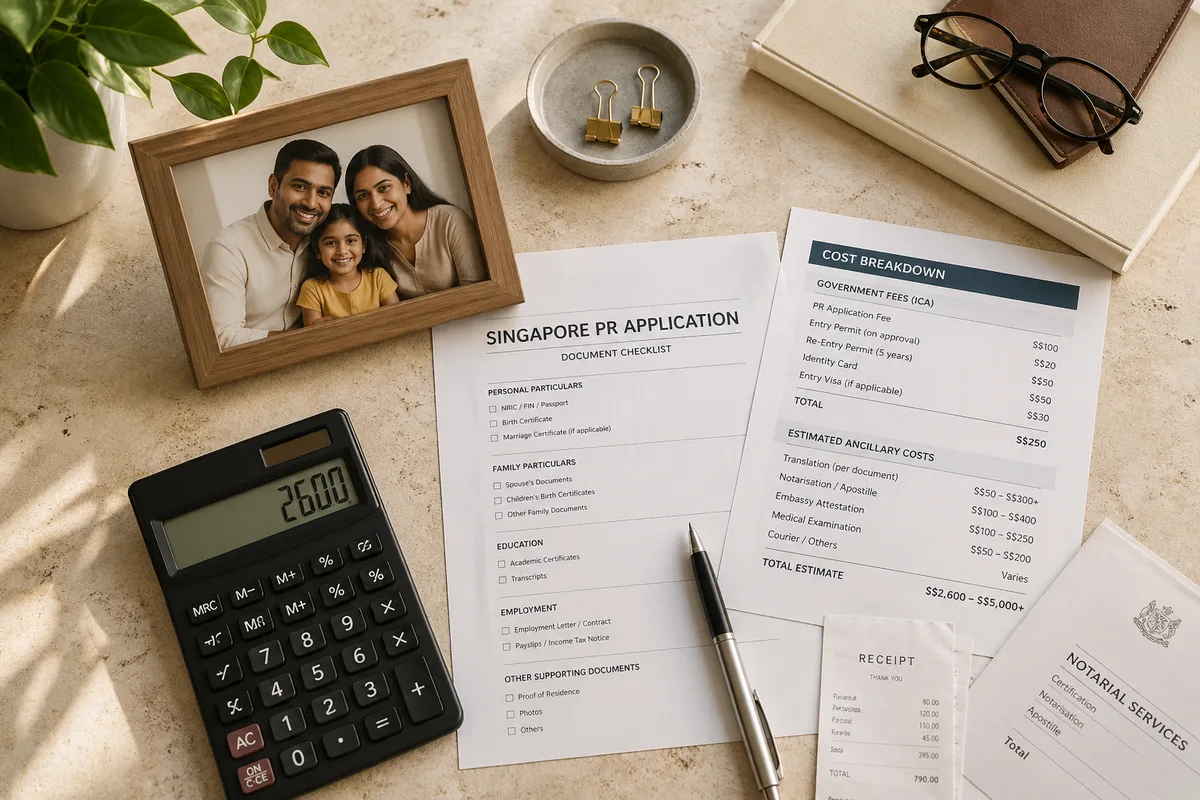
    Complete Cost Breakdown: All-In-One Table

    The table below consolidates every realistic cost line you should plan for, from the ICA fee through to ancillary expenses such as translations and embassy attestations.

    Cost TypeItemEstimated Cost (SGD)
    Government FeesPR Application Fee (ICA)S$100 per applicant (non-refundable)
    Government FeesEntry Permit (on approval)S$20
    Government FeesRe-Entry Permit (5 years)S$50 (S$10 per year of validity)
    Government FeesIdentity CardS$50
    Government FeesEntry Visa (if applicable)S$30
    E&H Professional FeesSingle Applicant (incl. ICA fees)From S$2,400
    E&H Professional FeesFamily Application (incl. ICA fees)From S$3,000 + S$600 per additional applicant
    Ancillary CostsDocument TranslationS$50–S$300+ per document
    Ancillary CostsNotarisation / Legalisation / ApostilleS$100–S$400 per document
    Ancillary CostsEmbassy Attestation (e.g. India MEA, China Consulate)S$100–S$250 per document + 2–4 weeks
    Ancillary CostsMedical Examination (post-approval)S$50–S$200
    Ancillary CostsDocument Retrieval (overseas records)Varies
    Ancillary CostsCourier / Embassy ProcessingVaries

    How Much Will Your PR Application Actually Cost? Two Worked Examples

    Total cost varies significantly with applicant count, document complexity, and country of origin. The scenarios below illustrate realistic end-to-end costs based on cases E&H regularly handles.

    ScenarioCost ComponentsEstimated Total
    Single EP holder, straightforward profileS$2,400 E&H fee (includes S$100 ICA fee) + ~S$200 medical & courier~S$2,600
    Family of 3, one spouse from China, child born overseasS$3,600 E&H fee (includes S$300 ICA fees) + ~S$600 translation/notarisation + ~S$300 medical~S$4,500

    These figures are indicative. Your actual cost depends on document availability, translation needs, and case complexity — all of which we assess upfront before quoting. More complex cases involving prior rejections, missing records, or multi-jurisdictional documentation can extend total costs to S$5,000 or beyond.

    Get a personalised quote in 24 hours

    Send us your profile summary and we will respond with a transparent fixed-fee quote — no obligation, no upselling. Visit eh-immigration.com or WhatsApp our team directly.

    Hidden Costs Most Applicants Overlook

    Government and consultant fees are easy to research. The expenses that catch applicants off guard are the ancillary ones — particularly for applicants with overseas documents or complex personal histories.

    Document translation

    All non-English documents must be translated by a recognised translator. Typical costs:

    • A 2-page Chinese marriage certificate translated and notarised in Singapore: S$80–S$150
    • Indian education and employment documents requiring translation plus apostille: S$400–S$800 for a full set
    • Vietnamese, Korean, or Japanese civil documents: S$60–S$200 per document

    Notarisation, legalisation, and embassy attestation

    Some countries require additional layers of authentication before documents are accepted by ICA:

    • MEA (India) attestation: approximately S$100–S$200 per document plus 2–4 weeks of waiting time
    • China Consulate legalisation: S$150–S$250 per document
    • Apostille (Hague Convention countries): S$100–S$300 per document

    Document retrieval and legal complications

    Missing or damaged records — particularly old education certificates, employment letters from defunct companies, or civil documents from rural jurisdictions — can require professional retrieval services. Divorce finalisation paperwork or replacement death certificates can add several hundred to several thousand dollars depending on jurisdiction.

    Medical examinations and courier fees

    Post-approval medical check-ups cost S$50–S$200 depending on the clinic. International courier fees for overseas documents typically run S$30–S$100 per shipment.

    Time-related costs

    A well-prepared application takes 2–4 months to compile before submission. ICA processing then takes 4–6 months. Factor in the opportunity cost of delays to career moves, relocations, or family reunification plans.

    Why Some PR Applications Cost More

    Not all applications carry the same workload. Costs scale upward — typically into the S$5,000+ range — when cases involve any of the following:

    • Previous PR rejection: requires forensic profile review, root-cause analysis, and strategic repositioning before resubmission.
    • Complex family structures: blended families, overseas children, or dependants requiring separate documentation tracks.
    • Overseas documentation: multiple jurisdictions, each with their own translation and attestation requirements.
    • Missing or inconsistent records: discrepancies in name spellings, dates, or employment history that must be reconciled with affidavits or supporting evidence.
    • Children approaching age thresholds: expedited timelines and tighter strategic windows.
    • Legal complications: ongoing divorce proceedings, custody matters, or unresolved civil status issues.

    E&H Professional Fees: Transparent PR Consultant Pricing

    E&H Immigration Consultancy brings 25 years of combined experience handling Singapore PR, citizenship, and complex immigration matters. Our fees reflect the actual work required for each case — there are no hidden charges or strategy upsells once we begin.

    Fee tiers

    • Single PR Applicant: From S$2,400 (includes S$100 ICA submission fee)
    • Family PR Application: From S$3,000 + S$600 per additional applicant (includes S$100 ICA submission fee per applicant)

    Our quoted fees include the S$100 ICA submission fee per applicant — there is no separate ICA fee to budget for at submission. Ancillary costs (translation, notarisation, medicals) are billed separately based on actual case requirements.

    What is included

    • Initial profile assessment and eligibility consultation
    • Full document checklist tailored to your case
    • Document review, organisation, and quality control
    • Drafting of the cover letter and supporting narrative
    • Submission via the ICA e-PR portal
    • ICA submission fee (S$100 per applicant) covered within our quoted price
    • Direct chat group messaging and phone support throughout your case
    • Response handling for any ICA queries during processing
    • Post-approval guidance on Entry Permit, REP, and IC issuance

    Hardship considerations

    We recognise that for some applicants, professional fees are a genuine barrier. E&H offers hardship considerations on a case-by-case basis — if cost is a concern, please raise it during your initial consultation. We would rather work with you on terms than see a strong applicant proceed without proper support.

    Speak to a Senior Consultant

    Our senior team has handled hundreds of Singapore PR cases across PTS, Family Ties, GIP, and complex reapplications. Book a free 15-minute consultation through eh-immigration.com.

    How a Singapore PR Consultant Reduces Your Total Cost

    A common assumption is that hiring a consultant adds cost. In practice, it usually reduces total spend by avoiding the most expensive mistakes: rejections, missing documents, and resubmissions.

    • Avoid the cost of rejection: the S$100 ICA fee is non-refundable. A rejection also weakens any future reapplication. Professional positioning materially reduces this risk.
    • Avoid translation and notarisation rework: minor formatting errors on translated documents trigger costly redo cycles. We catch these upfront.
    • Identify the right scheme: PTS, Family Ties, Student, and GIP each have different documentation and strategy requirements. Misclassifying your scheme is a common cause of delay.
    • Tailored strategy: we advise on the timing of submission, employment positioning, and supporting evidence based on the current ICA assessment climate.
    • Holistic immigration support: we handle related matters including Employment Pass renewals, Long-Term Visit Pass (LTVP) for family members, and downstream Citizenship applications.

    Common Pitfalls That Inflate Costs

    • Paying for unnecessary services: some agencies bundle “profile enhancement” packages that do not materially affect outcomes. Ask exactly what each line item achieves.
    • Ignoring document guidelines: ICA’s translation and certification rules are strict. Cutting corners forces resubmission.
    • Failing to update your profile: marriage, job changes, or new dependants must be reflected accurately. Outdated information is a fast track to rejection.
    • Choosing on price alone: the cheapest agency is rarely the cheapest outcome once rejection costs and resubmission timelines are factored in.

    Frequently Asked Questions: Singapore PR Application Cost

    How much does it cost to apply for Singapore PR in 2026?

    Total cost typically ranges from S$2,600 to S$5,000+, depending on family size and ancillary documentation needs. E&H professional fees start from S$2,400 for a single applicant (with the S$100 ICA submission fee included), plus separate ancillary costs for translation, notarisation, and post-approval medicals.

    Is the S$100 ICA application fee refundable if my application is rejected?

    No. The S$100 submission fee is non-refundable regardless of outcome. This is one of the strongest financial reasons to ensure your first application is properly prepared.

    How much does a family PR application cost compared to a single applicant?

    E&H family applications start from S$3,000 plus S$600 per additional applicant — and the S$100 ICA submission fee per applicant is already included in our quoted price. A family of three (two parents and one child) would therefore start at S$3,600 in professional fees, plus ancillary costs such as translation and medical examinations.

    Are PR consultancy fees tax-deductible in Singapore?

    Generally no — personal immigration fees are not tax-deductible for individuals. If your employer is sponsoring or reimbursing the fees as part of an employment package, treatment may differ. Speak to a tax professional for case-specific advice.

    What is the cost difference between PTS, Family Ties, and GIP applications?

    ICA fees are identical across schemes. Professional fees differ because the documentation and strategic work differ. PTS and Family Ties applications fall within our standard fee tiers. GIP applications, which involve significant investment thresholds, are quoted separately given the complexity.

    Is it worth hiring a Singapore PR consultant?

    If your case is straightforward and you have time to research ICA’s requirements thoroughly, you can apply independently. For applicants with overseas documents, prior rejections, complex family structures, or limited time, a consultant typically pays for itself by reducing rejection risk and avoiding rework.

    Are PR approval rates guaranteed?

    No. Approval is determined solely by ICA based on holistic assessment. No agency — including E&H — can guarantee approval. Any consultant claiming a guaranteed outcome should be treated with caution.

    Why do PR consultancy fees vary between agencies?

    Fees vary based on case complexity, applicant count, documentation issues, prior rejection history, and the depth of strategic work required. They also vary based on the experience of the consultant team — fees that look cheap upfront often correspond to lighter-touch service.

    What hidden costs should I budget for beyond government and consultant fees?

    The most common are document translation (S$50–S$300+ per document), notarisation and embassy attestation (S$100–S$400 per document), medical examinations (S$50–S$200), and courier fees for overseas documents. For applicants from India or China, embassy attestation alone can add several hundred dollars and weeks of waiting time.

    Ready to start your Singapore PR application?

    With 25 years of combined experience and transparent fixed-fee pricing, E&H Immigration Consultancy helps you get it right the first time. Visit eh-immigration.com or WhatsApp us to book a free initial consultation.